Review of RoboCop (1987) by Harry W — 07 Feb 2017
Considered one of the most iconic action films of the 1980's, RoboCop sounded like an exciting guilty pleasure.
RoboCop is a film I've seen several times in my life, but only upon a third viewing can I certify that RoboCop is one of the greatest films ever made. You can tell it's going to be strong from the beginning because the first thing the film certifies is its brilliant pacing. It opens by immediately contextualizing the current dystopian structure of its society and establishing commercial media dominance before touching upon the handling of contemporary crime. We see that the legal system is failing but gender is no longer an issue in the police force since the most powerful officer is the female Office Anne Lewis, a character bereft of any sexualization even though we do get some nudity from other characters along the way. After that we are greeted to a spectacle of mercilessly bloody violence at the hands of an animatronic robot just before a car chase kicks off. By that point the film has already delivered on its generic contract by 15 minutes in, and the titular RoboCop himself hasn't even made himself present yet. Once the construction of RoboCop is completed, we are given an appropriately sequential display of his capabilities. After seeing him exact immaculate accuracy in a shooting rage, we see him go out into the field. He shows his ability to deflect bullets with his armour, bend a gun with his own hand and knock a criminals across the store with the power of one arm. The film isn't even halfway done yet and already it has displayed absolute cinematic expertise on behalf of director Paul Verhoeven. RoboCop's plot is very simple and its strong political themes have yet to be expanded upon, but the sheer brilliance of its consistently fast paced spectacle ensures that it is not boring for a second. And after having this as its beginning, RoboCop eventually begins to appreciate the importance of characterization and gives a mind to its titular character. Yet even while it does this, it finds enough depth within the mind of protagonist Alex Murphy without having to slow down its pace.
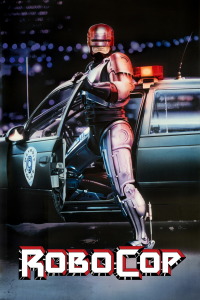
The film serves as a backstory to RoboCop and a clear display of his capabilities as well as struggles with his true identity, essentially structuring its narrative like a superhero film. The musical score evokes very much a superhero feeling which boosts the film up in its larger-scale ambitions, though it also works to carry the emotional heft of its more character-oriented scenes. The fact that the film is able to organically develop such a balance testifies to Paul Verhoeven as a filmmaker. The film is a cross between Dirty Harry (1971) and The Terminator (1984) yet has far more humanity to it than both combined, and its production values are top notch. Even though RoboCop has such a large-scale setting, plenty of political undertones and a display of technological expertise, it's remarkable to recognize that the budget for the film is only $13 million. This makes it one of the greatest examples of the director's artistic capabilities as the special effects and production design are both top notch. The iconic RoboCop costume is the most unforgettable image from the film, and his engagement with action scenes that are both bloody and explosive in the right parts proves immensely entertaining. The action in RoboCop provides a strong combination of practical stunts and visual effects, used for powerful dramatic effect and spread out properly through the narrative. These scenes are also shot with precision cinematography and strongly timed editing without the demand for any particularly artistic technique. The sound editing is also perfectly positioned, and this all comes into play perfectly during the action scenes where we see RoboCop kicking major ass with his technological upgrades and genuine brute strength. The action is shot and edited perfectly with a strong emphasis on showing off the capabilities of the titular character with a series of awesomely violent shootouts. The violence intentionally borders on excessive with a shameless glamourization of blood, but it still maintains that fun aspect without pushing into exploitation territory.
But as well as looking and sounding great, RoboCop mediates its stylistic brilliance at an appropriate balance with the emotional core of the film throughout its entire running time. RoboCop's story remains consistently focused on following the path of its protagonist, sporadically stepping aside to expand the scale of the story through brief segments of characters discussing the political climate as well as news reports. Between this and the brilliant action scenes are some powerful moments that capture the intense struggle of Alex Murphy having difficulties at maintaining his humanity, and this all plays into the story without it ever losing its consistent movement. There are even some hilarious one-liners spread out across the story to maintain the 80's feeling of the film without interfering with the serious nature of the story, creating a perfect tonal balance. So in essence, RoboCop is an exercise in brilliant writing and even greater style.
With all this to support the film, the cast of RoboCop have no option but to succeed.
Peter Weller makes a perfect casting decision. Though you could argue any man could take on the role of RoboCop due to the importance resting on the design of the costume, the element that Peter Weller brings to the role is predominantly the tone of his voice. The man gets flawless physicality in the part because he has the confident stature of a true action hero and the robotic limbs of a cyborg, but he dominates through the delivery of his words. With his deep tone of voice, Peter Weller commands the screen with a monotonous robotic echo that possesses a true sense of power. Alex Murphy is a complex character even though the film doesn't obsess on arbitrary elements of his characterization, and RoboCop is an easily marketable action hero with an unforgettable design. Peter Weller successfully captures both sides to the character by capturing the excitement and sympathies of viewers at every moment. The man kicks some major ass in the role while remaining restrained in his energy to capture the dehumanized aspects of the character, impeccably balancing everything out to create a sympathetic protagonist and one of the most iconic characters of the 1980's.
Nancy Allen is similarly great. Her character Anne Lewis is a powerful feminist figure without even trying; she is a fearlessly powerful member of the police force whom nobody questions for her gender whatsoever, and she is a really kickass action heroine as a result. Yet when it comes to the identity struggle faced by Alex Murphy, Nancy Allen also provides kind and reassuring support to him. This shows that the two of them make a pair of strong action heroes and genuine characters at the same time, leading the film as a strongly characterized duo. Anne Lewis is a simply-crafted yet great character whom Nancy Allen tackles with natural charismatic intensity.
Lastly, Kurtwood Smith delivers a memorable supporting effort. The actor has such a natural skill for playing antagonistic characters due to his ability to deliver such a sadistic tone of voice in his line delivery while maintaining a bleak facial expression. He is a shameless sociopath whose lack of emotion shows him taking pleasure in the violence he creates without creating being an over-the-top stereotype about it.
RoboCop is a perfectly paced science fiction film which balances its satirical social commentary and character development with a large barrage of brilliant action scenes and strong production values, standing as one of the greatest films ever made.
This review of RoboCop (1987) was written by Harry W on 07 Feb 2017.
RoboCop has generally received very positive reviews.
Was this review helpful?