Review of Road to Perdition (2002) by Moviemastereddy — 02 Apr 2016
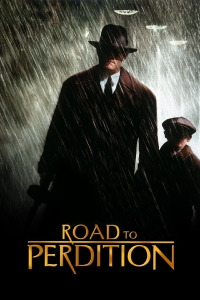
Early in "Road to Perdition," a period gangster film that achieves the grandeur of a classic Hollywood western, John Rooney (Paul Newman), the crusty old Irish mob boss in a town somewhere outside Chicago, growls a lament that echoes through the movie like a subterranean rumble: "Sons are put on the earth to trouble their fathers.".
Rooney is decrying the trigger-happy behavior of his corrupt, hot-headed son, Connor (Daniel Craig), who in a fit of paranoid rage impulsively murdered one of Rooney's loyal lieutenants. The ear into which Rooney pours his frustration belongs to Michael Sullivan (Tom Hanks), his personal hit man, who witnessed the killing. An orphan whom Rooney brought up as a surrogate son and who has married and fathered two boys, Sullivan is in some ways more beloved to Rooney than his own flesh and blood. He is certainly more trustworthy.
But as the film shows, Rooney's bitter observation about fathers and sons also works in reverse: fathers are eternal mysteries put on the earth to trouble their sons as well as teach them. The story is narrated by the older of Sullivan's two boys, 12-year-old Michael Jr. (Tyler Hoechlin), who in a prologue establishes the movie's tone and setting (most of the events take place over six weeks in the winter of 1931) and invites us to decide, once his tale has been told, whether his father was "a decent man" or "no good at all.".
"Road to Perdition," which opens today nationwide, is the second feature film directed by Sam Mendes, the British theatrical maestro who landed at the top of Hollywood's A-list with his cinematic debut, "American Beauty." The new movie re-teams him with Conrad L. Hall, the brilliant cinematographer responsible for that film's surreal classicist shimmer. With "Road to Perdition" they have created a truly majestic visual tone poem, one that is so much more stylized than its forerunner that it inspires a continuing and deeply satisfying awareness of the best movies as monumental "picture shows.".
Because Sullivan is played by Mr. Hanks, an actor who invariably exudes conscientiousness and decency, his son's question lends the fable a profound moral ambiguity. "Road to Perdition" ponders some of the same questions as "The Sopranos," a comparably great work of popular art, whose protagonist is also a gangster and a devoted family man. But far from a self-pitying boor lumbering around a suburban basement in his undershirt, Mr. Hanks's antihero is a stern, taciturn killer who projects a tortured nobility.
In surveying the world through Michael Jr.'s eyes, the movie captures, like no film I've seen, the fear-tinged awe with which young boys regard their fathers and the degree to which that awe continues to reverberate into adult life. Viewed through his son's eyes, Sullivan, whose face is half-shadowed much of the time by the brim of his fedora, is a largely silent deity, the benign but fearsome source of all knowledge and wisdom. An unsmiling Mr. Hanks does a powerful job of conveying the conflicting emotions roiling beneath Sullivan's grimly purposeful exterior as he tries to save his son and himself from mob execution. It's all done with facial muscles.
Yet Sullivan is also beholden to his own surrogate father, who has nurtured and protected him since childhood. Mr. Newman's Rooney, with his ferocious hawklike glare, sepulchral rasp and thunderous temper, has the ultimate power to bestow praise and shame, to bless and to curse. The role, for which the 77-year-old actor adopts a softened Irish brogue, is one of Mr. Newman's most farsighted, anguished performances.
Those shades are matched by Thomas Newman's symphonic score, which infuses a sweeping Coplandesque evocation of the American flatlands with Irish folk motifs.
In the flashiest of many visually indelible moments, a cluster of gangsters silhouetted in a heavy rain are systemically mowed down on a Chicago street in a volley of machine-gun flashes that seem to erupt out of nowhere from an unseen assassin. But no shots or voices are heard. The eerie silence is filled by the solemn swell of Mr. Newman's score. It is one of many scenes of violence in which the camera maintains a discreet aesthetic distance from the carnage.
Although "Road to Perdition" is not without gore, it chooses its bloodier moments with exquisite care. The aftermath of another cold-blooded murder is seen only for an instant in the swing of a mirrored bathroom door. Another is shown as a reflection on a window overlooking an idyllic beach on which a boy frisks with a dog. Here the overlapping images evoke more than any words the characters' tragic apprehension of having to choose between two simultaneous, colliding worlds. One is a heaven on earth, the other hell.
This review of Road to Perdition (2002) was written by Moviemastereddy on 02 Apr 2016.
Road to Perdition has generally received very positive reviews.
Was this review helpful?