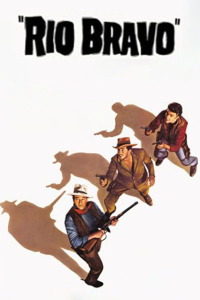
Review of Rio Bravo (1959) by Paul Z — 18 Mar 2009
This highly lauded 1959 western contains an intimate clique of haywire individuals who secure their reparation through group effort and brushing off exclusive self-sufficiency. The nixing of real names and the clannish custom of nicknames like Chance, Dude, Colorado and Stumpy by this humble troupe of losers and odd men out epitomizes a formation of cumulative self-coinage, which is imperative for them, into an able and firmly self-reliant regiment of heroism, a demonstration of the men's longing to embody gingerly makeshift mock-mythic whimsical story lines for their lives.
Supposedly, this gunslinger ballad was made as a comeback against High Noon, which is often seen to be an parable aimed at the Hollywood blacklist, a criticism of McCarthyism. Wayne approached director Howard Hawks to tell the story his way. Wayne was a conservative and an unyielding partisan of blacklisting. He felt insulted by Fred Zinnemann's classic western. So in Rio Bravo, his character is encircled by allies such as deputy Dean Martin recovering from alcoholism, young gunfighter Ricky Nelson, ranting and raving old man Walter Brennan, Mexican innkeeper Pedro Gonzalez Gonzalez, and Angie Dickinson, and again and again rejects help from anyone he doesn't think is fit to help him, yet in the climactic showdown they come to help him anyhow. All this supposed subtext I find extremely annoying, but all the same, I feel comfortable enough watching a John Wayne film like Rio Bravo, because unlike John Ford, who was so vain he might've taken his own hand in marriage, notoriously clever Howard Hawks avoids the era's often extreme religious ardor, schmaltz, flag-waving populism and maudlin mushiness. Fortunately, I don't feel that Wayne's intentions resonate.
The opening scene, with positively no dialogue, is a testament to flexibility of the prolific director, famous for his gabby, street-survivalist classics like His Girl Friday, To Have and Have Not and The Big Sleep for instance. Rio Bravo is nevertheless more talk than action, which is part of its charm, but Hawks fashions a cliquish succession of compositions and dismisses all but two close-ups. In the opening, Dino's town drunk, enters a saloon wanting a drink. Joe Burdette, seeing Dude eying his glass, throws a silver dollar into a spittoon to mock him. Just as Dude goes for the spittoon, John Wayne's Tough Interceder protagonist Sheriff John T. Chance kicks the spittoon away, judgmentally looking at Dude with dejection and repugnance. As Chance turns to face Joe Burdette, Dude snatches up a piece of wood and clubs Chance on the head, knocking him out. Dude then starts toward Burdette, but two of his hired cowboys seize Dude and Burdette starts to beat him up. An onlooker grasps Burdette's arm so he can't swing on Dude again. Burdette draws his gun and shoots the bystander. The close-up of Joe's revolver firing is the first of the two close-ups. Burdette then leaves the saloon and sets out for another one seeming to have already forgotten about the ugly scenario.
Rio Bravo is the kind of film that wants the audience to relax for its pleasantries. It's a male bonding picture with comic reliefs, heartthrobs, tough guys and even cool cats. It's about the things that we don't normally see in westerns, which are usually bone-dry parables, for better or worse, with a very impersonal edge. The music here is a big part of the film's lounging effect. Because it starred a crooner, Martin, and a teen idol, Nelson, Hawks includes three performances by them. Martin sings My Rifle, My Pony, and Me accompanied by Nelson, after which Nelson sings a brief version of Get Along Home, Cindy, accompanied by Martin and Brennan. God forbid Wayne sing, what with his masculinity complex and all. As a foil to these quasi musical numbers, the musical score itself by Dimitri Tiomkin includes El Degüello, a nostalgic air which is played several times to layer suspense. Nelson recognizes the melody and tells the song's history.
The Texas town in which the film is set is hardly anything but a soundstage as our band of brothers fortifies themselves. It is in the jailhouse and the Mexican-run inn that the movie plunges, where Sheriff Chance determines that he nurture a family of friends, a small network on whom he can rely for both affection (exclusively Dickinson) and support (everybody else except Dickinson). We begin to enjoy seeing such moments as when Dino and Brennan share a laugh that when they encounter Joe Burdette and his minions again, the tension is already perceived by us, the audience, because the camaraderie of the good guys makes us abhor the idea of any of them getting shot. There are long intervals, but nonetheless Hawks manifests his urge for consistent inspiration at the hub of excitement, whether it be fighting, shooting, singing, talking or sitting.
This review of Rio Bravo (1959) was written by Paul Z on 18 Mar 2009.
Rio Bravo has generally received very positive reviews.
Was this review helpful?