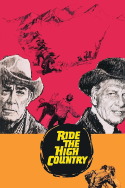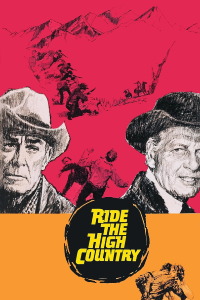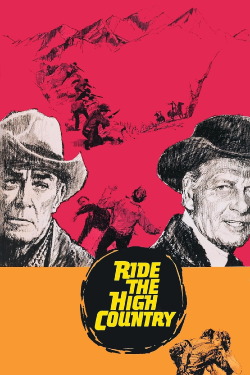
Review of Ride the High Country (1962) by Noel B — 05 Jan 2008
Sam Peckinpahâ??s second film (his first-The Deadly Companions) is a sublimely lyrical valedictory hymn to the passing of the West and the aging of two of its greatest and most representative stars. I had loved them both as far back as my earliest, most formative film experiences but here at last, in the autumn of their film lives they had found the final showdown for which they had been rehearsing all their lives. With biblical grandeur, they play, or more to the point are Gil Westrum and Steve Judd-two ageing gunfighters who have fallen on hard times (and into a new era which neither recognizes nor has a place for their like).
In accepting a menial job transporting gold from a mining camp (Coarse Gold) high in the Sierras back into the nearest township, these two old friends and comrades with a lifetime of shared histories undergo an ordeal of shifting moral allegiances which temporarily turns them into enemies before they finally join forces for one last blazing shootout (the â??guns in the afternoonâ??of the Australian title). In the process they re-attain grace, dignity and self-respect.
Joel McCreaâ??s interview with Patrick McGilligan (Films in Focus) sheds fascinating light on how the roles of Steven Judd and Gil Westrum germinated. Apparently Burt Kennedy had given Scott, then 62, N B Stone Jrâ??s script to read. An impressed Scott originally envisaged himself as Judd but was only prepared to share star billing with Joel McCrea whom he tried to persuade over lunch to play Westrum arguing that the role was more subtly shaded than the Judd character. McCrea, then 57 and officially retired, baulked at the idea of playing a role that overturned his screen image of honesty and integrity. A deal was finally struck in which McCrea played Judd and Scott Westrum.
I believe McCreaâ??s instincts were absolutely correct; the identification of a star with specific realms and genres is an important one in compounding and enriching each succeeding performance by that star. Superficially, McCrea and Scott may be interchangeable icons of the terrain of late 40s and 50s western landscapes. They certainly shared similar backgrounds in their lengthy film apprenticeships, both beginning as extras around 1929. Scottâ??s involvement with the western began with a series of Paramount Bs in the early 30s based on Zane Grey stories and directed by a young Henry Hathaway. He then drifted into roles in other genres including some Astaire/Rogers musicals and even one notable foray into screwball comedy with his good friend Cary Grant (My Favourite Wife); but although he also played Wyatt Earp (Frontier Marshal, Allan Dwan ) in 1940 as did McCrea (Wichita, Jacques Tourneur, 1955 ) he never quite rose to the achievements of the latter in this period of his career. McCrea as a young man appeared in one of Hitchcockâ??s greatest 40s films (Foreign Correspondent ), an excellent La Cava comedy/drama (Primrose Path ), Wylerâ??s These Three, King Vidorâ??s Bird of Paradise, George Stevensâ??s The More the Merrier and a string of unsurpassed romantic/satirical comedies for Preston Sturges . By 1946, McCrea had a most impressive CV and there was more to come in the late 40s (Ramrod, Colorado Territory, Four Faces West) as he, like Scott, began to focus exclusively on westerns.
Scott, meanwhile, came into his own in this genre, beginning with his association with producer Harry Joe Brown (Coroner Creek, 1948); and continuing into interesting cycles of westerns at Columbia, Fox and Warners that began with an Edwin L Marin directed group, progressed to the Andre De Toths and culminated in the seven films mostly written by Burt Kennedy and directed by Budd Boetticher. These films are now held up as paradigms of B-film making in the genre and deservedly so. They also greatly extended and made more complex the image of Scott himself. His laconic, stoical loners now often internalized darker secrets that could only be exorcized by showdowns of considerable violence. Increasingly with age, Scott took on a moral ambiguity that was only occasionally hinted at in previous incarnations (under Lang, for example, in Western Union or as the avenging angel figure in Coroner Creek).
McCrea on the other hand made a lot of western programmers throughout the 50s but there were three films in this period that set in concrete his abiding screen image of moral rectitude and resolve (Stars in my Crown , Wichita and Stranger on Horseback ). All were directed by the elegant, low-key director of minor genre masterpieces Jacques Tourneur; the first of them, where he plays a frontier parson with a gun, is his personal favourite of all of his films. This probably provides an interesting clue as to why he insisted on to playing Steve Judd rather than Gil Westrum. Ride the High Country has one of the densest and most carefully wrought scripts in the genreâ??s screen history and one where every gesture, every line and every action is pregnant with thematic relevance. On one level, it is a profoundly metaphysical parable about living by moral codes, as Judd attempts, and the consequences of â??forgetting (them) for a whileâ?? as Westrum discovers to his literal physical discomfort before he returns to the fold in the filmâ??s magnificent coda. I love the Jacobean biblical flavour of Stoneâ??s entire screenplay but its moral righteousness is beautifully tempered by a shrewd humanity and some caustic wit. Randolph Scott in the Boettichers was laconic to the point of long stretches of silence; here he gets many of the best lines and is very funny in a barbed and ironic sense which serves as a brilliant foil to McCreaâ??s near-loquacious philosophising.
In their parallel careers, Scott and McCrea cleaned up half the frontier: Albuquerque, Carson City, Abilene, Dodge City, Tombstone, Wichita, Fort Worth, Santa Fe, Kansas City and other legendary locations. Scott oversaw the development of Western Union; McCrea was Buffalo Bill. In an interesting switch, Scottâ??s Westrum is dressed up as a Buffalo Bill lookalike in a sideshow when McCrea spots him in the filmâ??s opening sequence and chastises him for his bogus stories about cleaning up some of the westâ??s most notorious outlaws.
Juddâ??s adherence to his moral code is inflexible and unswerving and ultimately costs him his life; but in the process he not only â??enters his house justifiedâ?? but also ensures that Westrum and the wild young man (Heck Longtree, played by Ron Starr), who follows Westrum are redeemed as well. It is especially important that Westrum be redeemed because he has once lived by the same code as Judd and fought by his side as his friend against the common enemy â??in the old daysâ??. Now, like his friend Judd, he has outlived his era, is old and tired (he emphasises his aching bones and asks McCrea to untie his wrists because he doesnâ??t â??sleep so good anymoreâ??). Like Buffalo Bill before him, he is at the beginning of the film involved in questionable showmanship which exaggerates his past glories so that he can capitalize on them to a gullible public. He is setting up easy targets like any seedy carnival barker (â??Shooting against you, mister, is like taking candy from a babyâ??). He has fallen from grace, no longer believes in the values both he and Judd once stood for. His aside to Heck Longtree that â??the Lordâ??s bounty may not be for sale but the Devilâ??s is!â?? indicates just how far he has fallen. Scott is perfectly cast as Westrum. The steel in his soul can just as easily be put to darker purposes as to morally righteous ones-we had already had a glimpse of it in some of the hell-bent revenge figures he played for Boetticher and other directors. He may have just as readily played Judd, but then McCrea could not have convincingly played Westrum because, for all his underratedness as a performer, he never had that darker edge. Scottâ??s lethal cynicism rings very true here.
The film concerns itself at all levels with the codes people live and die by and for. Mariette Hartley, the heroine in distress whose youthful bloom Peckinpahâ??s film so wondrously captures, provides Judd with the greatest challenge to his view of how the world ought to operate when she says: â??My father says thereâ??s only right and wrong, good and evil, nothing in between. It isnâ??t that simple, is it?â?? Juddâ??s reflection is revealing: â??No, it isnâ??t. It should be but it isnâ??t.â?? Westrum has learned to live with those contradictions, but Judd the idealist cannot accept them comfortably.
Juddâ??s code is found to be ineffectual in a number of worldly circumstances: a good example occurs when Judd is pitted against the minerâ??s court in Coarse Gold with the Court ruling in favour of Billy Hammond against Elsa after their marriage and its terrifying aftermath. It is Westrum not Judd who saves the day by force and chicanery when he steals the Judgeâ??s licence and has him lie to the Court. Judd is very uncomfortable in dealing with the moral complexities surrounding Elsa throughout the film and initially wants to leave her to the mercy of the Hammonds as he had wanted to send her back to her father when she first ran away. Ironically, it is Heck Longtreeâ??s intervention in both cases that ensures the commitment of Judd and Westrum to her safety.
But the codes of the world are seen to be no more effectual in defining a satisfactory value system for people to live by. Judd scrupulously signs and attempts to fulfil the letter of his contract with the bank to transport their gold (â??the only gratitude I expect is my paycheck-$20 worthâ??). Living by the letter of the law has, however, cost him dearly in the worldâ??s terms; Judd and Westrum joke uneasily about how rich they would be if they were paid adequately, that is, $1000 for every bullet hole they received in the line of duty. Poignantly and with deep irony, Judd indeed dies a very rich man (â??they put them all in one placeâ??).
The Hammond brothersâ?? code of â??family honourâ?? doesnâ??t bring them any joy at the end of the day, either. Sylvus (L Q Jones) dies an ignominious death in a rocky, barren outcrop; later even his gun and gunbelt are stripped from him by a desperate Westrum and his carcass is left to rot in the windswept elements. The three remaining brothers bite the dust being goaded into defending their â??family honourâ??.
Joshua Knudsenâ??s fundamentalist code is the most contradictory and hypocritical of all of the moral codes put to the test in this film: it has him interpreting biblical passages literally in order to control his daughter Elsa: in warning her off all men as indecent and depraved and only after one thing, he tries to conceal his own incestuous desires. The authority of the â??good bookâ?? is Knudsenâ??s sole reference point in dealing with questions of moral complexity and it has not equipped him to deal with his own desires and contradictions, let alone those of an adolescent daughter trying to deal with sexual yearnings.
Ride the High Countryâ??s mise-en-scene fully complements the eloquence of the screenplay. Sam Peckinpah was fortunate in having Lucien Ballard capture the autumnal hues of the breathtakingly beautiful Inyo National Forest. The journey in and out of Coarse Gold by the ageing protagonists and their fellow travellers contains a visual symmetry perfectly in keeping with the classical (spiritual) quest structure underpinning the film. It is a journey into and out of the dark night of the soul for its participants. Its clear-cut imagery and narrative simplicity allow Peckinpah to develop his moral parable with great directness and a kind of austere purity. In some ways it resembles a medieval morality tale like Chaucerâ??s Pardonerâ??s Tale which also deals with the consequences of greed and straying from the true path. It is also a distant relative of John Hustonâ??s The Treasure of Sierra Madre although Hustonâ??s concerns were humanist (not at all concerned with redemption) and his view of the human condition fairly cynical.
The filmâ??s deceptively loose structure allows Peckinpah to develop a strong sense of camaraderie on the trail where the moral dilemmas are thrashed out in great detail. It also provides the two old men ample opportunity for grandstanding which they each take up with relish. Punctuating the filmâ??s deceptively relaxed pace and tone are a wonderful string of taut set-pieces that occur at the Knudsen farm initially, in Coarse Gold itself and later back at the farm (the final gunfight). Here the complex moral issues boil up, reach a deadlock and are finally (nobly, but for Judd tragically) resolved .
Besides the central performances, the film is enriched by the two younger leads and a whole clutch of memorable character vignettes. Ron Starr is reasonably effective as Heck, who switches mentors and moral positions from Westrum to Judd after the enthralling showdown between them. Peckinpah draws some discomforting parallels between Heck and Billy Hammond-both are greedy and exhibit depraved behaviour; both grope and claw at â??looseâ?? women; both come on too strongly to Elsa whose repressive background has made her very vulnerable and in need of a â??gentle manâ??. Mariette Hartley is particularly appealing, playing with an appropriate lack of guile and affectation. The victim of her vicious fundamentalist zealot father, she escapes into the arms of an even nastier fate at the hands of Billy Hammond and his family of memorable lowlifes before she regains her perspective- and a possible future with Ron Starr-at the end of the film. R G Armstrong brings her father fiercely and frighteningly to life-the scene where he physically abuses her is extraordinary in its warped, incestuous intensity. He is equally effective in the tense dinner table scene where he and Judd play a game of one-upmanship by countering one biblical quotation against another with Westrum chiming in with the amusing punch line about Appetite, Chapter One as a response to Elsaâ??s home cooking.
Some of Ride the High Countryâ??s considerable pleasures revolve around the appearances of familiar faces like those of Percy Helton (he of the staccato squeak and beached fish face) and the ubiquitous Byron Foulger who appear and disappear quite early in the film as the bankers who hire Judd, â??expecting a younger manâ??. Juddâ??s reply: â??Well I used to be. We all used to beâ?? is typical of the scriptâ??s trenchant economy in delineating the filmâ??s relentless thematic concerns and mood.
When the film moves into Coarse Gold, described by Joshua Knudsen (accurately as it turns out) as â??a sinkhole of depravity , a place of shame and sinâ??, Peckinpahâ??s mise-en-scene really comes into its own. The Hammond brothers are played by several of the members of what was to become a kind of Peckinpah stock company-L Q Jones, Warren Oates, John Davis Chandler. The clan with its parody of family honour evokes other depraved families like the Clantons or the Cleggs in John Fordâ??s Wagonmaster. They paw at the â??saloon girlsâ??in Kateâ??s hotel/brothel like wild animals and their expectation after the wedding between Billy and Elsa is that they will all share the bride in a nightmarish drunken orgy. The wedding itself is treated with a baroque garishness (at odds with the spareness and classical austerity of the rest of the film) that evokes Fellini of all people: the grotesquely proportioned and dressed Jenie Jackson as Kate reinforces these echoes as events heat up and it really does become the wedding from hell. Edgar Buchanan gives the sleaziest performance of his career as the fat soak of a judge.
McCrea and Scott are magnificent throughout the film-the following are typical of the behavioural vignettes that ensure the audience never take their eyes off these old troupers: Scott constantly fumbling and doing moral back flips; both of them standing stiffly in their long johns reminiscing about battles long gone and McCreaâ??s long-lost love Sarah Truesdale; the footsteps in the camp followed by the reveal on McCreaâ??s grimly determined face as he provokes Scott to â??Draw, you damned tinhorn! You always figure.
This review of Ride the High Country (1962) was written by Noel B on 05 Jan 2008.
Ride the High Country has generally received very positive reviews.
Was this review helpful?