Review of Revolutionary Road (2008) by Brett C — 05 Feb 2014
Revolutionary Road, when looking at the way it was being promoted, could have been seen as a melodramatic romance film. Sam Mendes was too good for that, instead he gives us a film that speaks about a certain culture in society through the experience of the relationship/journey of a couple.
The film was written by Justin Haythe who has not written a lot screenplays during his career, as of 2014. The screenplay was also based on a novel by Richard Yates. Haythe has written something that truly stands out from many of the romance films, during the time of it's release. Revolutionary Road seems to show more than just the rocky road of a couple's marriage. It also displays the pressures and trappings of the middle class. Unlike American Beauty, that tackles the same concept, it doesn't show it as a definite fate for everyone who is living within it, as we see others in this world that seems to be happy and safe living with this lifestyle. True, it can be seen as a form of denial, but the film never truly confirms this or gives off a hint of such that they are projecting a shade of happiness in order to get through it. The couple that we are following are examples of people who are placed in a society that they presume would be right for them. It establishes the couple's sadness and emptiness that they have during the start, by spending almost half an hour exploring their life, while also having the film move forward during the process. At the start of the film, we see how they met and how happy they were when they were just living in the moment. This few minutes of introduction to their relationship is the reason why I am convinced of the love they had for each other, and also the reason why I never felt irritated or questioned the logic of April's decision to not have divorce as an option. The film doesn't really have a clear hook, instead the film moves through like a story during a period of their life. The film's dialogue was great to listen to, and this is an important aspect of the film as the entire film is mostly driven by it. Haythe used dialogue as a way to shape his characters, instead of relying on a narration to explain it to us. When I finished watching the film, I was trying to really think about what I had just watched because I was trying to look for areas that I thought needed an improvement, especially in it's story, but no, there was nothing I could think of.
Revolutionary Road is Sam Mendes' 4th film. I have seen all of Mendes' films, except for Jarhead. Mendes has created a film that is much more smaller and more personal than his previous films, he would go even further with his next film, Away We Go. This intimacy is the reason why I was attached to both leads. Mendes has shown in his previous films that he is an actor's director. Revolutionary Road is the most prime example of that. He loves to have the characters of the film to be a priority, making sure to get the actor's full potential and also filling each of the characters with layers that keeps the actors and the audience invested. Mendes also makes sure that his film is able to share it's message, ensuring that the audience will get the point of seeing this couple's journey in Revolutionary Road. Revolutionary Road does touch on similar themes as American Beauty but he avoids completely repeating himself by having the film be set on a different place in time and a different approach in telling the story. Mendes has been known to make films with a bit of ambition in them and it does make the film seem more importnat, but I felt that this film worked with it's simple and personal appraoch. It didn't need to be more than what it is because it would have us feel more distant with it's characters, and if this film wasn't able to impact us through it's characters, then it would have failed miserably in investing it's audience. To truly appreciate this film, one must have patience as it takes it's time moving the film along. Mendes wanted the film to feel as natural as possible when it takes place in the main house, as he wanted the relationship and the dynamics of it feel grounded. Though the film is set during the 1950's, Mendes avoids this film from becoming a period piece, by placing it's focus sorely on the lives of two people.
The film's photography was handled by Roger Deakins. Deakins, after Conrad L. Hall's passing, seems to have taken over as Mendes' number 1 choice for his film's cinematography. Deakins and Hall, both have different visions of how a films would look. Deakins, seems to lean towards the cleaner look, and definitely more noticeable on his post-2000 films. While Hall was more in favor to the old style of cinematography, and allowing the image to look and feel more natural. Since I haven't seen Jarhead, I cannot compare his work from that to this, but what he has done for Revolutionary Road is outstanding. Deakins clealry understood Mendes' intentions and has applied it in the way he shoots it. The film's photography never tries to create this sense of period of time like we are looking at an old document, instead he makes it more contemporary. It makes us feel like we are there standing next to them, which is important because demands us to be in close touch with these characters, having us feel and understand what they're feeling. When Mendes envision his films, he always seems to see it in a cinematic point of view, which is why for the significant part of his films, including this one, are composed of tracking shots instead of applying the quick hand held approach. At times, the camera seems to be placed on the right spot and the right angle. It allows for his characters to be in focus, and not have us be too distracted.
The film's score was compsed by Thomas Newman, who also is a common collaborator with Mendes. What Newman has created for this film, is at times tender and sweet. It also fluctuates, in accordance to what is being shown on screen. Newman is very aware, on how dark the film can get during certain moments of the film, and he makes sure the mood is amplified through his music. Newman uses the paino to create this feeling of sadness, as moments of the film would have you feeling hurt. Newman's score may come off as sentimental to some people but it seems to work here, much better than it did on Road to Perdition. The score somewhat predicts the fate of the couple, but it is done in a way that in our first viewing, it doesn't feel too obvious. It is during my subsequent viewings where I started to appreciate his score, and this was also the same way I felt for all of the films he has collaborated with Mendes.
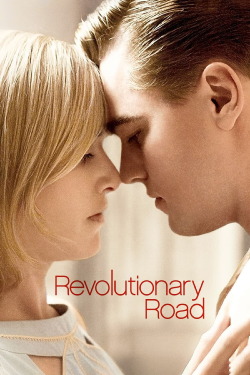
Revolutionary Road puts most of it's focus on the couple which stars Kate Winslet and Leonardo DiCaprio Winslet was definitely excellent here, as she was able to play this woman who was tortured by the hollowness of her environment. Throughout the film, we see that inside she wants to escape from the shell that she has created for herself. DiCaprio was also fascinating to watch. His character isn't all too different from Winslet's, as he also wants to escape from his current lifestyle. We can see from him that he is trapped and is somewhat depressed with what he has made for himself. The chemistry between the two leads have already been established in Titanic, but their characters in that film were young and naive. Their roles in Revolutionary Road is much more mature in it's romance and it's relationship. The moments where both of the leads get into an argument or when they are being intimate, it truly felt real like as if we were just watching something that can be found in a regular home. Michael Shannon was great as John Givings. He represents the man who sees the truth of the situation and sees no reason to be in denial. As this makes the person stand out from the crowd, it makes the audience open their eyes and really take notice of Michael Shannon's performance.
Revolutionary Road is just simply a very well-made film. This proves that Mendes is able to tackle relationship-driven, romantic, intimate films like these. Mendes is slowly building himself to be one of the greatest filmmakers of this generation.
This review of Revolutionary Road (2008) was written by Brett C on 05 Feb 2014.
Revolutionary Road has generally received positive reviews.
Was this review helpful?