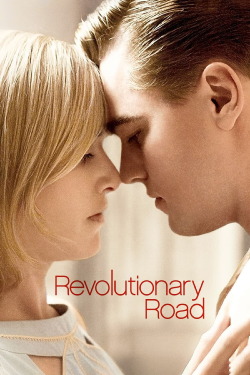
Review of Revolutionary Road (2008) by Cameron J — 03 Apr 2013
"And the only sound that's left after the ambulances go is Cinderella sweeping up on Revolutionary Road!" Yeah, yeah, I know the song is about a row, not a road, but it's not like I was going to reference Lyndsay Buckingham's "Holiday Road", like my father does every single blasted time he hears this film's title, seeing as how the cheeriness of this film leans more toward something about desolation than an '80s pop song, and plus, I'm pretty sure that the, like, 34th verse of "Desolation Row" references the Titanic. Well, I reckon this is what would have become of Jack and Rose if their relationship made it well past the Titanic's demise, so I guess you could say that if the boat sinking wasn't going to get them, then the trainwreck marriage would have. Shoot, now I've got another reason to cry like a little baby whenever I watch "Titanic", and it's not necessarily the fact that this other DiCaprio-Winslet tragic romance kind of shakes my faith a bit in the relationship of the leads of "Titanic", but rather it's the fact that just thinking about this film makes me a bit choked up. I must say that I can't think of too many people better to portray the struggles of the middle-class, whole American family unit than some English son of an author and university professor who split up the family unit into incompletion when their kid was a kid, and if you think I'm being sarcastic, well, yeah, I kind of am, but Sam Mendes would at least know a thing or two about adultery, seeing as how, in this film, he has to tell his wife how kiss and simulate passionate love-making with other, more handsome men. Oh, Sam, you are a trooper, but it's not like all of this awkward work hasn't paid off, because even though the marriage somewhat ironically fell apart about two years later (Hey, he's got Rebecca Hall now, so I reckon he's digging on the cute younger girls with weird mouths), hey, we got an awesome movie out of it. Still, as surprisingly excellent as this film is, like the marriage around which it is centered, it's not without its issues.
We're dealing with a minimalist and steady, maybe even, if you will, meditative character drama, so it's not like the film was ever to be a riot, and not just because its crushingly realistic, something that isn't too much more lighthearted than pessimistic, but definately could have been more limp than it ends up being, which isn't to say that the final product is thoroughly juicy in atmosphere, having more kick than I feared, and enough of it to engage consistently, but not enough to fully battle back bland spells. The film's slow spots never get too terribly bland, and they certainly never get close to dull, but the fact of the matter is that atmosphere will limp out here and there, and moments such as those retard momentum, but ever so slightly, at least when compared to conventionalism. Sure, even then, conventionalism is hardly all that considerable of an issue, partially because very little can be done to pump up a story this traditional with uniqueness, a little bit of which can be found in the final product nonetheless, but not so much so that predictability is kept as far at bay as it probably should be. The film may take a few routes that surprise, at least a little bit, but on the whole, it's not too difficult to figure out this story's destination, and yet, with that said, every beat toward the final product's final notes is rich with engagement value that is intense enough to also thin out slow spells, thus reducing the consequential shortcomings behind this film to not much more than light, and I reckon you can guess what that means. Yes, people, as powerful as this film is, it is held back quite a bit from greatness, all but entirely because of natural shortcomings found within this story concept, which is meaty enough to be fleshed out as excellent in the long run, but still just too minimalist for its own good, so it's not like you should go in expecting the substance of "Titanic", but rather a plot that was always doomed to be thin in a few too many places. The film is almost aimless in its minimalism, going with a flow that has meat, but only so much of it on paper, and it's impossible to deny that fact, because when it's all said and done, the film is only as good as it can be. Of course, make no bones about it, that's still mighty darn good, and enough so for the final product to deliver as a powerfully excellent effort that sells you on its depth, as well as even its era, and attractively so.
Primarily set in 1950s suburbia, this period piece isn't exactly drifting into settings that are radically different from the ones that people of today occupy, but it still needs to put some effort into convincing viewers of the settings, especially when you consider how ultimately key this story's setting is, and sure enough, this film delivers as an attractive and convincing period piece that doesn't bear down, but pronounces its era distinctly, with costume designer Albert Wolsky capturing the flavor in fashion that defined the time, and sometimes even its wearers, while production designer Krisi Zea and set decorator Debra Schutt put together convincing environments, from the intricate hustle and bustle of the city that stands beyond suburbia, to the old-fashioned beauty of an American dream home that you can see being not as comfortable as they say after a while. This film certain captures the good looks of the times, while the lively, if a little underexplored soundtrack takes you back to the good tunes of the time and breathes a bit of life into things, though decidedly not as much as Thomas Newman's score, which isn't all that juicy or dynamic, but reasonably comfortable in its minimalism, when not graced with a distinguished spirit that fits this tale memorably. Soulful artistic touches like the ones provided by Newman are reasonably worthwhile in the long run, yet they're maybe a bit too light to make all that big of an impact on the final product, as opposed to the cinematography by the great Roger Deakins, which cannot be ignored as an eye-catcher that delivers on neatly tight framing, as well as richly crisp lighting that pronounces color ever so lushly, and sometimes even plays with the environment in a fashion that uniquely compliments atmosphere considerably. When brilliant light works its way into the picture, you feel glimmers of hope, and when a shadow falls, choking most color out of a shot, you feel the claustrophobia that bears down on our leads, thus making Deakins' efforts worthy as compliments to the depth of substance that holds plenty of potential for depth. Sure, the substance behind this minimalist drama isn't so rich that the final product ever stood a chance of being all-out great, but make no mistake, Richard Yate's classic story is still a powerful realist piece that is unafraid to deconstruct what were supposed to be the golden years of families seeking the American dream as just as harsh as any period. The story concept stands to have more bite, but it is still promising as dramatic effort that deserves to be fleshed out about as much as it can be, and is, thanks to the efforts of screenwriter Justin Haythe, whose dialogue is cleverly lively during the lighter spots of the story, and chillingly realist when things get heavy, whether when it's building brutally accurate argument sequences, or defining the layered humanity within the characters of this very dialogue-driven human drama. I didn't find the film to be quite as emotionally challenging as many say, but it is an ambitious effort that could hit hard if executed by a competent dramatic director, something that this film definately has.
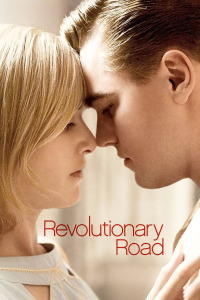
When Kate Winslet submitted this film's script to producer Scott Rudin, he came back and said that her husband at the time, of all people, was perfect to direct this film, and sure enough, Mendes didn't just earn this job because he was married to the star, for he has indeed proven himself capable of handling material of this type, and especially proves his dramatic storytelling competence with this, his best film, which he drives with a layered and intimately human atmosphere that fights back aimlessness by bonding you with the progressive unraveling of our characters' relationships and personal humanity tightly enough to sustain emotional investment, which does very much find payoff time and again. Many deem the film depressing, but quite frankly, I don't so much find it depressing as much as I find it perfectly balanced in its audaciously raw emotional resonance, so much so that, I must admit, by the time this heartbreaker enters its third act, I couldn't help but cry like a baby on multiple occasions, thanks to the genuineness within the heights of Mendes' emotional impact, which help greatly in defining the humanity that in turn defines this film, and is further brought to life by inspired performances, essentially across-the-board. Sure, its our leads who shine the brightest, but this is a film whose cast is rich with talents, and most all of them earn your attention at one point or another, whether it be the predictably extremely charming Kathy Bates, or the occasionally emotionally-involved Kathryn Hahn and David Harbour, or, of course, the show-stealer of the supporting cast, Michael Shannon, who isn't in the film a whole lot, but commands your attention every time he steps onto the screen, tightening nerves and hitting strong height in dramatic range as an emotionally unstable, unpredictably audacious, and all around sickly realist intellectual. Shannon and his fellow secondary cast members claim the spotlight when material is found, but it's never too long before your focus is jerked right back into being centered around our leads, Leonardo DiCaprio and Kate Winslet, two of the greatest performers alive, back together for the first time since James Cameron's masterpiece, "Titanic", and with high standards that they do indeed live up to, turning in effective and layered chemistry, as well as a pair of performances that are phenomenal by their own right. DiCaprio is pretty much about as good as anyone in the acting industry is these days, and boy, does he further prove it in this film with his hauntingly committed and layered performance, which leaves him to be charismatic and impeccably believable as a smooth '50s man of business and family, as well as dramatically stellar when such a man reveals his true colors as a broken spirit who feels trapped by the unwanted and monotonous responsibilites and environment that hold him back as a promising visionary and strong-willed man. As for Winslet, her portrayal of April Wheeler, an emotionally repressed and entrapped housewife whose life is not what she had hoped it would be, is fiercely convincing, being driven by an atmosphere that is profoundly genuine, and backed by emotional power that ranges from the piercing subtlety that looms over her character in perhaps most scenes, to the enthralling intensity that particularly reflect the anguish and instability of a broken woman. It's difficult to fully describe just how powerful our leads' strongest acting notes are, but rest assured that our leads hit every high mark you would expect them to with the awe-inspiring effortlessness that they infuse in every one of the performances that have earned them recognition as acting powerhouses, and do it consistently as they unravel the souls they define so profoundly as layered humans and components to the substance whose execution is most everything this film's concept promises and more, not exactly to where the final product isn't held back from greatness by its natural shortcomings, but certainly to where it strikes deeply as a thoroughly engrossing and all around excellent heartbreaker.
At the end of the road (Get it?), you can find a final product that takes some damage from slow spells and conventional aspects, but is most hurt by natural shortcomings, spawned from a minimalist story concept that can be fleshed out only so much, and is milked about as much as it can be into an excellent effort, which is livened up by excellent production and costume designs, a decent score by Thomas Newman, and stunning cinematography by Roger Deakins, and truly driven by Justin Haythe's clever and engrossingly realist script, Sam Mendes' penetratingly inspired direction, and a talented cast, from which our leads, Leonardo DiCaprio and Kate Winslet, stand out with the layered chemistry and stellar dramatic range that help in defining "Revolutionary Road" as a poignant drama that engrosses through and through, and rewards as an excellent, emotionally riveting effort.
3.5/5 - Excellent.
This review of Revolutionary Road (2008) was written by Cameron J on 03 Apr 2013.
Revolutionary Road has generally received positive reviews.
Was this review helpful?