Review of Rebel Without a Cause (1955) by Blake P — 07 Feb 2016
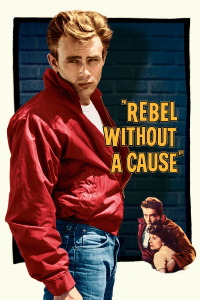
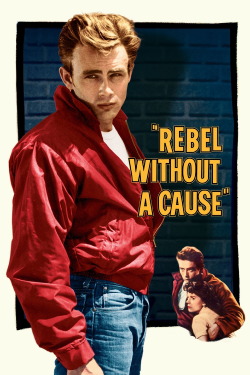
Perhaps there will never be a film regarding teenage dissatisfaction more iconic than "Rebel Without a Cause." Not because of its merit of the way it's aged, mind you - it all has to do with James Dean, who, despite only having starring in three films and tragically dying at the age of 24, has become a legendary figure of the cinema due to this film and this film alone. A surprise? Not really: just look at his Brando echoing performance, the way he has a star magnetism you can't quite put your finger on. The film has dated rather supplely in the sixty-plus years since its release, but Dean's characterization hasn't. His intensity, paired with the overwhelming scent of untimely death, makes his performance such a grand statement that it becomes deeply imprinted in our minds, a branding of idolization hopeless to withstand.
I can think of few films containing a similar kind of explosion of talent while being rather effete themselves. Not old enough to have lived through its release myself, I know little of the social statement it must have made when it settled into theaters in 1955 like an odd man out. It's sometimes melodramatically spurious, appearing as a filmmaker's notion of what teenage life really is rather than a true-to-life commentary, and it is often romantically tragic, so overzealous to sell its breathy vehemence that it forgets about the wondrous possibilities subtlety can bring.
But intact is its divine aimlessness. It doesn't come to a specific conclusion concerning teenage life and its many rebellions, instead standing as an intimate observer paying special attention to causal forces backing mutiny. We're witnesses to petty knife fights, exchanges of "I love you's" more a result of romantic excitement than knowing authenticity, pathetic assemblings of makeshift families out of friends, and general defiance shrouded in a haze of youthful stupidity, all seemingly ramifications of torrid family lives and constituent issues with self-actualization. Some of the film's characters act atrociously because their fathers are not the masculine, stoic figures they'd wish them to be, others because they have no adult figures to look up to to begin with, and many because there simply isn't anything better to do besides wreak havoc.
"Rebel Without a Cause" is interested in why its focal teenagers act the way they do (keep in mind that it isn't intrigued by the well-adjusted, more the ones terrified of looming adulthood), but more important is the scrutiny of their actions, and how their relationships with one another often make up for what's lacking in terms of home life. Directed by Nicholas Ray, a filmmaker whose career consists mostly of movies bemused by the complexities of human nature ("In a Lonely Place," "The Lusty Men," "Johnny Guitar"), it is a film of vision and adulation whose oft contrived tendencies are made up for with satisfying zeal, topped off with sensational performances from its young cast.
Of course, the best thing about "Rebel Without a Cause" is James Dean, who stars as Jim Stark, an unsettled teen whose run-ins with the law have all but shattered the dynamic of his family. His mother (Ann Doran) domineering and his father (Jim Backus) emasculated, town hopping has taken up most of his teenage years - he has few, if any, healthy personal relationships. Acting out is almost inevitable, as sitting back passively and letting his pessimistic thoughts brew would lead to perhaps even more destruction.
The film takes place during the first few hours of Jim's getting settled into his new placed called home, which, understandably, is quickly marked by a brush with the police. Wanting to start his life anew afterward, he considers the possibility of embodying what's expected of a "good boy" on his first day of school, until a bid for attention is taken hard by the town's most prominent pack of juvenile delinquents. First involved in a knife fight and later in a drag race that ends lethally, his searching for himself is further complicated when he becomes a part of the lives of Judy (Natalie Wood) and Plato (Sal Mineo), a pair of similarly tormented youths. Covering the events of a twenty-four hour period, it is to be expected that "Rebel Without a Cause" isn't much keen on a tidy ending. It thrives when reflecting the thoroughly uncertain mental states of its leading characters.
One can consider that "Rebel Without a Cause" might have been a better film had it been made decades later, when melodrama wasn't always a go-to tone even when aiming to go for parallels of the kitchen-sink mindset, but it is still effective and emotionally sturdy, mostly in part to its incredible performances, which hold up in their sincerity. Dean, looking like an icon in his every move with his white T-shirt and fire red jacket, is astounding as a young man so picked apart by his inner demons that we can hardly blame him for his lashing out. The all-too convincing portrayal of his unstable family life is enough of a justification - a set of supportive authority figures is not something familiar to him. Wood, only seventeen here, is excellent as a girl who wants to be good, but is too indulgent in risk to remain so (unnerving is her relationship with her father, who seems to have an uncomfortable attraction to her); Mineo is heartbreaking as the closeted homosexual (a fact more apparent now than it might have been in 1955) whose neglect results in ultimate catastrophe.
Watching "Rebel Without a Cause" is like viewing a cultural artifact, maybe not as potent as it was upon release but still powerful all the same. It is iconic mostly for its terrific Dean, whose death still remains to be one of Hollywood's biggest tragedies (we can only wonder what other tour-de-force performances he might have given in a healthy lifetime), and yet we cannot resist the sum of its parts; it grabs us by the lapels, its datedness there but not focal.
This review of Rebel Without a Cause (1955) was written by Blake P on 07 Feb 2016.
Rebel Without a Cause has generally received very positive reviews.
Was this review helpful?