Review of Rear Window (1954) by Bazooka J — 09 Nov 2013
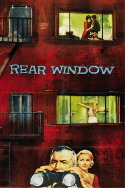
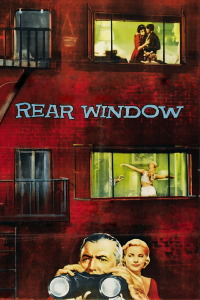
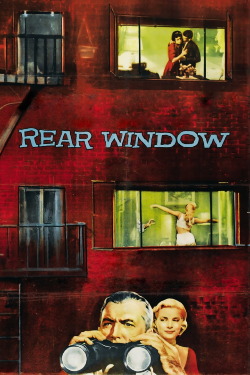
Alfred Hitchcock's Rear Window is the story of a wheelchair bound man named J. B. Jeffries, who, in his boredom, watches his neighbors through a pair of binoculars. The days seem normal until he starts to see things that imply that one of his neighbors might have murdered his wife. He tells the people he's close to, but they just brush it off, until they also begin to see something nefarious is going on in the apartment complex. It's an Alfred Hitchcock classic, and one that is equally humorous and suspenseful. It's a film only Hitchcock could make, and it's one of my personal favorites from the director's acclaimed filmography.
The theme of Rear Window is voyeurism, and how we, through the binoculars of Jeffries, look into the private lives of the tenants in his apartment complex. The entire film is viewed from within Jeffries' apartment. He is confined there, due to a leg injury from a disastrous photo shoot on a race track. As he's stuck there, so is the audience. We see him watch a scantily clad female dancer as she practices around her apartment, and the goings on of a newly married couple. He also sees the distress of a lonely and lovesick woman. But most importantly, he witnesses what he believes to be a murder. We see things unfold just as he would see them. I thought this worked excellently for suspense when Lisa, Jeffries' girlfriend, sneaks into the suspected killer's apartment to try to find some kind of proof of a murder. We see her through that apartment's windows as she looks around, and as she does, we see, from another window, same shot, the murderous husband approaching his door and preparing to open it. He sits there, in his wheelchair, powerless to help Lisa. And since we are seeing this event through Jeffries' eyes, the audience is powerless. This is what really makes this scene so suspenseful. Another well shot scene is the film's climax when the murderer discovers Jeffries spying, and proceeds to go to his apartment to kill him. Jeffries turns off all his lights, and in his wheelchair, tries to stay out of site. We see the light of the hall outside, and the shadow of the killer outside. It is another very suspenseful scene that uses the limited set extremely well.
Jeffries, the film's protagonist, is in a relationship with a woman named Lisa. She wants to marry him, but Jeffries is a photographer who travels and takes large risks to get good photos. He feels he wouldn't be a right fit with a wealthy, dainty woman. But when he tells Lisa about what he believes is a murder in the apartment across from him, she proves that she is willing to risk life and limb for him when she sneaks into the apartment of the man who murdered his wife to search for clues. His arc is that he sees that he was wrong about her the whole time, and through all the danger, comes to see she is the right fit for him. Also, as the film progresses, Jeffries begins to think that his spying is wrong, and that he has no right to look in on the lives of those that he's been looking in on.
Rear Window's narrative is told in a chronological way. There are no uses of flashbacks or other narrative devices. The film's pacing is leisurely in the beginning, setting up characters, the environment, and the way the audience will be seeing things unfold. But once the talk about a murder starts, the film's pace quickens, and gradually the suspense and tension build until it peaks at the films climax. The editing is simple, but effective. Hitchcock seemed to not want to distract from the film's tension by using overly stylized cuts. The only real tricks I saw were the visual effect to replicate seeing through binoculars and a small effect used when Jeffries was using his camera flash bulbs to temporarily blind the killer when he comes into his apartment at the end. Whenever the bulb would flash, and the killer closed his eyes and opened them again, there was an effect to replicate the momentary blindness. I noticed a slight instance of slow motion, when Lisa first kisses Jeffries. There were also several fade outs and fade ins.
Hitchcock's directing style is seen several times throughout Rear Window. There is dark humor sprinkled in the film's dialogue. But the most obvious is the film utilizing its single location so well. Hitchcock did this in a previous film, called Rope. It was a brilliant choice to film this the way he did. It really adds to the film and makes it unique. It also, as I said before, really aids the suspense. We are seeing things happen, that our protagonist has no power over. It's quite a feat to make a thriller where the main character never leaves his wheelchair, or his apartment. Another major aspect of the film is another Hitchcock trait. And that is the point of view shot. There are shots in Rear Window that were shot to mimic the look of seeing through binoculars. The film's climax also utilizes a Hitchcock trait, which is using darkness to show danger. All the lights in Jeffries' apartment are turned off, making it completely dark inside. Another example of this is the scene where Lisa goes into the killer's apartment. It's a very dark scene, due to the fact it takes place at night, and that Jeffries' apartment is also dark. And finally, Jeffries is a normal man thrown into unusual circumstances, which is, of course, getting involved with a murder. This is a trait in many Hitchcock films.
As I stated in the opening, I love this movie. James Stewart gives a great, snarky, yet sympathetic performance. I also find it amusing he is always in his pajamas. He's very vulnerable, which makes the film's nail-biting climax that much scarier. I also like the care-giver character, as she provides plenty of humor to the film. Grace Kelly is also very good. I love the use of its single location, and feel it's one of Hitchcock's greatest directorial decisions. There are many little details, like the diegetic score and the cinematography that I find fantastic. These things really add to the film. The way events are revealed through windows makes for an interesting visual experience. No matter how many times I see Rear Window, I still find it suspenseful and thrilling. This is my second favorite Hitchcock film, right under North by Northwest. Rear Window is a classic that definitely deserves its status.
This review of Rear Window (1954) was written by Bazooka J on 09 Nov 2013.
Rear Window has generally received very positive reviews.
Was this review helpful?