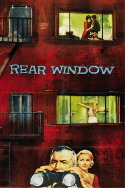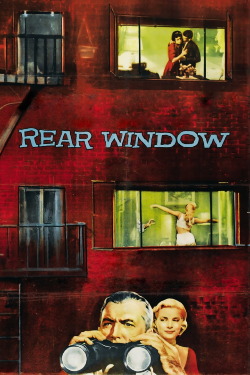
Review of Rear Window (1954) by Harry W — 30 Mar 2015
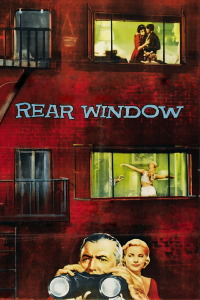
Rear Window opens in an excellent manner, since it immediately sets up a classy atmosphere and pries into the guilty pleasure of being a Peeping Tom, and follows it up with a shot of the fast of a broken leg with words on it expressing its main character L.B. "Jeff" Jefferies' sense of futility at the pain of losing his leg, and therefore his ability to capture images outside of his confined apartment resulting in a broken camera. We instantly get an understanding as to the passion Jeff once had and now what his new interest is, and it takes it from vehing the window that Jeff sits behind so we witness everything as if we are the character which is successfully an excellent cinematography technique, one thing various Alfred Hitchcock films are known for. What is summarised in the beginning of Rear Window is excellent, and its quite frankly one of the greatest film intros I've ever seen, even superior to the shocking intro to another Alfred Hitchcock and James Stewart collaboration, Vertigo.
This theme is reflected throughout all of Rear Window, and frankly it was a great journey. The journey wasn't big as Jeff is confined to a wheelchair and can only see out of the rear window of his apartment, making judgements on that what he can see combined with what he can not see. But the journey of a man's internal struggle with what he is dealing with and how he has to inform society of what he sees is held aloft by James Stewart's fine performance. It's difficult to play such a strong role when the mobility of the character is so limited, but James Stewart passes with charm and charisma similar to James Caan in Misery. Except that the entire story revolves around James Stewart holding it on his own while other characters come and go, and he maintains strong facial gestures and intensity in his performance.
He also gains positive support from Grace Kelly who gives him chemistry to work with which develop into complex dynamics and Thelma Ritter who gives a backbone to him when his character seems to be at some of the hardest points in the story.
Raymond Burr also played a good villain because his physicality made him seem like just a normal everyday neighbour without any form of villainous intentions, and so the entire mystery surrounding him never seemed to have a sense of certainty to it, applying a strong atmosphere to the story.
Alfred Hitchcock truly gives it his all as the director of Rear Window and exerts his full potential in capturing masterful suspense in a realistic story without his usual Bernard Hermann score to add to it, making it cunning in a sense of mystery that embalms the story in everyday situations that a man with an empty life watches for the sake of his own amusement and to satisfy his developing voyeurism. It's an internally complex yet simple story which is told well. And even though its slowly paced and significantly atmospherically different from many other Alfred Hitchcock thrillers, it's still a masterfully crafted film and amongst his finest work as a film director.
This review of Rear Window (1954) was written by Harry W on 30 Mar 2015.
Rear Window has generally received very positive reviews.
Was this review helpful?