Review of Ready or Not (2019) by Bertaut1 — 13 Oct 2019
An entertaining horror-comedy that takes aim at the decadence and insularity of the 1%.
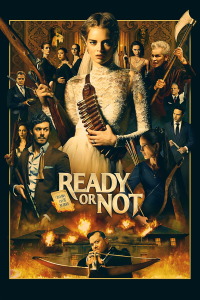
Written by Guy Busick and R. Christoper Murphy, and directed by Matt Bettinelli-Olpin and Tyler Gillett, Ready or Not is a horror-comedy and social satire that comically exaggerates the anxieties attendant with marrying into a wealthy family and mocks the insular nature of such families, so obsessed with their wealth that they've become disconnected from the real world. And whilst the manner in which it presents some of its violence is somewhat problematic, this is a very enjoyable and funny film that's well worth checking out.
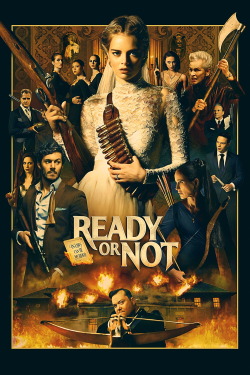
It's the wedding day of Grace (Samara Weaving) and Alex Le Domas (Mark O'Brien), whose family earned their fortune making board games and are now decadently wealthy. Shortly after the ceremony, Alex explains to Grace that whenever someone marries into the clan, they must participate in a game, chosen at random by a mechanised box. At an austere ceremony, Grace's game is selected as hide and seek, with Alex's father Tony (Henry Czerny) explaining the only way for her to win is to stay hidden until dawn. And so, Grace hides in the mansion, unaware that the family (sans Alex) are arming themselves with crossbows, axes, hunting rifles, and assorted antique weaponry.
The film's various psychoanalytical/satirical subtexts are fairly obvious – a lampooning of blue blood families clueless as to how the real world works, a savage deconstruction of the institution of marriage, and a gynocentric celebration of a woman fighting back against old-world patriarchy. In relation to these last two themes, nowhere are they more apparent than in Grace's wedding dress, with costume designer Avery Plewes using the dress to show the stages of Grace's symbolic deconstruction of such concepts.
Concerning the film's engagement with wealth, essentially it suggests that the rich are very different, but could it be that not only are they different, maybe they're actually evil? Of course, it's not suggesting this with anything even approaching realism, and much of the humour comes from the Le Domas family's incompetency. For example, they spend a good chunk of the film arguing with one another about the hunt – some want to use modern weapons, but Tony maintains they have to use antique weaponry, but, really, his argument never gets beyond "tradition...reasons". The film gets a lot of laughs out of showing characters trying to get to grips with their weapon – from looking up "how to use a crossbow" videos to accidentally dispatching several maids due to their inability to handle their weapons.
Another theme, although one not developed to the extent of the above, is religion. Le Bail, a mysterious traveller from decades ago who promised the family great wealth, is believed to be a demonic figure, with his name an anagram of Belial, the demon from the Tanakh who formed the basis of the Christian depiction of Satan. On the other hand, Grace's name references Divine grace. Elsewhere, the film depicts a pit of slaughtered goats. Goats are important in Christianity, especially in the practice of scapegoating, whereby a goat takes upon it the sins of the community and is cast into the desert, symbolically removing the taint of those sins (Leviticus 16:8-10). Along the same lines, Grace injures her hand on a nail, in a veiled reference to the Stigmata. However, whether or not we're supposed to interpret her as a Christ figure is hard to say as, although these references are interesting in isolation, they never really coalesce into anything concrete.
Looking at some other problems, the film maintains that the rich are insane and their violence contemptible. However, some of the biggest laughs are reserved for the accidental killing of the maids. And I have to admit, I found these scenes funny. Also funny is that after one of the kills, the family are trying to have a conversation, which is continually interrupted by the gurgling of a mortally wounded maid; until someone takes an axe to her head to finish her off. And again, I laughed a lot at that scene, even though I recognised that the film was essentially asking the audience to see this violence as funny but some of the violence elsewhere as not so much. In this sense, it wants to have its cake and eat it; it takes Grace's stakes seriously but also encourages us to laugh at some (and only some) of the violence elsewhere.
Ready or Not's satirical ire is focused, even if the tendency towards irreverence doesn't always chime with the socio-political agenda. Allegorically skewering inherited wealth, marriage, tradition, and religion, it suggests that with their atavistic rules and sense of entitlement, the Le Domas family embody the concept that old-money can lead to insularity from modernity. Offering us a match, it posits that perhaps the only way to deal with such irrelevancies is to burn them to the ground. And it has a blast showing us why.
This review of Ready or Not (2019) was written by Bertaut1 on 13 Oct 2019.
Ready or Not has generally received positive reviews.
Was this review helpful?