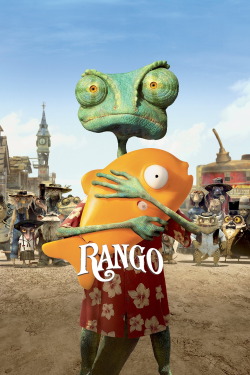
Review of Rango (2011) by Shiira — 16 Mar 2011
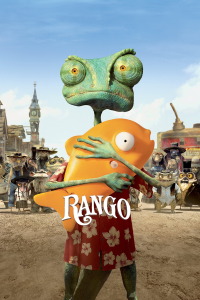
Who is the movie buff: the filmmaker or the protagonist? Is "Rango" the culmination of all the films that the hammy chameleon may have glimpsed perchance from behind his terrarium glass over the course of time in a home with a nearby television.
In other words, is Rango's misadventures in the hallucinatory town of Dirt a moving picture, a post-modernist one to boot, that unreels psychically through his tiny reptilian head? It sure looks that way.
From time to time, the domesticated(and cultured) animal constructs an invisible box in the air with his finger, which would seem to indicate a screen, as if he was setting up the next shot. It's a little bit of self-awareness on the film's part suggesting that it's the chameleon calling the shots, like a John Ford with scaly green skin, filling the mis-en-scene with costumed critters in a tribute to the old west that's more cracked than Alejandro Jodorowski's cult-classic "El Topo".
"Rango" could be entitled "El Dopo". It's almost a stoner movie. If Rango is indeed the true author of the film-within-the-film, the next question we should be asking is if he's even alive? After all, terrariums don't come equipped with either seatbelts or airbags.
When the chameleon is jettisoned from the back of his owner's crashing vehicle, does the impact of the road leave him unconscious, paving the way for his dreaming self to conjure up a glass shard, the remnant of a blown-out back-window which allows him to skid safely along the highway? If the armadillo(Alfred Molina) with the missing midsection offers any indication, Rango probably never did survive that vehicular accident, because only roadkill can hear other roadkill speak.
Arguably, death is the best thing that ever happened to the chameleon with directorial aspirations. (This decidedly avant-garde offering actually has a lot in common with Brad Bird's "Ratatouille".
) In life, Rango suffers from writer's block, somebody who is long on theory but short on story; somebody who can't even decide on a genre, mulling over as he does on a multitude of genre-specific roles, among them, a sea captain, a rogue anthropologist, and a Casanova type.
Limited by the inanimate objects that make up his sorry compliment of ensemble players, the chameleon also seems to be disenchanted by his apparent medium, the play, as suggested by the demarcations of the imprisoning glass which confines the lonely varmint to a single setting, thereby converting his terrarium into a stage.
Throughout his opening soliloquy, steeped in metafiction and existentialism, Rango interacts with "actors" who can't act back; he yearns for the collaborative experience that mere props simply can't offer, and a change of scenery from the fixed mountain range and sky which comprises the backdrop of his controlled environment; his laboratory for artistic development.
Stuck in a sort of Brechtian hell, Rango indicates his desire to escape from the terrarium(which is, for all intents and purposes, a metaphor for experimental theater), and then to enter the filmic world, a diegesis, when he draws that first rectangular screen, a sort of portal which leads to the place where dreams come true.
No more aimless soul-searching: this chameleon wants to break free and live. Construed as a death metaphor, the allusion to the "other side" that the sage-like armadillo imparts to his new scaly friend, can also be taken as a showbiz one, meaning the transition from stage to screen.
Later in the film, Rango successfully crosses the highway, and on this other side, he meets the High Plains Drifter himself, which to the chameleon, is the perfect being, a god who looks over the weird array of cowfolks that populate his movie.
In reality, Rango may be near-death on the highway, or on the side of the highway, so what we're actually seeing is an imagined life filtered through the cinema as it flashes before his(and our) eyes, which encompasses a span of diverse films(especially Roman Polanski's "Chinatown") that met the chameleon's approval.
When one of the minor characters uses the term "man" in a speech(rather than "critter" or varmint"), the fourth wall is broken, because in this self-contained world, there are no humans to speak of.
It's Rango who is providing the lines; it's Rango who is doing all the talking. His reptilian consciousness forgets to convert "man" into animal terms. Being domesticated, maybe the chameleon forgets that he's an animal, as well.
Look at his god. It's Clint Eastwood, not some animal version of the venerable actor/director. Rango flatters himself. He may think that he was made in god's own image.
This review of Rango (2011) was written by Shiira on 16 Mar 2011.
Rango has generally received positive reviews.
Was this review helpful?