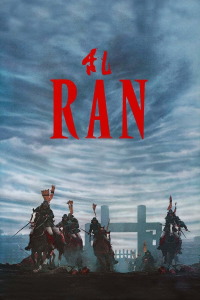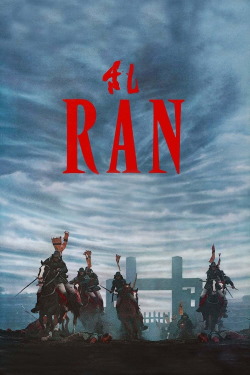
Review of Ran (1985) by Gareth J — 27 Nov 2009
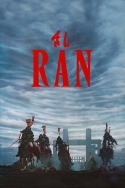
Akira Kurosawa's feudal samurai adaptation of King Lear is yet another example of how his cannon exceeds its hype.
Despite not having Kurosawa favorite, the late great Toshiro Mifune to provide the narrative with his usual happy-go-lucky Japanese narrative irreverence; Kurosawa instead opts to play the film's theatrical tragedy element to the very limit. This is most evident in the striking kabuki-esque make-up of his ailling despot Hidetora Ichimunji (Tatsuya Nakadai), intesionally making the character obsurdly over-emphasised and drawing a distinct comparison with his decidedly normal sidekick of a Fool.
It is also important to note that Kurosawa, who shot most of his epics in grainy monotone, uses the presence of technicolour in much the same way as Zhang Yimou would later do with Hero and House of Flying Daggers, keeping most of his pallet earthy and natural so that the violent battles which proceed can fill the screen with explosions of scarlet. It is a technique which Yimou would unsuccessfully attempt to recreate later in Curse of the Golden Flower, which shares a suspiciously similar plot.
Of course, no Kurosawa historical epic would be complete without its two most crucial elements: thrilling battles and Nihilistic moral philosophy into the faults of human nature. Both elements seem to fit the tragedy better than with most genres because the drama provides its own examples. The most startling ones being the destruction of Hidetora's castle (which abandons sound effects and generates emotional power through music and visual montage) and the climatic murder of Soburo, Hidetora's youngest and only moral son (following an all two brief reunion/reconciliation).
Thus concludes what was Kurosawa's last great masterwork. My only real criticism of Ran is that I did not get the privilage of witnessing a version which offered proper Japanese dialogue, and consequently limited my viewing pleasure more than Seven Samurai. Still, one can always appreciate his use of poetic symbolism, unbiased accounts of upper class arrogance and bitingly subtle use of social commentary. The final image of the blind boy, Serumaru, ambling towards the edge of the cliff is perhaps allegory for the human condition: that he is blind. Blind to his folly...blind to his ignorance... and blind to the hurt and self-destruction that they will inevitably cause.
This review of Ran (1985) was written by Gareth J on 27 Nov 2009.
Ran has generally received very positive reviews.
Was this review helpful?