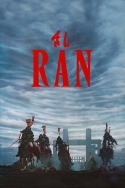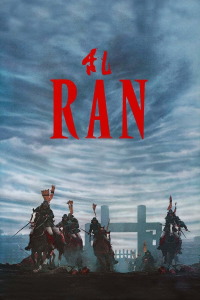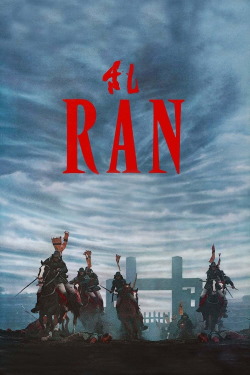
Review of Ran (1985) by David L — 21 Apr 2009
There is no doubt whatsoever that Akira Kurosawa was one of the greatest film directors who ever lived. Directing a myriad of great movies over a career spanning 50 years, Kurosawa was known by many as Japan's greatest director, and the term 'legendary' was used frequently to describe his vision and cinematic genius. Although some of his movies weren't quite as good as his best work, Kurosawa's greatest films continue to amaze, astound, engross and enthral us today.
Ran is just one of the movies from his celebrated and acclaimed filmography, and as well as being a contender for his magnum opus it's undeniably and unquestionably one of the greatest movies ever made. Kurosawa effortlessly and successfully adapts Shakespeare's King Lear, and combined with the director's vision we get is a brilliant, flat-out masterpiece, and a film that adds even more repute to Kurosawa's already respected name.
Retaining much of King Lear's story and themes, Ran is a faithful and successful adaptation of said play, considered to be one of Shakespeare's greatest works. Like most (if not all) of Kurosawa's films, the film is set in Japan ? medieval Japan, to be precise ? and the whole concept of Feudalism and warlords etc is substituted in brilliantly. Despite being set on an English play written 500 years prior, Kurosawa's own personal touch and style are added to it exceptionally.
The whole story starts when Great Lord Hidetora, the head of the Ichimonji family, decides to step down as ruler of his kingdom. He divides his empire up into three, each one diminishing in significance and power in accordance with the age of his three sons (in lieu of three daughters as in Shakespeare's play): Taro, Jiro and Saburo. Sanjuro, being the youngest of the three, warns his father that the other two will develop a lust for power, and will destroy the Ichimonji family in their quest for the title. Enraged and furious at this claim, Hidetora banishes Sanjuro and disowns him as a son.
Taro, being the oldest son, becomes the head of the Ichimonji family and claims all power and responsibilities, whilst his father still retains the title and privileges of Great Lord. But just as Sanjuro predicted, Taro's fealty to his father is nothing but a façade, and he plots to get rid of Hidetora by any means necessary, and hence become the real head of the family. Meanwhile, Jiro becomes the lord of the second Ichimonji castle, and will do anything to get his older brother out of the way ? even if it means civil war. Kurosawa's brilliant epic tracks the majestic rise and fall of the once mighty Ichimonji clan, and perfectly illustrates power, greed and revenge as the darkest and most contemptible aspects of human nature.
Ran is a movie as close to utter perfection as you can get, and whilst it does have flaws (like every other movie), these are so, so minor compared to the greatness of the movie ? you're inclined to just ignore them. The fact is, the positives outweigh the negatives one million to none, and the audience can only be awestruck and astounded at the sheer masterpiece that is Ran.
There are way too many good things about Ran, I simply can't write them all down in a review, let alone in an orderly fashion. Among other things, there's the wonderful screenplay (which, like I said previously, is excellently adapted), the visual-sumptuousness of the film and, of course, Kurosawa's grand and fine direction. Ran's excellence can only be fully realised when one watches the film right the way through; only then can you truly understand why it's considered to be such a great film. It's what an epic should be: sweeping and glorious but at the same time grim and bleak in its view of the world. Even though it's strictly for fans of drama, Ran is a must-see for any film aficionado. Trust me, you definitely will not regret seeing it.
This review of Ran (1985) was written by David L on 21 Apr 2009.
Ran has generally received very positive reviews.
Was this review helpful?