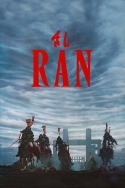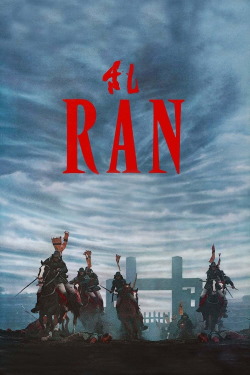
Review of Ran (1985) by Matthew R — 03 Jun 2011
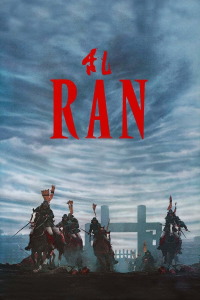
I came to this without having seen any of Kurosawa's films (Seven Samurai and Rashomon most significantly so) and was surprised by many elements. I didn't expect this film to be so theatrical, even down to the make-up which seemed more theatrical than usual for naturalistic cinema. I do wonder if maybe Kurosawa in his later period was delicate to Japanese criticisms that he was too "western" in his technique, and wanted to give it more of a Japanese feel; or perhaps he was deliberately paying tribute to the theatrical origin of the story. Even so, this is certainly a great movie, epic in range and with a huge emotional impact.
"Ran" is basically an updating of Shakespeare's King Lear; the film sees the elderly Lord Hidetora Ichimonji deciding to hand over the reins of power to his three sons. His eldest, Taro, becomes the new Lord, while his younger sons Jiro and Saburo are each granted a province of their own to rule over. Saburo however protests, believing it to be a foolish decision that will split the clan and Hidetora banishes his third son. It isn't long however until Taro and Jiro's ambitions of power lead them to betray their father and the nation begins to fall apart, spurred on by Taro's manipulating wife lady Kaede.
Kurosawa thus blends Shakespearean tragedy with a sweeping historical epic about the loss and gain of power. At the center of it all is a remarkable acting presence in the shape of Tatsuya Nakadai as the displaced elderly Samurai. At the beginning of the film he is a man of stubborn pride, but as his world crumbles and his people die, he soon finds himself with nowhere else to go. The emotional turbulence of being betrayed by his own flesh and blood drives him to his limits, but nevertheless he still refuses to contact Saburo because his warrior principles will not allow him. There seems to be a definite element of Kurosawa himself up there on screen, the director having been near the end of his career with his health failing and his wife having tragically passed away during shooting. Hidetora isn't a perfect ruler but as evidence of his cruelty and oppression during his reign mount up, he remains a sympathetic character, questioning his past decisions and what exactly it is he has achieved in his lifetime. He is the pillar that holds the film together and no mistake. He is aided by some impressive performances all round. Daisuke Ryo's impetuous, outspoken but loyal Saburo is a highpoint of course even if his screen time is limited, spending the majority of the storyline in exile. Jinpachi Nezu's Jiro is another remarkable presence, equally proud and stubborn as his father but beset by insecurities and mistrust. Mieko Harada's Lady Kaede is the film's most hated rouge; her performance is spot on as Kaede is a cold, calculating woman with vengeance on her mind at the best of times, during one pivotal scene towards the middle, she explodes with one dramatic emotional outburst to another, ranting, screaming and licking blood from a knife wound.
The battle scene that forms the centerpiece is absolutely breathtaking, with legions of Samurai warriors storming a castle in total silence. There are no sound effects, no speech, just the sad musical overture for the majority of the fighting, until a particularly important gunshot rings out and we are plunged right into the maelstrom. Bodies are filled with arrows, blood drips everywhere and hundreds of warriors are slaughtered in spectacular fashion. It may be a glorious sight to behold, but it is the closest thing a historical epic has got to show that war is hell, no matter what period of human history it is set in. The more blood thirsty among us may then be disappointed by the second clash towards the end, a far more unremarkable skirmish that promised to be incredible after several scenes of armies maneuvering in anticipation.
The greatness of Ran doesn't end at its visuals though. There is a fantastic narrative within these vivid and colorful vistas. It is a very slow paced film that dwells on certain scenes for a very long time, yet never overbearingly long. The story itself is fairly complex, as would be expected from such a grand scheme of a picture, yet as long as you stay with it, it is an incredible story with a great deal of subtext and underlying themes that serve to give it an even greater purpose as a revolutionary film. With any epic film like this you'd expect it to cover a lot of proverbial and existential ground and it certainly does. We see everything from the themes of close family bonds and loyalties, to the traumatic effects of war on the human mind and soul. Ran is a dramatic tragedy of lost innocence and peace. It is a harrowing look at the destruction of family and kingdom. Yet, despite these bleak themes, it still manages to be a stunningly beautiful film. This beauty serves to drive home the emotional impact of the film, engraving some very gripping images into your mind.
In the end, Ran is an artistic masterpiece of such beauty and grandeur, that it can put one in an immense state of awe and wonder. It may seem theatrical at times, but like a watercolor painting that moves, it is beautiful to watch time and time again.
Story: B+.
Acting: B+.
Direction: B.
Visuals: A.
Overall: B.
*** out of 4 stars.
This review of Ran (1985) was written by Matthew R on 03 Jun 2011.
Ran has generally received very positive reviews.
Was this review helpful?