Review of Raising Arizona (1987) by Jack M — 10 Dec 2014
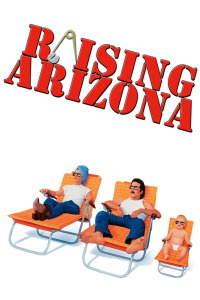
If the Coen brothers' first movie, "Blood Simple," was the earliest example of their brand of nail-biting but thrillingly imaginative violence, "Raising Arizona" is the first full realization of their knack for wordplay. Several of their later works, notable "Fargo," would blend the two components in more or less equal measure, but here the dialect and dialogue are front and center. The supporting character played by Frances McDormand uses an imperative tone, with eyebrows raised in pre-judgment, to ask new mother Holly Hunter about the baby's future matriculation: "You are going to send him to Arizona State." She is not an exaggeration; the question marks her as a type familiar to anyone raised near the clannish land-grant colleges of the south and southwest.
Though this line is sufficiently believable, and though McDormand and Hunter prove their command of accents (not for the last time), there is of course a great deal of affectation in the way the Coens' characters speak. Yet it is not correct to say that the archaic poesy the Coens put in the mouths of countrified people is a pretension or a ridiculous jest. When Nicholas Cage's character substitutes "slumber" for "sleep," "ether" for "air," and "twain" for "two," he is speaking in a way folk really spoke once upon a time. His letter to his wife reads almost like a letter home from a Civil War soldier. There is a great deal of ridiculousness in "Raising Arizona," all of it intentional and some instances of it more successful than others, but the emotions of the characters and the language they use to express them are as heartfelt as they are playful.
Some critics have accused the Coens of punching down with their humor, but in "Raising Arizona" all of the comedy is the kind that puts the audience on the side of the desperate and downtrodden. The "hayseeds" in the local grange easily out-argue a pair of robbers (who are themselves sympathetic enough, in their turn). The only really dislikable person in the film is a relatively well-off factory manager, and it is he, not the man who lives in a trailer park, who shows himself to be a racist and a degenerate.
Coen brothers films are not known for social commentary, but "Raising Arizona" contains some light critique of society's treatment of individuals with convictions on their records. Nobody in the movie believes that prisons exist to rehabilitate people. A frequent offender opines in a marvelous opening monologue and montage that their purpose must be revenge. At the other end of the movie, the victim of the central crime bookends this idea by declining to press charges since "there's no harm done.".
What doesn't work as well as the Coens' crackling script and characters are the movie's action sequences. The editing is a little rough, which is understandable since much of the drama involves a live baby whom the director cannot actually put in harm's way. The introduction of a motorcycle-riding, grenade-tossing villain is funny at first, but when he starts talking (through a voice-stifling fake nose for some reason) he loses much of his appeal. Holly Hunter carries herself well as a twice-decorated police officer, a presentiment perhaps of Marge Gunderson in "Fargo," but she is given too little to do in the final set piece.
"Raising Arizona" is a very good movie in its own right, but in comparison to the Coens' later masterpieces it can also be viewed as a working out of principles and patterns that would take several more years to come to their fullest fruition.
This review of Raising Arizona (1987) was written by Jack M on 10 Dec 2014.
Raising Arizona has generally received very positive reviews.
Was this review helpful?