Review of Raging Bull (1980) by Jesse B — 05 Apr 2012
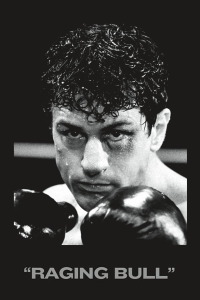
Jake LaMotta is not an animal. It is odd to think of this film, this character of LaMotta and find some element of sympathy well up inside of me as I have of late. It's curious to think that one would have any other reaction besides complete and utter disdain for the man.
After all, he's a womanizer; he has a razor thin temper which seems to brutally gush forth, not only in the boxing ring, but more devastatingly on those who love him. I cannot say, with any good faith, "the people he loves.
" De Niro's LaMotta has no understanding of what love is. Not the slightest concept of true affection. Rather, his life has been defined by violence and violence is the only expression which he is capable of.
Martin Scorsese's Raging Bull is not typical of other works of biographical cinema. It does not concern itself with answering the deeper questions of the psyche or laying out a schismatic of the trajectory of a life through many scenes of laborious and monotonous exposition (a trait which is far too common among all modern cinema -- the origin story), nor has its narrative taken us through the arc of an entire life.
Rather, it plops us down off center toward the first half of a life which has now, in this real world, surpassed some eighty years. Scorsese finds his joy very much as a biologist would -- peering through a microscope in order to scrutinize the most primitive of life forces.
It just so happens that Mr. Scorsese's microscope shoots at 26 frames per second. In the opening credits we hear the music of Pietro Mascagni's operetic masterwork, Cavallieria Rusticana. It fills our ears and lifts our souls and starkly contrasts the black and white image of a cold, focused, dancing LaMotta with its richly layered emotions and vibrant life.
It is in these beginning moments that we are allowed to feel the only beauty which is able to exist within the story of a man who knows nothing but punishment. The only hint of emotion. Even near the films end when LaMotta is a fat, washed up has-been prize fighter, and is locked away for allowing two underage girls to consume alcohol in his club; even at the point of being found alone in the cold and dark of his cell, finally having to confront (to some extent) the person which he has created for himself, even then true expression escapes him.
He only knows to break his hands on the concrete walls and smash his head up against them in some attempt at redemption. Or perhaps simple punishment without the hope of expiation for his many sins. In this man's world violence is his only method of coping.
It is quite obvious from very early on in the film that we are looking at this life through Jake's own understanding, or interpretation. This is made more clear to us as we briefly glimpse the state of his first marriage.
A fight breaks out between the man and his wife over what appears to be an overcooked steak. We can tell that there is a long history between the two as his wife sizzles as she tends the stove and receives an earful from her overbearing lord.
After this we see her only one other time: LaMotta, having seen a pretty young Cathy Moriarty (who shines brilliantly as Jake's second wife, Vicky), pursues her to a nightclub with Joey. After another brief spat with his wife outside of their tenement building, accompanied by some flying dinner-wear, we are never made privy to her presence again -- even though Jake's eventual courtship of Vicky begins while he is still un-blissfully married.
We hear her name only once more and that is enough. There is no mention of a divorce preceding, it simply drifts into the next marriage (if that is what one would call it). This is very important to understand while viewing the film, otherwise all of the characters come off as cold and heartless.
Although this may have been the case in actual life, one should argue that do to the narrative control obtained through LaMotta's own point of view, all other characters are colored (or in almost all cases, desaturated) do to his bleak, simplistic outlook on life.
This review of Raging Bull (1980) was written by Jesse B on 05 Apr 2012.
Raging Bull has generally received very positive reviews.
Was this review helpful?