Review of Raging Bull (1980) by Daniel R — 31 May 2011
Personal Score: 10/10.
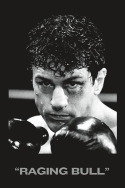
When one is watching a film by Martin Scorsese, one must know that their full attention is required. No American director seems more invested in his craft, more exacting in his shots, or more confident in his ability. This has never been more apparent to me than it is after watching Raging Bull, finally, for the very first time. This is, without a doubt, the finest film he has ever made, and one of the best of all time by any director.
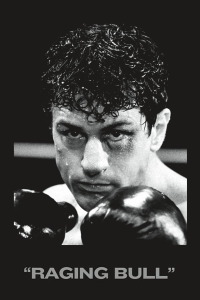
The story of Raging Bull is all about Jake La Motta, the famed middleweight boxer of the 1940s who rose to become champion after years of climbing the ranks. But as La Motta decimated opponent after opponent, with the occasional difficult bouts with rival Sugar Ray Robinson, his life outside the ring was a train wreck.
Jake La Motta is his own worst enemy. His own rival. His motto in the boxing ring is to never go down to anyone, and this is also true in his private life. He is a bull in the ring, and bull-headed out of it. He can never be told he's wrong, or that his suspicions and preoccupations are false. And he has many of those. Much of the film focuses in on La Motta's insatiable fears that he's being cheated on by his wife, Vicky, a pattern we also see at the beginning of the film with his first wife. Jake's brother, Joey, tries hard to keep him in line and keep his head in the right place. At times, we likely think that Joey is a bit loathsome too, and perhaps he is, seeing as how he constantly tells Jake to leave his wife because she's ruining him. But truth be told, as harsh a thing that is to say, one can't help but believe that the real reason Joey suggests these things is to keep Jake's mind on boxing, which seems to be the only thing that he can focus on and do well without destroying himself. Everything else just causes problems, for Jake, for Vicki, for their children, and for Joey. One thinks that Joey almost wishes that Jake could stay away from people all together just so there'd be no one left not to trust.
None of this advice helps. Jake is too paranoid to just let things go. Too paranoid to trust. Too unwilling to just lay down let others be. His suspicions, though never confirmed, often make him violent, and every scene in his home feels like a bomb is ticking inside Jake and you're just waiting for it to go off. It doesn't go off in every scene, mind you, but Scorsese's brilliant directing never lets that tension be removed, and neither does Robert De Niro's outstanding acting.
I mentioned earlier that this is Scorsese's finest film, and that there isn't another director this capable. I would also like to say the same about De Niro as an actor. He is not my favorite actor, nor Scorsese my favorite director, but they are the best I have ever seen at their craft, and this film is fortunate enough to have these two juggernauts at the height of their abilities. Thankfully, De Niro won for Best Actor for his performance, but the fact that Ordinary People stole Best Picture, Best Director, and Best Supporting Actor (which should've gone to Joe Pesci) is not just a mistake, but an utter travesty.
Scorsese did eventually take home prizes in both of these categories for The Departed, but that film does not begin to compare with this, and nor do I think any of his other films do, and that is certainly saying a lot. If any other director could have Goodfellas, Taxi Driver, Casino, or many others that Scorsese did in their own library of films, it would certainly be their magnum opus. But for Scorsese, as brilliant as those films are, they all bow to Raging Bull. This brutal tale of a wretched, self-destructive human being is enthralling, difficult to watch, but impossible to take your eyes off of. Raging Bull is magnificent, and the champion of Scorsese's works.
This review of Raging Bull (1980) was written by Daniel R on 31 May 2011.
Raging Bull has generally received very positive reviews.
Was this review helpful?