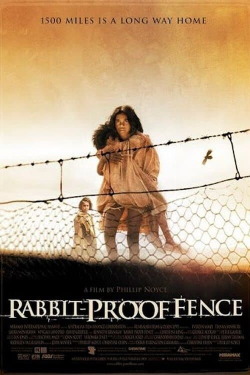
Review of Rabbit-Proof Fence (2002) by Sharon S — 06 Sep 2008
In 1931, Molly age 14, Daisy her 8 year old sister and Gracie their 12 year old cousin are removed from their home in Jigalong. Their mothers and their grandmother are devastated. Their fathers are white. They are called half caste (aborigine and white). Constable Riggs is sent it Jigalong per order of Neville, the head director, to put these three girls on a train to the Moore River Settlement, a home for half caste. Molly decides almost immediately upon arrival at the settlement that she, Daisy, and Gracie are going home. Molly?s determination at such a young age was impressive. The way Daisy and Gracie trusted and relied on her was also unbelievable. Even though she was only 14, she pushed the girls to as well as her self to keep going. Molly?s mother and her grandmother kept the faith. They never gave up believing that the girls would come home. Faith can reach across unseen barriers. The fathers of the girls were afraid or cowards. I am not sure which. I cried and I got very angry at Moodoo, who was tracking his own people. Near the end of the movie, I think he admired Molly. I didn?t care for Neville, the devil either. I don?t think he even realized he was dealing with human beings and that this wasn't just an experiment or a project. I was rooting for the girls all the way. I enjoyed this movie.
This movie relates to world religion in that these three girls were removed from their home and taken to a school that was trying to change them. Neville kept saying that these people didn't realize that he was trying to help them. He and the people that were under his supervision wanted the half caste to stop speaking their language and practicing their religious ways. He was trying to make them abandon their Aboriginal ways to become culturally white. S Salou.
This review of Rabbit-Proof Fence (2002) was written by Sharon S on 06 Sep 2008.
Rabbit-Proof Fence has generally received very positive reviews.
Was this review helpful?