Review of Rabbit-Proof Fence (2002) by Angie T — 05 Sep 2009
Rabbit-Proof Fence is a look into the affects of an Australian government policy in place from around 1880 until the late 1960?s (Fisher 62) to remove aboriginal children from their homes and integrate them into white society. Now referred to as the ?stolen generation?, these children mixture of aboriginal and white blood and were called ?half-castes?. It was believed that the aboriginal blood could be eliminated over time through breeding with white people. The policy was established In order to hasten this affect and to ?prepare? the children for a more modern way of life.
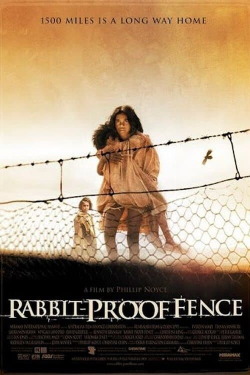
Rabbit-Proof Fence is centered on three young aboriginal girls who are removed from their home in Jigalong and taken from their families to be placed into a camp for established for teaching them the white man?s way of life and religion. The majority of the movie is focused on their capture, the subsequent escape from the camp and the hardships they endured on the long twelve hundred mile journey home. Although I found the movie to be a little dry due to the flatness of the characters, I still found it very moving emotionally because of the issues surrounding the events in it.
Although the details may differ, this story is one that has been repeated many times in history and on every continent in the world. The story of how the dominate cultures in society have a tendency to think that their way is the right way and indigenous people are nothing but ignorant savages. This way of thinking is very prevalent with global religions. Although the policy in Australia may not have been religiously motivated, I felt the movie reflected a strong religious undertone because the camps were supervised by nuns and church seemed to be a large part of the assimilation process.
With religious groups, much of the time there is a well meaning intention behind the overall act. They truly feel that by teaching indigenous people about their faith, they are enlightening them and saving their souls. But many times what starts out as a mission of faith ends up harming those they originally intended to ?save?. Sometimes there is an alternative motive such as to gain control of their land or other natural resources?or worse, the people themselves by placing them into a life of servitude as in this movie. Of course even the most sincere reasons could end up causing major problems such as bringing new diseases to which they had no immunity to or disrupting their way of life by bringing to them new gadgets, new weapons, alcohol, food, etc. Whatever there reasons, historically more damage has been done than good for most indigenous people and many of their traditions have been destroyed (Fisher 62) and unfortunately, I personally feel there is very little anyone can do to make up the losses they have suffered.
I thought the ending was the most powerful part of this movie. To see Molly and Daisy as elders now and to hear their words translated about the how the end of the story in the movie was not the end of it for them helped to make it very real to me. Molly stated that her daughter was taken at three years old and she has not seen or heard about her since. There is nothing that can be done to rectify that.
Works Cited.
Fisher, Mary Pat. Living Religions. Upper Saddle River: Pearson Education, 2008.
This review of Rabbit-Proof Fence (2002) was written by Angie T on 05 Sep 2009.
Rabbit-Proof Fence has generally received very positive reviews.
Was this review helpful?