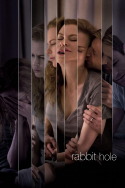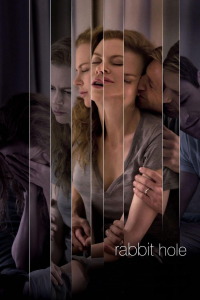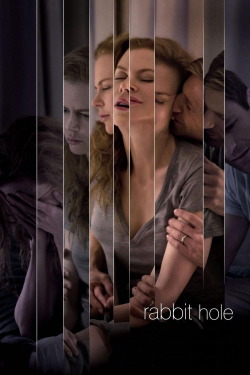
Review of Rabbit Hole (2010) by Shiira — 28 Jan 2011
Becca(Nicole Kidman) does not suffer fools gladly. And since those fools, by the grieving woman's estimation, are Christians, "Rabbit Hole" bravely saddles itself with an ice queen for a protagonist that some moviegoers may find hard to identify with.
She's an atheist, an egotistical one to boot, who isn't at all shy about making her opinion heard, even in the most inappropriate of all venues, an encounter group, where charity is supposed to take precedence over ideology.
As the young couple recounts their story of loss, Becca can't help but react with eye-rolling exasperation; her facial expressions, awash with contempt, lead to wounding words toward the bereaved parents, whose belief in angels is just too much for the empirical-minded nihilist.
She behaves badly, perhaps abominably, but her churlish interruption serves an aesthetic purpose. The film's material, so often the stuff of inspirational made-for-television tripe, in which god is peddled as a knee-jerk cure-all for overcoming adversity, gets reworked in "Rabbit Hole" to evince a secular sensibility, a mindset that excludes the persistence of god's design upon the living as a crutch for dealing with loss.
Foregoing the fellowship of the support group and her mother's church, Becca spends her days and nights in godless isolation, without a coping mechanism, and worse, because of her freethinking stance, god isn't even an option, a floating component in some desperate contingency plan, should her anguish over the dead child intensify.
In a nutshell, "Rabbit Hole" is about finding a replacement, a surrogate, for god. Maybe Becca would make a good Buddhist. In the opening gardening scene, the obvious joy that spreads across the phantom mother's face after she plants a seedling is suggestive of the former Sotheby's Auction House executive having a deep reverence for nature, a prevailing trait that's universal to all eastern religions.
The careless murder of the young plant by her neighbor's fatal footstep, can be interpreted as Christianity's monolithic influence over the religious spectrum in our country. But at the restaurant, following the altercation at the meeting, in addition to characterizing all Christians as "god freaks", Becca dismisses the other religions, as well, figuratively, when she goes through the menu list and declares to her husband(played by Aaron Eckhart) that "nothing is jumping out" at her, prompting them to seek nourishment and sustenance(read: enlightenment outside of religion) elsewhere.
Ironically, Kidman played one of those freaks whom Becca loathes in Jonathan Glaser's "Birth", where magical thinking leads a widow to believe that a ten-year-old boy is the reincarnation of her late husband.
The bride-to-be's undying faith, at its strongest, makes allowances for deviant behavior, in which she permits the pre-pubescent child to undress and join her in the bathtub without protestation. Becca's lack of faith, on the other hand, allows this science-based woman to cultivate a state of oblivion where signs and superstitions don't factor in her everyday living.
When Becca pulls up alongside a lettered bus that reads "Deville", the fact that the word "devil" can be teased out of the overall appellation isn't given any significance, since the driver's categorical dismissal of the metaphysical world precludes her from signifying the biblical figure with an abiding belief in the fallen angel's ability to insinuate himself upon her reality.
The teenaged boy in the bus window isn't the devil; he's just a kid, who happened to be at the wrong place and time. While Jesus saves in genre films of this sort, parallel ones in which the left behind find solace in god, it's science that provides comfort for Becca's troubled mind.
Instead of a bible, the good book is a comic book called "Rabbit Hole", written by her son's murderer, which explores the possibility of alternate universes. Becca likes the idea that she's having a good time in one of these auxiliary worlds, because in one of these worlds, heaven is indeed a place on earth.
It's heaven in the sense that the earthbound person imagines his/her dead loved one in another realm, and for the atheist, that realm is an earthly, not heavenly one. Science, as it turns out, has the benefits of religion, because Becca finds peace in imagining the continued existence of her son.
This review of Rabbit Hole (2010) was written by Shiira on 28 Jan 2011.
Rabbit Hole has generally received positive reviews.
Was this review helpful?