Review of Raazi (2018) by Swati K — 16 Nov 2018
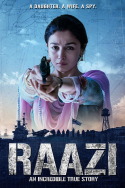
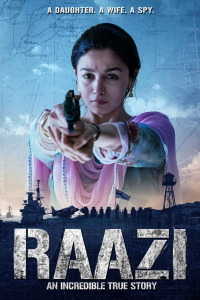
Raazi is an epic that tells a previously untold story of a Kashmiri college student who marries a Pakistani army officer to spy for India during the Indo-Pakistani War of 1971 during the midst of East Pakistan's fight for liberation. Alia Bhatt is the star of the film and we see her in this role transcending normative Bollywood heroine roles arriving at something entirely different; Sehmat represents a different type of heroine and even so, maybe a different type of Mother India. The film begins in the present-day on an Indian army ship addressing a group of soldiers detailing the sacrifices a particular woman made whilst undercover in Pakistan during the horrific war in 1971. The story flashes to the events right before the war when Sehmat's father, an Indian agent posing as a Pakistani informant, arranges her marriage to his Pakistani Brigadier "friend's" son, Iqbal Syed, another military officer. The story follows 20-year-old Sehmat's training and journey into infiltrating the enemy in the name of her country.
Unlike Veer-Zaara, which I would argue is a love story set in the context of war and its aftermath, Raazi is a war story with brief subplots hinting to life during war-what love looks like, what domestic life looks like, what family looks like during horrific, trying times. Because Raazi is still, of course, a Bollywood movie, there's still extradiegetic song sequences, though are few and not accompanied with dancing or playback singing. Similar to Veer-Zaara and Main Hoon Na, though, Raazi humanizes Pakistan and Pakistanis in ways many other Bollywood war films don't. Like Saba Bhaumik says in "Politics of Indian War Films," many war films paint Pakistanis as inherently evil and villainous (86). These three films resist "the stereotypical discourse about the Muslim criminal and terrorist as a threat to the Indian nation that marks much Hindi cinema" and show the similarities between Indians and Pakistanis echoing the sentiment that Pakistanis love their family and country like Indians do so what makes them so characteristically different (Violent Belongings: Partition, Gender, and National Culture in Postcolonial India 158)? Even the name of the film, Raazi, is a statement because it's an Urdu word; the film could have easily been called Sehmat, but the director, Meghna Gulzar, made a deliberate choice to make the title the Urdu equivalent. This plus the fact that the main character, Sehmat, is Muslim, points to this Bollywood secularity that we all know and love, but also solidifies that the differences between an Indian and Pakistani are just the name. It also sends the message that there is indeed a place for Muslims in India and its national story no matter what current events reflect.
All in all, I really loved this movie and what it stood for as a whole. Finally the stories of women during war are coming out, and even though South Asia as a whole has a lot more work to do concerning this, I see Raazi as a success. Sehmat represents one of millions of Pakistani, Indian, Bengali women who faced unspeakable acts of violence during these wars that were then erased from history, society, and the entire countries' narrative. How do you heal from pain when it's not acknowledged? Raazi makes steps in eroding this culture of silence.
Something small that I think the film could have done better is more adequately mention East Pakistan/Bangladesh. The entire plot is centered around these moments before the military confrontation between India and Pakistan during East Pakistan's liberation yet they are a third party in their own independence story.
This review of Raazi (2018) was written by Swati K on 16 Nov 2018.
Raazi has generally received very positive reviews.
Was this review helpful?