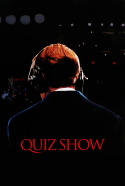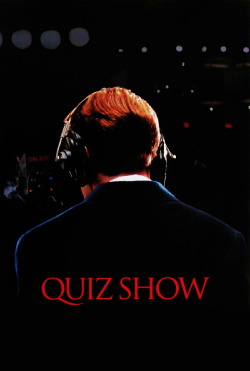
Review of Quiz Show (1994) by God? — 03 May 2006
[FONT=Verdana]Amazing how in the book from which the movie?s storyline is taken, [I]Remembering America: A Voice from the Sixties[/I] by Richard Goodwin (which I cannot recommend highly enough), it only comprises twenty-two pages. What was fascinating on the page could have quickly turned stale on screen. But in this adaptation, by Paul Attanasio, Goodwin?s account is stretched out, embellished, and altered to the point where it emerges as two of the best hours I have ever given to cinema.
Robert Redford directed [I]Quiz Show[/I], and it is arguably his strongest film. He?s not one of my personal favorite actors (though he is in one of the darkest and most beautiful of ?Twilight Zone? episodes in which he plays the ubiquitous Mr. Death), yet behind the scenes he always seems to work pure magic. And this is no exception. It looks authentic, feels authentic, and hits all the right notes.
Of course, great direction and fantastic writing aren?t enough to make a film a true classic. Also needed is a memorable and lively cast. Here the casting is absolutely perfect. One of the finest living actors, Ray Fiennes, gives a performance that rivals his earlier Oscar nominated work in [I]Schindler?s List[/I] (1993) or his later Oscar nominated role in [I]The English Patient[/I] (1996). He plays Charles Van Doren, a member of a prominent intellectual family from the Northeast. He teaches at Colombia University, where his father, Mark Van Doren the poet (the great British actor Paul Scofield in a performance that earned him an Oscar nod), also teaches. The producers of ?21?, Dan Enright played by David Paymer and his sidekick Al Friedman, played by Hank Azaria, want him to appear on their show. As the show?s host asks them, ?why would someone like that want to be on a quiz show?? Why indeed. It seemingly defies logic for someone of his intellect to put himself on display in front of millions of people.
While his reasoning for wanting to appear on the show is unclear, Dan?s desire to have Charles compete on the show is self-explanatory. He is young, charismatic, handsome, and hails from a famous family. They want him to to dethrone the current champ, Herbert Stempel, a working class Jew from New York with an annoying voice, played to near perfection by John Turturro. His sidewalk haircut prompts at least one woman to label his face, ?a face for radio.? He does have but one thing going for him: a sponge like memory.
So how could Van Doren beat him? He could very well be trampled like all the others. In order to ensure victory, they devise a foil-proof plan. They will ask him the questions he answered correctly in their office. When he protests that this is dishonest, Dan is quick with a comeback: ?That book that Eisenhower wrote, a ghostwriter wrote it. Nobody cares.?
The second half of their plan is what sets up the more dramatic elements of the story. Dan takes Herbert out to a fancy restaurant for dinner, for the purpose of informing him that he has ?plateaued.? His time is done, the fifty million watchers of ?21? are ready for something new. He is to take a dive. Adding supreme insult to injury, the question that he is instructed to fumble over is over the Best Picture winner of 1955 (which was [I]Marty[/I]). He is to act as though he has no idea, then to answer [I]On the Waterfront[/I] (the previous year?s Best Picture winner). When he tells Dan that this will be ?too humiliating,? he fires back, ?For seventy grand, Herb, you can afford to be humiliated.? The camera then pans out as Dan walks away and we see him wounded, unconfident, and unsure of his next move.
Dick Goodwin, played by Rob Morrow looms over the first act of the film. He is the lone hero in the film; the force of uncorrupted purity, in a scandal where even the victims have guilty consciences. The first scene in [I]Quiz Show[/I] is of him perusing a Chrysler dealership. The scene only lasts for a few minutes, yet it richly sets up his character and the film in general. We learn that he is very self-conscious of his Jewish identity. He changed his name from the very Semitic ?Goodman? to a more German sounding ?Goodwin?, which was presumably a common move for Jews in the Ivy League schools at the time. When the car salesman calls him by his actual name, he quickly snaps the correction. He graduated from Harvard Law School (where he was first in his class, as he is fond of reminding people) and works in Washington. When he turns on the radio, the announcement that the Russians have launched Sputnik into outer space, it ties the events of the movie into that time period of the late 1950s inexorably.
He first learns about the quiz show mess while reading the newspaper in his cramped government office. It doesn?t interest any of his co-workers, yet he clearly sees something afoul. The judge in the case sealed presentment after Herbert Stempel accused Dan and others at NBC of corruption. He is intrigued that the presentment (which is a statement of findings) is sealed; it almost seems like an oxymoron.
Goodwin is able to garner enough support to investigate the case (?We?re gonna take on television, television. Everybody in the country will know about it.?). He meets with the New York judge who quickly dismisses the entire premise of his quest, saying in effect that Stempel?s testimony was so bilious that he sought to protect the reputations everyone ?unfairly implicated.?
After that Goodwin attempts to speak with as many ?21? contestants as possible; few will utter a word to him. When he finally goes to Stempel?s house, Stempel wears a look of supressed delight. It is like he has been waiting there the entire time, waiting for someone like Goodwin to come along. The differences between the two individuals, both East Coast Jews, are remarkable. Stempel inquires: ?Didn?t you go to City College?? Goodwin: ?No, Harvard.?
That is something that marks Goodwin?s relationship with Van Doren and his encounters with Stempel: adoration. Stempel is envious of the world-class education that Goodwin has earned through hard work and perseverance, while Goodwin looks admiringly at the lives of the egghead Van Dorens. Stempel views them with a mixture of spite and jealousy. Jealousy for all their success and unbridled spite for the fact that he has been screwed all his life. He suspects that Goodwin doesn?t really care about his predicament; he and Van Doren are probably off ?giving each other the old Ivy League handshake.? He isn't. When he visits their opulent house in the countryside of Connecticut, Goodwin could not be more out of his element.
Goodwin doesn?t get much out of Van Doren in these pleasant visits, but as it turns out: several people had been receiving the answers. Van Doren wouldn?t really admit it to himself initially; the prospect of making thousands of dollars that he would otherwise never see was enticing enough to let him temporarily cast aside his ethics (one of the best shots in all of [I]Quiz Show[/I] is of him running down the stairs unable to contain his delight). He is opportunistic though, not truly dishonest. The whole lie clearly wears on him. When he is on the on the 'Today Show with Dave Garroway' to discuss his winning streak and his upcoming book on Abraham Lincoln ([I]Lincoln?s Commando[/I]), Dave asks him a simple question ? How do you think Honest Abe would do on a quiz show?? Watch the look of panic in his eyes, as the best he can muster is, ?Honest Abe? Well, I think that he would do very well. And of course on a show like this, he?d be wonderful.?
This is the type of excitement found in [I]Quiz Show[/I], and for a film about a television scandal, it is remarkably exciting. This is intellectual entertainment where the drama comes from moral debate, questions of ethics, and legal issues; not car explosions and nudity. Just think about the great cinematography when Stempel takes the dive by acting as though he can?t remember the winner of the Best Picture. The camera zeroes in on people who work on the show, audience members, and other characters at the film as they say in disbelief ?[I]Marty[/I]!? Or the scene where Stempel visits Enright in his NBC office and yells that he was every bit the sensation that ?Charles Van-Fucking-Doren? is, a scene that is short and very powerful. The scene in which the major players in the scandal, including Van Doren testify before the House Subcommittee on Legislative Oversight, provide a stunning climax to the film. All are forced to account for the wrongdoings. But the hardest person to tell for Van Doren is his father. When he confesses to him that he cheated on the quiz shows, he is absolutely horrified and furious ("Cheating on a quiz show, that's like plagiarizing a comic strip!"); driving home the point that our blunders we make in life impact many people, not just ourselves. These pernicious lies can ruin entire families by utterly ameliorating reputations.
And that concept lies at the heart of Redford?s masterpiece. While the movie at first appears to be little more than a game show and a dry scandal that surrounded it, it is about so much more. Lives were changed. Friedman and Enright?s hiatus from show business was short-lived. Goodwin would go on to work for Supreme Court Justice Felix Frankfurter (an extremely interesting and prolific political mind) and from there he would go on to write speeches for President John F. Kennedy and later Lyndon B. Johnson (he coined the phrase ?The Great Society?). Van Doren was forced to resign from his position at Colombia University. He would go on to edit Praeger books and write for [I]Encyclopedia Brittanica[/I]. To this day he refuses to discuss the controversy. Stempel went on to work for the New York City?s Transportation Department and later he taught in the New York school system. Unlike Van Doren, he has embraced the interest in the scandal sparked by Goodwin?s book and [I]Quiz Show[/I]. It may seem like a bit of dramatized recent history, but look closer. Listening to the producers and the sponsors of ?21? rationalize their actions (?we did one thing wrong: we were too successful? and ?Its not like the quiz shows are a public utility, its entertainment?) one witnesses one of the earlier rides down the slippery slope to our current lack of ethics as exemplified by the likes of Enron. And that?s why it is as relevant a message today as it ever was.
[/FONT].
This review of Quiz Show (1994) was written by God? on 03 May 2006.
Quiz Show has generally received very positive reviews.
Was this review helpful?