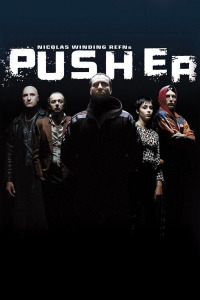
Review of Pusher (1996) by Milo M — 04 Nov 2013
Cocainehagen! ...Oh yeah, I did just say that, because as if Danish pastries weren't addictive enough, now we have Danish drugs. Huh, I just figured that the powdery topping was sugar, but no, it's evidently something a little more energizing, and it's sure not this film itself. Jeez, you might need to do a line in order to stay awake during this film, but hey, this flick is about drug pushers trying to get you to do a line, so I guess that means that Nicolas Winding Refn has made a pretty effective crime thriller here. I'd say that it's the first of many, but when I say that these are crime "thrillers", I use the term a little too loosely to overused. I don't know, I figure that this film is getting so much attention because it's considered the first Danish crime drama, which is bogus, for the record, because "Hamlet" was also about a Danish family doing some seriously disturbing junk, except, well, it was conceived by an Englishman, and it featured characters who at least attempted to show some etiquette while they were messing things up. With this film, you get a gritty gaze into the criminal heart of Denmark, and you know what, it's still boring, but for only so long, before it catches your attention with something.
Later on, I'll be touching upon this story's problems, of which there are oh so very, very many, but the subject matter itself has some meat to it, being an ostensibly realistic portrait of the lives of drug dealers, both as humans and men of criminal business, with an intricate attention to detail that bores more than immerses, but still has fascinating elements, undercut by shortcomings, both natural and consequential. A good bit of potential to this story concept is met by questionable areas, made all the more glaring by questionable areas within the telling of the story, but potential still stands, and light upon it can sometimes be found through effective moments in direction. Both as co-writer and director, Nicolas Winding Refn takes a very meditative approach to this subject matter, and such a storytelling style is distancing more than it is immersive, though there are times where the shaky, realistic filming style and thoughtfulness prove to be genuinely effective in drawing you into this environment, whose immersion value, of course, goes augmented by heights in intensity, seen through an audacious attention to danger and violence. Needless to say, lowlights outweigh highlights, arguably by a considerable margin, but highlights are still there to immerse, and for this, credit is not solely due to Winding Refn's hit-or-miss onffscreen performance, but also due to consistently sharp performances. Granted, the performances perhaps never slip-up because acting material feels relatively limited in this drama which mostly focuses on people simply being people, no matter how low-down and rotten, but the leads always have a certain charisma that almost sustains a reasonable bit of engagement value, which is decidedly sustained on the occasions in which dramatic layers are played up by this talented cast. As with most of these mediocre naturalist art film, the problem isn't incompetent filmmaking, it's questionable filmmaking, because no matter how well-done this film is in certain places, faulty ideas undercut engagement value, though not to where you can disregard the areas in the final product that are indeed done well. Still, those areas are far from abundant enough for you, or at least me, to come close to forgiving the final product for its many questionable moves, many of which aren't even all that unique.
The film is regarded as the first major Danish crime film, and in that context, you'd better believe that this thing was brand-spanking-new, but even by 1996, you needed only to look long enough through cinemas of other cultures to find subject matter of this nature explored time and again, even in this naturalist fashion, whose questionability is brought more to light by the familiarity, which also somehow manages to drive predictability into all of the aimlessness, exacerbated by some seriously draggy pacing. Considering the problematic storytelling style that Nicolas Winding Refn takes to this film, meandering was going to be a serious issue, but there's no excuse for the film to be as draggy as it ultimately is, bloating itself with only so much fat around the edges when it comes to substance, and a whole heap of excess to filler, whose limitations in liveliness challenge your attention about as much as pacing problems, in general, challenge the focus of storytelling itself. Two years before this film, Quentin Tarantino unveiled "Pulp Fiction", which was one of the more innovative bits in the aforementioned plentiful load of naturalist crime thrillers of this type, and rewarded in spite of its achieving its two-and-a-half-hour-long runtime largely through meandering excesses in filler and dialogue, but Winding Refn, as writer, accompanied by Jens Dahl, doesn't know what he's doing, offering only so much to keep you drawn to the drama through all of its excessiveness, which ends up directing your attention more and more toward natural shortcomings. I don't know if it's fair to call some of the biggest problems with this narrative natural, because Winding Refn didn't have to make an arty, subjective meditation on the day-to-day lives of drug dealers, but that's the story he's drawn, and let me tell you, even on paper, it barely works, outlining a narrative that meanders to no end, thriving on aimless filler that tries to immerse you, but typically doesn't, partly because the usual audience member isn't likely to relate to these characters and their stories enough to see the world through their eyes, or even like them. Even when you disregard problematic characters and their situations, this meandering, distancing type of narrative concept is mighty difficult to pull off with compellingness, and as you can imagine, the aforementioned draggy plot structuring is not the way to go, especially when you make matters all the worse with a distancing flaw that solidifies the final product as just downright disengaging: atmospheric limpness. Again, Winding Refn's naturalist directorial approach to this subject matter is sometimes pretty effective in immersing you, especially when, you know, something actually happens in this blasted do-little plot, but on the whole, Winding Refn's direction is mostly distancing, making quiet and cold meditations upon nothingness that stiffen pacing, and therefore give you a chance to ponder upon all of the dragginess to storytelling, resulting in a near-punishing dullness that rarely abates, and thoroughly disengages. Sure, what might save the film most from contempt is its simply being too bland to be bad, and genuinely engaging attributes sure do help, but the final product is also too bland to be enjoyable, having a certain potential that is all but obscured by hopelessly aimless, dull and even familiar storytelling that ultimately crafts a mediocre "effort".
Overall, the concept of realistically approaching gritty subject matter is kind of interesting on paper, and is brought to life enough by highlights in meditative storytelling and charismatic, when not dramatically layered lead performances enough for the final product to escape contempt, but there's no getting around the familiarity and meanderings of this naturalist, do-little story concept, whose near-painfully draggy and atmospherically cold storytelling establishes an overwhelming dullness that drives Nicolas Winding Refn's "Pusher" into mediocrity as yet another misguided art crime "thriller".
2/5 - Weak.
This review of Pusher (1996) was written by Milo M on 04 Nov 2013.
Pusher has generally received positive reviews.
Was this review helpful?