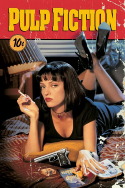
Review of Pulp Fiction (1994) by Blake P — 02 Jul 2015
Quentin Tarantino is a modern cinematic master, but he isn't a Hitchcock, a Spielberg, or a Nolan. Those directors, wonderful as they are, took the normalcies left behind by their filmmaking ancestors and spiced them up, making the familiar suddenly indelible. Tarantino, on the other hand, has never made something familiar to the viewer. His films, though often paying homage to the greatest of the grindhouse and the sturdiest of the studio system, twist anything even resembling an expectation - maybe the plots of Tarantino's films have been portrayed in some way or another before, but don't bet that the dialogue, the actors, the dynamics that fill each scene will match anything you've come to know.
"Pulp Fiction" is his most widely adored film, the one where his notable violent tendencies are kept to a comic minimum, the one where his dialogue never rings offensive and his exchanges glow with the smooth wittiness of yesterday's fools. Situations don't play out with the professional easiness of a square that went to film school: everything feels as though it were washed and dried by a cinematic nut more fond of staying home Friday nights watching Pam Grier kick ass than going out on the town with slightly drunken friends. Even watching a bad movie was better than experiencing the mundanities of life, because bad movies, bad as they were, took them away from the troublesome thing called reality.
And so "Pulp Fiction" is a stew of cinematic wonders, some sexy, some funny, some tragic, some bloody - like the sordid comic books of the same name, there's unrelenting sleazy appeal to be found among the campy ruins. But the film is more than camp: it's parodical noir, thunderously romanticized, delirious in its aesthetical violence. Tarantino doesn't just film his actors, his scenes: he falls in love with them, clinging on to their every move, making even the smallest of a detail, of a character, seem enormous in their connection to the overall buoyant picture. Tiny intricacies, such as the way John Travolta casually corrects Uma Thurman when she refers to all the waitresses at Jack Rabbit Slim's as Marilyn (one is Monroe, yes, but the others are actually schlockily dressed like Mamie Van Doren and Jayne Mansfield), says much about Tarantino's filmmaking personality.
As much as he loves the icons and movies the general public refers to as masterpieces, he can't help himself from putting the underdogs on a pedestal and letting them shine, even if it's for a blink - because "Pulp Fiction" is directed by a cinephile who appreciates everything about cinema, not just the conventional Oscar nymphos. There's something about the film that still seems as dangerous as it did in 1994 - there has always been daring auteurs in the slippery slopes of Hollywood, but exciting is the way that Tarantino pushed, and continues to push, boundaries, making madness seem mainstream, luminous.
Stories intertwine in a fashion reminiscent of 1956's "The Killing", time hopping yet staggering in its ability to complete each other's sentences. "Pulp Fiction" follows an assortment of characters, all connected: assassins Vincent Vega (John Travolta) and Jules Winfield (Samuel L. Jackson), powerful gangster Marsellus Wallace (Ving Rhames), his wife, the chic, cocaine addicted Mia (Uma Thurman), washed up boxer Butch Coolidge (Bruce Willis), and bank robbers Honey Bunny (Amanda Plummer) and Pumpkin (Tim Roth). How they are associated I cannot say (it would ruin the genius of Tarantino's screenplay). But each character, so well drawn and so flawlessly portrayed (the actors are excellent, their characterizations already iconic in some shape or form), is unforgettable.
Look at the way Vincent covers up his lack of smarts with his ability to go from agreeable to brutal in a matter of seconds; how Jules can enjoy the taste of a hamburger while ready to commit a hit because he's too damn used to killing; how Mia can make the mere smoking of a cigarette bolster the same sexy power of Ava Gardner or Louise Brooks; how Butch is willing to risk he and his girlfriend's (Maria de Medeiros) life for a watch passed (with disturbing fervor, I might add) on through generations; how Honey Bunny and Pumpkin don't think about the risks of robbing a restaurant because life is short and sin is fun.
Even the most despicable of characters participate in conversation so complex and blackly hilarious we can hardly help but side with them. Tarantino doesn't just write characters; he lives vicariously through them, as if he kept them locked inside his mind until it became time to write the screenplay. Among the finest scripts ever written, startling is how confident every line is, how well the performers deliver each sentence. "Pulp Fiction" is a near perfect film, and though I prefer "Kill Bill", one can hardly deny the genius of Tarantino. How many directors create worlds as simultaneously grimy, cool, dangerous, humorous, appealing, as he does? If you can name five others, I'll have to take your word for it and revoke mine.
This review of Pulp Fiction (1994) was written by Blake P on 02 Jul 2015.
Pulp Fiction has generally received very positive reviews.
Was this review helpful?