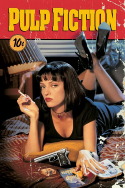
Review of Pulp Fiction (1994) by Rob S — 23 Nov 2015
This film may play with its use of chronology, and it may be episodic, but people generally claim this movie to be great because it is the first to do so. It is certainly not the first film to do either of these things. It is inspired by many films before it, such as Rashomon - which tells the same story from four different perspectives - as well as "My Life to Live," a neorealist film which is told in twelve distinct episodes. However, Pulp Fiction was the first film to play with chronology in this manner in many years, and it is because it does so with great purpose which helps to make it my favorite movie (among various other reasons).
Some complain about this fiddling with chronology to cause confusion, yet the story only goes out of the linear timeline in two spots in the film, and I always found it easy to follow. As for the BIG episodes in the film (the ones Tarantino actually gave titles to) the first two are played in chronological order, and the third episode shown jumps back to a spot before the other two stories. I will not got too in depth with my next comment as it would give too much away if I did, but Tarantino's choice to show Butch Coolidge's story (Bruce Willis) before Jules' story (Samuel L Jackson) has a huge impact on the way the audience views Vincent Vega (John Travolta) by the end of the film. It is this fact combined with the way Jules' story ends that left me mind-blown when I watched this film for the first time.
I understand that in the context of 1994 when this film was released that it was an extremely violent film. If you're still going to complain about the violence in this film today, I would laugh and tell you there is no way you could handle more contemporary films like Mongol, 300, or Gone Girl. Hell, I hope you can make it through Django Unchained, Tarantino's most recent and by far his most violent film to date. What people forget to say about the violence in Pulp Fiction is that most of it actually happens off screen, leaving the violence up to the audience's imagination (maybe this is why people remember it to be more violent than it actually is).
What I realized and loved about this film after watching it for a few times is that the three stories of this film all have a common connection - they deal with loyalty to a father figure, each one more intimate than the last. We have Vincent Vega struggling to be loyal to Marsellus Wallace (the crime boss), we have Butch Coolidge honoring his father, and we have Jules Winnfield rethinking his relationship with God.
Other than the chronology of the film, what is easily the most notable thing about Pulp Fiction is the dialogue. Tarantino has arguably written better scenes after this film (in fact, I agree with his choice of the opening scene of Inglourious Basterds as his favorite thing he has written), but this is the movie by Tarantino that EVERYBODY quotes, especially the famous scene when Jules dominates the conversation about breakfast and what Marsellus Wallace looks like (trust me, even if you haven't seen the movie you've probably heard a friend quoting this scene). Tarantino is a master of dialogue - he writes conversations that people might actually have with each other. The topics may seem random, but that's how real-world conversations work. You discuss events, make analogies, disagree and argue - you don't simply talk about what is going to happen or what has happened, which is unfortunately how a lot of dialogue in film goes. Tarantino always creates distinct and well-developed characters through his use of dialogue.
This movie is a roller coaster of an experience, and it gets my highest rating.
4.0/4.0.
This review of Pulp Fiction (1994) was written by Rob S on 23 Nov 2015.
Pulp Fiction has generally received very positive reviews.
Was this review helpful?