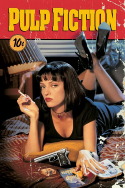
Review of Pulp Fiction (1994) by Mitchell S — 12 Jul 2017
Revolutionary film that practically spawned the 1990s and 2000 era of storytelling. Not only reminded the stuffy movie industry not to take itself so seriously, but also combined absurdist comedy with crime drama, and deep literature with cheese.
In the year 1994, Quentin Tarantino's Pulp Fiction was a trailblazing film, a fiercely independent and pulpy sponge of a motion picture that dared to be different in an industry dominated by clearly defined genre pictures. It's a film that's easy to take for granted now that we have so many postmodern art films of the new age that are conforming to the "unpredictable masterpiece" formula. The fact that Tarantino was underfinanced was God's gift to cinema-in the 1990s, by all logic, this movie should have been cleaned up and turned into a god awful Godfather knock-off or a campy Jim Carrey vehicle so that mainstream audiences could understand it. Pulp Fiction showed us, the audience starved for unpredictable plots, that mainstream movies didn't have to take themselves too seriously and yet they could still tell dramatic story arcs with cheekiness and a wink of self-awareness. Many people misunderstand Pulp Fiction...it's not a thoroughly original masterpiece. It owes much of its style to David Lynch and the Coen Brothers. What makes it amazing and the definitive 1990s films, is that it's a collage of movie genres that don't belong together, and yet are neatly packaged in a pulp noir collection that combines the best and worst fashion of every decade since the 1940s. In every single frame, it has an homage to another motion picture that preceded it. It was an underground comic book come to life and one that somehow snuck to mainstream attention with far too many famous faces to seem real. To me, Pulp Fiction was the celebration of independent filmmaking finally triumphing over studio-created schlock. Miramax backed it and ushered in the age of independent "hits." It was an uncompromised vision brought to the screen, which finally proved the artist more powerful than the studio suits. If Orson Welles had lived to see it, he would obsessively applauded by the end credits, ala his great scene in Citizen Kane.
What I Learned: Definitely helped with the postmodern dramedy format. I was relieved to see the world as Quentin saw it, as I wanted it to be, with an unpredictable narrative, and a very bawdy and audacious sense of humor-even when there were moments of silence. He really helped me to see that no matter what you write, it doesn't have to be dishonest, and yet it doesn't have to conform to set rules. He really helped the Independent Artist to reach a point where he could tell a story without compromising the vision.
This review of Pulp Fiction (1994) was written by Mitchell S on 12 Jul 2017.
Pulp Fiction has generally received very positive reviews.
Was this review helpful?