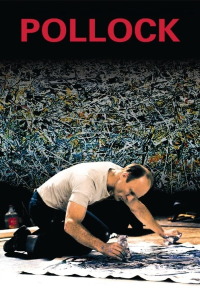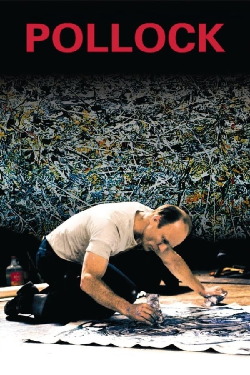
Review of Pollock (2000) by Ty U — 28 Oct 2008
Biopics are a tricky business. Especially when the director/producer/star is a great admirer of the subject of same.
On one extreme, hagiography is possible. On the other, you have a picture that may be accurate as for the life events of the subject, but not especially entertaining as a cinematic work. "Pollock" come far too close to being the latter.
For one, a biopic, as any movie, really should have a plot arc, even if it is a small one. Which is one reason biopics often opt to focus on one even of era in someone's life, hoping to capture the spirit of the person in context to how they handle same. in the cases of Pollock, we have a series of most unconnected vignettes, and repetitive ones at that.
Harris is trying to envoke the whole suffer artist thing here. And believe me, we get that in spades. To the exclusion of almost everything else. One short chapter from when Pollock got drunk and angry. Fade out. Fade up on one of two other things. 1) another snippet of life, wherein Pollock repeats the angry drunk pattern. 2) Relief from that in the form of a scene or two or three, wherein Pollock is actually happy or content with his life. 3) (and there are far too few of these, as they are the best scenes in the movie) vignettes that explore Pollock's creative process, as his signature abstract style comes into being, in stages, over the course of ten years or so.
Not much else happens, and that is one problem with the movie. Yes, we eventually cover different sections of the man's life within the two hours of the film, but they seem to bear little connection to each other. So alike are the "fly on the wall" segments we are exposed to, that aside from age make up, and the set, the could almost be interchanged with one another, without any real damage to the alleged coherence of the story. Makes it difficult to enjoy the experience.
Then, Harris pulls a "Silkwood" on us, and ends the flick with a rather unconvincing and tame looking car accident, with Pollock at the wheel, drunk. Only a last minute subtitle reveals to those not already privy to the information that we just watch Jackson Pollock die.
Not that we much care by this point anyway. The death of the real Pollock was tragic of course, but the death of the character of Pollock in the movie of the same name makes virtually no impression on the audience, unless they are painters, fond of Pollock, or of the suffering artist motiff.
Or, if they are Ed Harris.
This is true not simply because the final shot was poorly executed. It is true because Pollock has no sympathetic qualities, aside from the fact that he is sick. He is violent, angry, misogynistic, and just plane unpleasent. Biopics should at least strive for some sympathy for a flawed protagonist. If this movie does so, I missed it.
The other characters do not fair much better. Pollocks wife, played by Marcia Gay Harden, is a stead fast, long suffering wife of such a maniac. But we don't care.With one exception, the character displays almost zero emotion, as she, very mechanically explains to Pollock, and I suppose, us, that "I verymuch want to keep living with you. But I cannot if...". You get no sense of her love for him or anything...she is just..there, because she refuses to be anywhere else, and there is nothing touching about it. It was one of cinemas coldest love stories ever.
Pollock's signature style was abstract at it's most random. He drizzled, licked, and smeared paint all over canvases, refusing to represent an image of anything in particular. The result was, to the eye, an incoherent, at times sloppy, but certainly unconventional body of work which came from deep withing him.
The movie "Pollock" seems to be the same sort of confusing mess, coming from within the soul of Ed Harris. Theonly different between a Pollock Painting and this film about him is that in the end, the film really is quite conventional in it's presentation of the suffering artist motiff via uninspired, interchangeable vignettes, where cinematography replaces drama and Harris' obsession with the man the impetus for it all.
This review of Pollock (2000) was written by Ty U on 28 Oct 2008.
Pollock has generally received positive reviews.
Was this review helpful?