Review of Pollock (2000) by Chad M — 16 Jan 2009
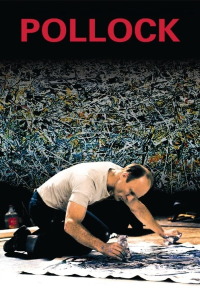
"Pollock" tells the true story of Jackson Pollock, the abstract expressionist painter who dominated the New York art scene post World War II. If the name isn't familiar - the technique in which Pollock painted will certainly refresh your memory. By dripping and splashing his paint onto the canvas, Pollock created immense pictures of what is little more than a series of lines and squiggles. To those outside the art community, you might say that his paintings are what inspired the vague critique of many modern artists: "Anyone could do that". Pollock, regardless, was a visionary - a man who found a complete spiritual release through the activity of painting, and through his innovation became one of the most significant artists of the 20th century. The film, directed, co-produced, and starring Ed Harris, isn't so much a celebration of Pollock's work, but rather a biographical study of Pollock the man. However, although elevated by good performances and direction, "Pollock" isn't ultimately too insightful.
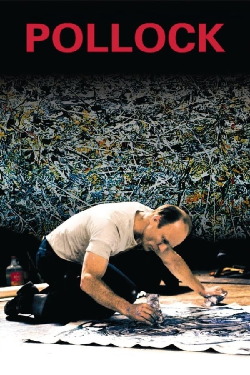
There are scenes in the film, before "Pollock" had found the style that made him famous, where brilliant lighting casts a shadow of Ed Harris onto the sprawling canvas before him. This assures us that the artwork of this picture is Jackson Pollock the man. It also delves into what made these paintings so powerful - what they represented, and the process in which they were created, moreso than the artwork itself. Although beautiful, the real artwork of a Pollock painting is all in how it was done. Ed Harris puts an emphasis on this through beautifully shot scenes of Pollock painting, rather than long critical studies of the form of his work. Painting, to Pollock, was a release, and thus a film about Jackson Pollock should be about the process in which he painted rather than his body of work as a painter.
The film "Pollock" tells the story of the self-destructive Jackson Pollock (Ed Harris) in a rather conventional matter. We meet him early in his career, a lost soul living in a tiny apartment. The bath is just feet away from the kitchen table. His paintings, in the beginning of the film, are abstract pieces that don't yet represent what he would later become famous for. Early in the film, Pollock meets Lee Krasner (Marcia Gay Harden, who won an Oscar for her performance), who would become his wife of 15 years. A fellow painter herself, she sees his potential and eventually brings him to the attention of Peggy Guggenheim (Amy Madigan), an eccentric millionaire art patron. It's when he is asked to paint a mural for Peggy's house that he develops the famous splatter technique, which are beautifully shot in the film. It's easy to forget that you're watching a professional actor, not a professional painter, playing the part of Pollock as Harris puts paint on the canvas confidently with great fluidity.
But, like every biopic, we know that you can't tell the tale about the rise of an artist without the subsequent fall. Although gaining great success, Pollock was a recluse. Living in a secluded country house with his wife, and completing his works in a nearby barn, Pollock had the similar tragic and lonely life of many of history's great artists. He was a drunkard who only found a release in the act of painting. Eventually, his career would be cut short in a drunk driving accident in which he took the life of an innocent girl.
There is a whole lot to like about the film. The performances are vibrant and memorable, and Harris' direction is refined enough to not be overbearing. And as this is perhaps his best work as a director, it is also one of (if not the) best performance of Ed Harris' career. I'd mostly put my criticism on the script. We know from watching the film that Pollock is a tortured artist who makes life hell for all those around him, yet we don't really know why he is that way. While there is a certain mystique about Pollock the man, we're kept an arm's distance from everyone in the film and therefore simply observe rather than involve ourselves in the story. For what is told as a conventional melodrama, the audience was too withheld from the inner psyche of the characters to really relate and sympathize. I liked this film quite a bit, but I would have liked it to expand on Pollock and his wife much further.
This review of Pollock (2000) was written by Chad M on 16 Jan 2009.
Pollock has generally received positive reviews.
Was this review helpful?