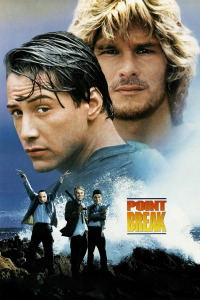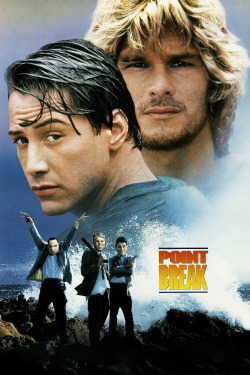
Review of Point Break (1991) by Paul N — 09 Jan 2010
What does it mean to be alive? If we're alive, how do we know it? What sort of life do you choose for yourself in acknowledgement that you're alive?
These are the questions that Point Break purports to deal with on some level, setting it apart from the typical 90's action flicks not by overpowering action, but by characters that, while still two-dimensional, represent larger decisions about what life means.
You've got the straight-laced, by the book, totally-bought-into-the-system option of FBI official Ben Harp (McGinley). He's wrapped up completely in 'the system', and has become a raging jerk in the process. Pappas (Busey) is the unorthodox agent that has never quite fit in and is mocked by all those around him. Yet he retains his unique quirkiness, using the system as much as the system uses him. Clean-cut Johnny Utah (Reeves) is the new guy on the FBI team. Seeking to establish himself in the system while detesting how the system either steals your soul (Harp) or numbs it to the point of pointlessness (Pappas). Tyler (Petty) is on the fringes of the system. She works a job, but that job keeps her close to nature, close to the ocean, and in touch with herself.
Representing two ways of living outside - or even against - the system, are two groups of surfers. There's the 'bad' surfers, those who live outside the system simply for the purpose of living outside the system for their own pleasure. Rude, obnoxious, violent, unpredictable - their lives outside the system are also lives out of sync with nature. They are ravaged by drugs and sex and violence. They represent the wrong way of opting out of the capitalist system, a hedonism and nihilism that is dangerous to themselves as well as others.
Then there are the 'good' surfers. They live outside the system, preferring simpler lives of surfing, friendship, and living on the edge. For them, the point of life is remembering constantly that you're alive by living on the razor edge of life and death. They are adrenaline junkies, traveling the world in search of the best waves, riding the sky as well as the ocean - two vast, untamed reaches of nature where man goes only carefully, and always in full knowledge that both could take his life. These 'good' surfers live in harmony, somewhat. They also happen to be armed bank robbers.
Only one of them is really aware of the deeper implications in how he lives his life and leads his fellow surfers - Bodhi (Swayze). Short for Bodhisattva - the general implication of the name is that this is an enlightened person who seeks his own blessedness as well as the blessedness and enlightenment of those around him. He's not selfish, he's genuinely concerned with those around him reaching their fullest potential.
Bodhi is keyed into balance and harmony in nature. He justifies bank robbery as an act of heroism against 'the system' that crushes and kills the souls of most people. He sees it as part of keeping balance. But in the final equation, it's just a way to live the life he wants to live. While director Kathryn Bigelow may try to soften the criminal life that Bodhi and his buddies lead by having them only rob banks part of the year, and never shooting anyone, it's still a way of life that is completely self-absorbed. Bodhi's buddies demonstrate this clearly, and it's eventually seen with Bodhi at the end of the movie. He'll go to almost any lengths to ensure his own preservation - and on his terms. For all his commitment to non-violence, he's happy to use violence if it preserves his own *personal* harmony and balance, even if it dangerously throws the harmony and balance of others tragically out of whack. He says it perfectly at the films anti-climactic ending - "My whole life has been about this." And what he's referring to is not balance and harmony, but doing what *he* wants. Following *his* dreams.
This is a pretty typical 90's action flick. Bigelow brings a different approach to it than the standard bigger and badder explosion formula so typically used. There's a very enjoyable (if not entirely believable!) foot chase scene. There are some good shots of surfing, but mostly distance shots instead of the closeup stuff you'd get from someone who's main concern was showcasing surfing. The dialog is pretty basic, and Reeves demonstrates here at the start of his career what we've all learned in the 20 years since this film was made - he can't act. Swayze seems perfect in this role, but never really gets to flesh out the character enough. He's a mass of contradictions that ultimately play havoc with the movie's deeper themes.
The film raises some good questions about what it means to be alive. It seems to suggest that a vivid emotionalism and adrenaline-soaked life is the best sort of life, even if that means that you have to break and destroy the lives of others to do so. It hardly strikes the tone of harmony and balance that Bodhi seeks to embody.
The system crushes most people, squeezing the life out of them with vague promises of a retirement that will somehow be different and worth sacrificing the bulk of their life for. But is the answer to balance and harmony actively fighting the system, regardless of whom is hurt in the process? This film doesn't make a very compelling case for that. But there are worse ways to kill a couple of hours.
This review of Point Break (1991) was written by Paul N on 09 Jan 2010.
Point Break has generally received positive reviews.
Was this review helpful?