Review of Poetry (2010) by Robert B — 12 Jul 2012
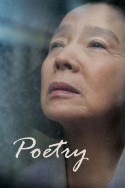
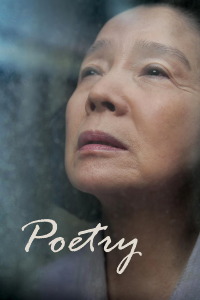
Poetry (Chang-dong Lee, 2010).
Note: the following review could be construed as containing spoilers, despite this not being a movie where the term "spoiler" would have the least bit of relevance. If you don't want to know what happens, don't read on. (But then, if you don't want to know what happens, why are you reading a review?).
The supreme irony of Poetry, the fifth film from novelist Chang-dong Lee (Secret Sunshine, Oasis, et al.), is revealed in a scene about halfway through the film (reprised about three-quarters of the way through). Mija (Jeong-hie Yun, one of the most popular, and beautiful, Korean actresses of the sixties and seventies), our heroine, has been taking a poetry class, and is having trouble finding inspiration. She stumbles into a reading being held by a group called Love Poetry. Suffice to say the poems-which, unlike what you'd expect to find in an American poetry reading, are a mix of original authors' works, recitations of works from famous authors, and members of the audience reading one anothers' work-are atrocious. The notes Mija is jotting down towards the poem she is supposed to write during her class are more poetic than that.
We contrast this with a series of scenes from the class. The teacher, who the students see as a great poet (but we know from the very first flyer where Mija finds out about the class he's far more skilled at self-promotion than poetry, and his every word reinforces this), has asked the students to describe their most beautiful moment. There are three scenes like this, each of them with three of the nine students in the class. The first three are heartfelt, but shallow. When we get to the scene with the second batch, they are also heartfelt, but the stories we're told are a bit more intimate. Then we get to the last batch, and we know these three people are going to throw wide the doors to their souls and let us as deeply in as they can, because that's the way Lee has structured this sequence. And given the juxtaposition of this with the first paragraph, it should not surprise you when I tell you that when we finally get to Mija, the last of the students to speak, what she says is already laced with poetry. Don't get me wrong, all three of the stories in that last bit are well-told. But Lee understands the difference between good storytelling and poetry, and that one is possible without the other. That should be an indicator to you that, given the title of his film, Lee wasn't going to mess around with a movie that's nothing more than good storytelling.
Mija's trip to the poetry classes is not the crux of the story; in fact, it's not even the main thrust. That involves her grandson Wook (Da-Wit Lee in his first screen appearance) and five of the boy's friends. In the movie's opening shot, we see a number of small children playing along the banks of a large river. (Actually, we see much more than this, but I'm abbreviating in the service of brevity; I won't tell you why, but I will tell you to pay close attention to the sequence of shots Lee and cinematographer Hyun Seok Kim use to establish presence in the opening shot. When you get to the point in the movie where you need this info, you'll thank me.) One of them stops, noticing something coming towards him, and then the camera focuses on it; it is the body of a schoolgirl. Some of the audience I saw the film with seemed shocked at this; maybe they hadn't caught the early reviews? In any case, it is established early on that Wook and the five friends he hangs out with were directly responsible for the girl's death, and the actual plot of the film deals with the closest parents to each child-the fathers of the other five boys and Mija, who takes care of Wook after his mother got divorced and moved to the city-and their plans to buy off the mother of the dead girl in order to preserver their sons' futures. This, of course, requires money. And how is a sixty-six-year-old grandmother, whom, we're also told early on, is living on government assistance and the money she brings in from a part-time job as a caretaker to an old man who's suffered a stroke, supposed to come up with her share of the payoff money?
While the movie does have a plot, and I am willing to advance that as a good thing (though not entirely, for reasons we'll get to presently), it's pretty much unnecessary to one's enjoyment of the film, save that the events at the movie's undeniably powerful ending are linked to it. This would have been just as strong a film had it been a simple character study of Mija; her adversarial relationship to Wook (a dullard, a lump, the kind of kid who's far too lazy and stupid to get into any trouble on his own; we find out in the first scene that goes into this in any depth that Wook was, in fact, just a follower), her struggle to learn to write poetry, her interactions with the people she comes into contact with over the course of the story, including her belligerent, helpless charge and the father of one of the other boys involved. (Of that subset of characters, Mija is the only one named; the others are all referred to as [x]'s father. The one to which Mija grows potentially close is Kibum's father [R Point's Nae-sang Ahn, who previously worked with Lee in Oasis].).
And then, on the other hand, we have the plot, which Lee sometimes doesn't quite seem to know what to do with. He drops hints every once in a while about places the plot might go, such as the tentative friendship between Mija and Kibum's father, but none of those relationships ever really go anywhere. To be fair, this is also true of what looks like it could have been a comedic adversarial relationship Mija has with one of the women who lives on her street, so it's not all plot-based. Just most of it. When you reach the film's deliberately-paced climax, you get why Lee structured some of it in the way he did, but that makes it almost more disappointing; all of what you suspected about things that are there simply to advance the plot is correct, instead of those bits being as lively, and lovely, as the others. (Contrast, for example, Bela Tarr, whose characters in Werckmeister Harmonies are perfect little glissandos whether they're integral or not.) Still, when you see how everything falls together, you've got to hand it to Lee; he did some great setup there. This won't be any surprise to anyone who's been paying attention, however; there's nothing in this film that isn't artfully posed. My favorite example: the conversation Mija has with the nameless, blustery hospital official folowed some minutes later with the flowers in the dead girl's mother's courtyard. Especially note we are never told during the film what pink flowers signify.
With everything I said in the last paragraph, I was going to give them film a 3.5; it's excellent, and well worth seeing, but it does have some flaws. And then we got to that final shot, which is so completely amazing that I had to bump it up to four stars. The montage is so perfect that if you haven't read this, you might not even realize it's a montage (and you get bonus points if you figure out what Lee's doing before he gets to the middle shot of the montage). And then... well, that would be telling. I said at the beginning of this review that this is a movie where the word "spoiler" would have little meaning, but there is one exception to that rule, and it's the final shot. I think-I hope-I've given you enough to draw your attention to all the markers you will need to puzzle it out. I don't really understand why I would need to, since to me it was obvious what Lee was up to, but listening to the conversation around me as the audience I saw it with walked out, I was struck by how much was about the ambiguity of the ending, which wasn't ambiguous at all. But like most everything else about that, it doesn't matter. It's so beautifully executed that even if you have no idea what Lee is telling you in that final scene, you still have to marvel at the cinematography. Like the rest of the movie, it is enjoyable simply as a surface ride, but if you feel the need, you can dive into it and examine all the layers of meaning it holds. I would suggest either way of viewing Poetry is equally rewarding. ****.
This review of Poetry (2010) was written by Robert B on 12 Jul 2012.
Poetry has generally received very positive reviews.
Was this review helpful?