Review of Pleasantville (1998) by Blake P — 11 Jan 2014
Every once in a while, after a particularly hectic time in my life, there are moments where I sit back, watch an episode of "I Love Lucy" and just can't help but think to myself: I wish I could trade all of the electronics, all of the stress, and all of the craziness of modern day times, and mold it into what resembles a 1950s, black-and-white sitcom.
If only my friends and I could partake in the same misadventures of Lucy and Ethel. If only I could be married to Lucille Ball and work as a bandleader like Ricky. If only I could wisecrack with pitch-perfect delivery like Fred and get away with it. I'm sure most people, at least once or twice in their lifetime, wishes that their life could only be so simple.
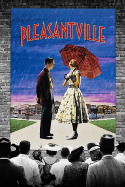
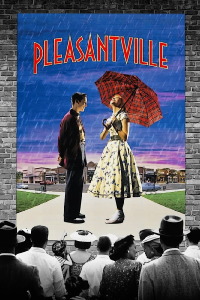
"Pleasantville" is ingenious because it takes this far-away dream and makes it a reality.
The film begins in 1998, and we are introduced to two siblings: David (Tobey Maguire) and Jennifer (Reese Witherspoon). David is shy and without many friends, and his favorite hobby is to sit back on the weekends and watch "Pleasantville", a TV-series that has the sweetness and charm of "Leave It to Beaver" or "The Donna Reed Show." It's an escape from his uneventful life that lacks perpetual optimism.
Jennifer, on the other hand, is confident in herself, maybe even a bit more popular. On one eventful night, the siblings get into a mega-fight over the TV: a "Pleasantville" marathon is occurring at the exact same time as an MTV concert. The twosome end up breaking the remote in a way that could only exist in a movie, and suddenly a quirky repairman (Don Knotts, in a memorable role) shows up at their doorstop. He fixes the TV and gives them a strange remote - which happens to zap them right into "Pleasantville".
The world is literally what is shown on screen - there is no color, sex doesn't exist, every team wins every game, etc. David is in heaven, while Jennifer's scoffing attitude brings in a certain spice that appears in a sort of shock to the creepily perfect fictional town. But the siblings' sudden appearance begins to give new life to the town - and eventually, color.
"Pleasantville" (the film, not the TV-show) works so well because it flawlessly balances satire and the dependable Hollywood formula so well. We're able to get a kick out of the completely G-rated TV-version of the '50s, but it still remains to be thought-provoking. By the end, we realize that, no matter how picturesque and simple a vintage sitcom can be, it is much better to live a life that is unexpected day by day, and full of opportunity.
The film is most definitely a satire, playful poking fun at the cliché characters that live in "Pleasantville" (the TV-show, town), while they sip their Cherry Cokes and eat hamburgers and fries, but there is never a moment of snakiness or wit that leaves us out. In a way, it's a film for everybody, as you can look at it from a sophisticated standpoint and look into the social commentary, or you can watch it simply to be entertained. Either way, you can't lose.
Gary Ross, who makes his directional debut here, balances story and special effects with utter smoothness. Most other directors who had this film in their hands, would rather focus on the look on the film and the sumptuous look of black-and-white combined with splashes of color, but Ross manages to have the cinematography there not as a distraction, but as a pivotal part of the story. Seeing the blandness change into something of a Technicolor dream is a marvel.
"Pleasantville" could be watched again and again and again, and it would still manage to deliver. It has that warming sweetness that most films dream to have, but it's intelligent enough to let us not feel bad about it loving it. A perfect film.
This review of Pleasantville (1998) was written by Blake P on 11 Jan 2014.
Pleasantville has generally received very positive reviews.
Was this review helpful?