Review of Pleasantville (1998) by Adam H — 21 Feb 2011
While Gary Ross has only directed two films, Pleasantville and Seabiscuit, he has written several more. Many of his screenplays deal with the idea of being a "fish out of water," or one who is thrown into a situation which is out of their comfort zone, and they are forced to adapt to the situation as best they can. His first three scripts for the films Big, Mr. Baseball and Dave all deal with this convention in one way or another. In Big an adolescent boy makes a wish to become "big" and transforms into a thirty year-old man. He must adapt to his surroundings to survive in New York society. Mr. Baseball is about a washed-up major leaguer who is traded to a team in Japan. He has to put his ego aside and adapt to unfamiliar Japanese customs. Dave involves a small-time huckster who, due to a series of semi-plausible events, finds himself acting as the President of the United States. After he comes to terms with his position, he starts to use his power for good. All of these films share a common plot device, but also a common theme of growth. Each of these characters learns valuable life lessons as a result of being forced to adapt to an unfamiliar lifestyle. Pleasantville uses a similar convention to set the plot up, but the lessons that are learned are not reserved for merely the protagonist in this case, an entire society is changed as a result. While the protagonist does learn a lesson of sorts, he is the one responsible for changing the newfound culture, not vice versa.
When asked about the overall theme of Pleasantville in an interview, Gary Ross stated, "This movie is about the fact that personal repression gives rise to larger political oppression...That when we're afraid of certain things in ourselves or we're afraid of change, we project those fears on to other things, and a lot of very ugly social situations can develop." Human history certainly gives some credence to this idea, but it is difficult to decipher whether it is the personal repression which gives rise to political oppression or vice versa. More than likely the two have always been intertwined throughout history, but in Pleasantville, the "repressed" citizens who refuse to change, or are frightened by the social changes taking place, take on the characteristics of NAZIs and Soviet Union-era Communists who resort to book burning and perpetrate violence towards those who no longer conform to their set of social values.
Ross presents this change in such black-and-white terms in the film that the result is very transparent. I found myself asking, "Who is Toby Maguire to come into this 1950s society and force his 1990s social norms on everyone?" Ross presents the 1950s as the standard repressed culture that the media has always given us. Just as the ideals expressed in the "Good Wives Guide," the women have subservient and menial roles in the society. Suburban life is a simple and conservative paradise where no evils exist; think Leave it to Beaver and Ozzie and Harriet. Even though the 1950s did not resemble these buttoned down utopias that have been perpetuated by the media for so long, the myth still pervades throughout our culture, so it is easy to take shots at the era. However, Ross seems to think that 1990s culture is far superior to that of the myth of the 1950s. In Ross's utopia of the 1950s, women should be unfaithful to their husbands and masturbate regularly while teenagers should engage in unprotected sex with one another with great frequency. Really, in spite of all of the lofty talk about freedom and self expression, the biggest change in the Pleasantville culture is a sexual revolution. Ross apparently feels that the 1990s norms are vastly superior to the norms of the 1950s. The idea seems rather arrogant, but in the 1990s we have reached perfection because we are all so smart, liberated and free. Certainly those stuffy repressed people of the 50s, what with their faithful marriages and nuclear family units must have it all wrong. In fact, because of their repression and family values, they will commit heinous acts of violence in response to any sort of change.
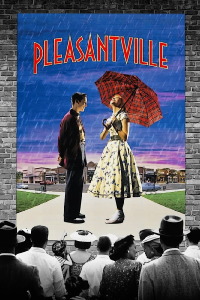
The motif that represents the changes which occur in the characters is a color change. While the characters are still stuffy and repressed, they remain black-and-white. When they become "enlightened," so to speak, they transform into color. What makes each character transform is different and sometimes contradictory and confusing. Most of the teenagers turn colorful when they act on sexual urges. Sometimes it is an idea from a classic novel that does the job. In an ironic and hilarious role reversal, Joan Allen, who plays the mother, learns about orgasms from her daughter. Soon thereafter she pleasures herself and turns colorful. One of the troubling color turns takes place in the courthouse where J.T. Walsh, as the town's mayor, turns colorful as a result of exploding with anger. The repressed black-and-white citizens of Pleasantville had already exerted great amounts of anger and violence, yet that did not turn them colorful. In fact, the violence and anger exhibited by the townspeople was in direct conflict with their previous personas, yet they did not change color as a result of it.
Gary Ross is trying to make deep and important points about the danger of conformity in a society. Too much repression and conformity leads to ungodly political ideals pervading the culture. Repression and conformity create the breeding grounds for Communism to rise. However, in his argument that freedom of expression is the superior path for a society to take, he inadvertently takes shots at morality and family values. This film was released during an era in America where the economy was booming while our president practiced infidelity in the White House. Clearly we could be strong and successful in spite of our lack of values. However, now that our national divorce rate is over 50% and children are growing up in broken families in the greatest numbers in our history, I can't help but wonder whether there was actually some validity to living in a repressed culture where family values were still enforced. It would be nice to find a happy medium between repression and freedom of expression where we could have our cake and eat it too. Regardless, I'm not convinced that Ross presented either culture (90s or 50s) in satisfying enough terms to prove which one is superior, and his presentation is insulting and condescending.
This review of Pleasantville (1998) was written by Adam H on 21 Feb 2011.
Pleasantville has generally received very positive reviews.
Was this review helpful?