Review of Platoon (1986) by Jay R — 22 Feb 2011
1987 Oscar Winner - Best Picture, Best Director.
A war that just begun for the new guys, and wouldn't end for the old guys. It seems that every war film that gets released in Hollywood is famous. Full Metal Jacket, Saving Private Ryan, Apocalypse Now; they all have their mark and are renowned for their directors and their particular views of war. So my excitement for Platoon, the 1987 Oscar Winner for Best Picture, was obvious. Well, Platoon blew all my expectations away as I have yet another war film to add to my masterpieces. Platoon is undoubtedly deserving of Best Picture and takes the disturbing factor of war and the duality of man to new heights.
The film's action is unquestionably intense and disturbing, but it is the character's stakes that really make a serious impact on how important that action is. I think the scene that really cut into my gut was when the platoon invades a village, and it becomes a debate as to whether they should shoot up the village and kill everyone, or not. It a tense decision making process because Sgt. Barnes (the incredible Tom Berenger) is a weak individual with bloodthirsty intentions everywhere. And he has done wrong before, so you really don't know if these people will cross into an uncharted territory of evil and brutality. Even when the soldiers rape a younger Vietnamese woman off screen, broken up by Chris (a career performance from Charlie Sheen), you soon understand that there are no heroes in this war. Only those possesed with the intention to kill something. It's as if they know they are losing, so they kill to feel better. Scary.
Sgt. Elias (the stunning and only real sense of sanity Willem Dafoe) even calls that. In a brief but memorable scene, Elias is staring up at the sky and say "I love the stars, there's no right or wrong, they're just there..." In one line, he sums up what the Vietnam war was about. Everything comes down to right and wrong, period. If it's right we do it, if it's wrong we do not. However, the war causes the characters to lose sense of right and wrong. It becomes about justice, survival and the need to kill something.
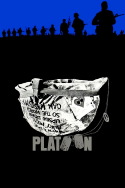
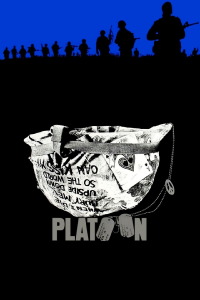
Oliver Stone (who also deservedly won Best Director for this) wrote this film based on his own personal experiences in Vietnam. He shows the frailty of human life and how those in your platoon are constantly threatened. New guys come and go, and the ones who stay, are the ones who are most immoral. This is why Sgt. Elias, the one with the strategy and the brains to beat the enemy is killed. I wouldn't call this a spoiler as his image of death is the iconic image of Platoon everyone knows. This is a dramatic death scene that is pure cinema because of the epic score in the background, the fact he survives so many shots, and when he throws his hands up in the air. That freeze frame of his death is on every single DVD cover of Platoon for a reason, it's the image everyone remembers. He hands thrown up in the air can mean so much. What do you want from me? I give up! Why me? All of those statements are encapsulated within one single shot.
Aside from the obvious message that war is hell, Stone asks us if there was anything good that became of this war. Everyone in this war will never forget how horrific it was, watching their short term friends get blown to pieces, or watching men be destroyed by enemy traps. It's a horror to witness, and Stone sustains the uneasiness throughout. It is uncomfortable when the soldiers are ordered to do the unthinkable. Some relish in it, some grudgingly agree, and some take a stand. And the worst part is, none of these people will probably be around the next week.
The bonding sessions, where the soldiers party and relax, are very short lived. They celebrate as a distraction and as a disillusion that they have a life. They know they are going to die, they accept it. They have absolutely nothing. Rich, poor, white, black, they are all in the same mud, lying next to each other, because their platoon is all they have. As Tyler Durden says, "It is only after we have lost everything, that we are free to do anything". The ones who fight nd die for America are the ones we see as the most flawed. There was no parades, sympathy, or even a simple thank you.
To these people, people died and it was awful. And that is what it meant to them, that is what is important. There are the deep dark themes here, but it is what matters to these men right here, right now. They want to forget what they've seen and can't, just like you probably won't be able to get the soundtrack or images out of your head from this film. Oliver Stone has shown us how the Vietnam war was pure evil. We see a glimpse of that in Sgt. Barnes's red eyes for a brief moment. The evil is hardly ever seen, but it is there. The important thing about Platoon is that it makes you feel like you don't want to be there. Too bad, Stone was there, and he uses the camera to show realistic horror and complete shock. Even the characters are questioned for being there. Charlie Sheen came to Vietnam out of goodness and unselfishness: to serve his country. Well, he's declared insane by his collegues.
Platoon is different and it matters, whether you like it or not. The action scenes appropriately are horrific, relentless and bombastic. Sometimes you can barely hear what the characters are saying over the RPGs and mortal shells. Moral ambiguity overshadow all the characters as choices get tougher and tougher. It's a natural fear to die, but it shouldn't be like this. When Samuel Barber's Adagio for Tears begins to fade in constantly, with the never ending string orchestra, it is only a brief comprehension of what Vietnam was. It was a war we couldn't forget, and a war we would never understand. Lives cost are in the thousands, but even the soldiers who lived lost something to: their innocence.
This review of Platoon (1986) was written by Jay R on 22 Feb 2011.
Platoon has generally received very positive reviews.
Was this review helpful?