Review of Planes, Trains and Automobiles (1987) by Cole P — 19 Nov 2011
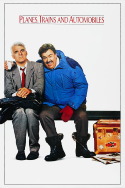
John Hughes wrote, produced, and directed Planes, Trains and Automobiles. Like so many other films in his expansive repertoire (or basket) of 80's films, Planes, Trains, and Automobiles is perhaps one of Hughes's most polished pictures--it has the classical Hugh elements of humor mixed with sporadic situational irony and gut-wrenching, sentimentalism all amid suburban American life. But that isn't to say that the film is typical; its story wildly entertains and its message (depicting loners on the holidays) bears semblance to Billy Wilder's The Apartment.
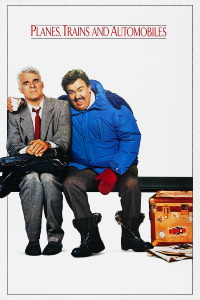
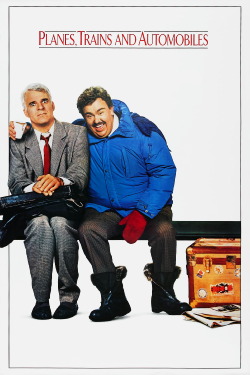
The film immediately picks up with Neil Page (played by a cantankerous Steve Martin) who, two days before Thanksgiving, is caught in heavy Manhattan traffic and misses his 6:00 flight to Chicago. From start to finish, Neil is plagued with bad luck and severe misfortune; he'd earn a medal for condoning Murphy's Law. Actually, so would Hughes for writing. Having written the screenplay, Hughes seemingly managed to capture just about every minute irk and calamity that so often accompanies unfortunate individuals in unfortunate circumstances. We've all been late for a train, or a bus, or late to school--and Neil's journey from Manhattan to Chicago satirizes that realization. The borders are never crossed between what is humorous or too over the top because Hughes expertly establishes the film's tone in the earliest of scenes. It's all incredibly funny as well.
Wrought with unshakable bad luck, Neil is corralled into perhaps his worst dead ringer: a shower-curtain salesman named Del Griffith, played by John Candy. Candy plays Del in a warm, likable way that completely counteracts Neil's irascible mood. It's not only funny but, again, excellent writing that Neil would meet somebody so friendly in a time he least cares. But apart from the jokes and gags and idiosyncrasies of Candy's character, Del is also integral for developing the film's theme--where he embodies the timeless word of advice to "make the best of your situation". Neil just seems to hate everything; Del chuckles gregariously at the circumstances.
The ending of the film (which coincides with the conclusion of their discombobulated journey) is both emotionally depressing and appropriately whimsical. Again, I give credit to Hughes for perfecting his trademark sentimentalism that so often pervades his numerous other films (Breakfast Club, Ferris Bueller, etc.) And Hughes makes good usage of his abundant regulars from Ben Stein to "Grace" the secretary. We even see the Home Alone house featured as Neil's auspicious domicile (this being before the young Macaulay Caulkin could rig it).
Planes, Trains, and Automobiles is a fine film that offers a humorous view on a terrible situation. It makes the assertion that no matter how bad the circumstances, you can always laugh at things when they're said and done.
This review of Planes, Trains and Automobiles (1987) was written by Cole P on 19 Nov 2011.
Planes, Trains and Automobiles has generally received very positive reviews.
Was this review helpful?