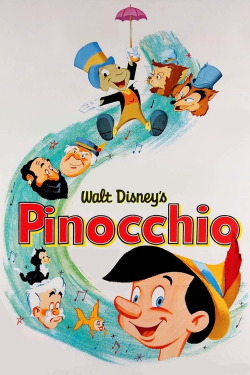
Review of Pinocchio (1940) by Robert A — 05 Aug 2009
It's alive.
Among other things, Walt Disney was a man of positively titanic ambition. By 1940, he had already done enough to be considered the most important pioneer for animation in the world, introducing American audiences to Mickey Mouse, sound cartoons, color cartoons, and even a feature-length film. Because of him, people in the film industry began to think that animation could be something more than a simple trick to please children. Entire legacies rest on accomplishments less impressive than what Disney did in the 30's. But he was far from done. Knowing that animation would soon become a significant film category, he set out to show people how it could be done.
The central challenge in bringing Carlo Collodi's "Pinocchio" to the screen was giving life to the main character. The animators would need to give the puppet personality and emotion while maintaining his woodenness. It's an almost impossible balance, but with the design of Pinocchio's joints, hair, and of course his nose, they pulled it off. In so doing they displayed, on two different levels, the fundamental nature of animation. The Blue Fairy in the story is herself an animator, bestowing movement and life on what had been inert. Disney's goal for the entire film was to make an even more exciting illusion of life than had been seen in "Snow White." He employed new techniques to add realistic depth and effects to the film. The illusion of three dimensions is particularly impressive when compared with his first feature. So many things are being done for the first time here--from the overall complexity of the story, to the realism of the underwater scenes, to the sheer overwhelming size of Monstro--that watching the film creates a sense of exhilaration even today.
That exhilaration is matched by a fearsome sense of morality. "Pinocchio" is a fable about the dangers of the world around us, especially the danger of temptation, which begins in our own hearts. The statements this film makes about evil and moral obligation reduce countless other animated films to laughable triteness. For example, the movie's most famous scene creates the perfect, unforgettable image of the consequences of lying, hammering home the message for all time. Most terrifying of all, for me, is the scene on Pleasure Island, as Lampwick utters the primal sounds of horror and guilt that suddenly morph into the braying of a donkey. These are the sounds of hell itself: a person dragged away to inhuman suffering because he threw his life away and is full of remorse now that it's too late. It's the kind of thing that sticks with you forever because you see it as a child. I believe for that reason it's one of the most powerful scenes ever filmed. You might say this movie scares you into doing the right thing, but it only does so by lifting the veil from evil's face, in brutally realized metaphorical images.
The underlying theme throughout "Pinocchio" is growing up. Children feel the need to prove they belong in the world of adults, and learning morality, ethics, and etiquette as they grow older allows them to do so. Pinocchio himself must accomplish a great deal of growing up in a very short time. He learns to spot potentially bad influences, to tell the truth, to help people, and to be brave as few of us are ever asked to be. It's just possible he learns more from direct experience than he would have if he ever made it to school.
Still a wonder to behold, "Pinocchio" remains one of the most piercing explorations of human nature ever drawn. It also contains delicate and intelligent humor, and an assortment of memorable animated characters (even the ones who don't speak). And that song. If there was nothing else, this film would be important for introducing us to a beautiful song, its lilting magic summing up the Disney legacy in its entirety. Walt Disney still wasn't finished, but this feature-length film might be his greatest single accomplishment. He brought that puppet to life, and placed him in a world of mind-blowing imagination--a world where purity and courage win the day; where a boy can come of age knowing he has lost nothing of the enchantment and danger of life, and has gained freedom and the feeling that he truly belongs with the people he loves.
This review of Pinocchio (1940) was written by Robert A on 05 Aug 2009.
Pinocchio has generally received very positive reviews.
Was this review helpful?