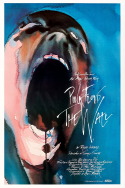
Review of Pink Floyd: The Wall (1982) by Jenna D — 18 Dec 2010
The pain, the torture, the suffering, the entrapment, the phobia, lust, love, hunger, war, starvation, loneliness, life, death, sin, infections of the poisons arising from the pits of humanity... built in a wall. Pink Floyd's masterpiece album could not practically be made any more accurately for the cinema as Alan Parker meticulously captured the album's nature of personal suffering expressionism set amongst an existential backdrop.
Pink (Bob Geldof) is a young man warped by the many oppressions we all face individually, reflecting upon the reasoning for feeling the personal enslavement he feels. Stuck in front of a TV - a perfect allegory for ever-growing societal zombiism - Pink's mind remains in a state of mutilation, lacking progress and dwindling in thought. But it's not totally psychotic thought; these thoughts are familiar. Paranoid feelings. The anxiety caused by a cheating wife and the longing for the comfort of a mother; these thoughts are intertwined, as are many such bold concepts.
There's an expression of evolution in here, making the film a modern prophecy 28 years after its release. It shows the fear in a young man of where people have come and where people are going; much of that fear today has been realized. But it also expresses how that evolution happens. "Empty Spaces" might be one of the most intriguing pieces of animation I've ever seen to exemplify these concepts. In the animation, a metaphorical mating of flowers, unconscious of their physical attraction and more prone to the instinct of seeding, warps into an ever-evolving evil that eventually grows into a flying dragon. The dragon flys away and the wall begins to construct, enclosing a sea of faceless society inside of it.
General audiences may be afraid to explore this very personal film, but a respectful understanding of it will not inhibit the viewer as much as it will help the viewer regain a solid self-comprehension of subconscious feelings. I believe as a tool of such exploration this is one of the most important contributions to the cinematic archives, for without it we are given one film less that exemplifies bold truth.
This review of Pink Floyd: The Wall (1982) was written by Jenna D on 18 Dec 2010.
Pink Floyd: The Wall has generally received very positive reviews.
Was this review helpful?