Review of Pink Floyd: The Wall (1982) by Daniel M — 23 Feb 2010
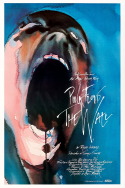
Pink Floyd -- The Wall does something which very few musicals can do -- it can really, really scare you. Discounting Sweeney Todd and The Rocky Horror Picture Show (which scare in completely different ways), it is the only musical film I have ever come across which is closer to horror than family-friendly entertainment. It's a chilling, heady, terrifying mix of war, politics, sex and self-loathing, all drawn together by the powerful combination of Pink Floyd's music and Alan Parker's direction.
Filmmakers who learnt their trade making adverts are noted for their versatility, particularly in their ability to take any subject matter and turn it into a unique artistic vision. Like his contemporary Ridley Scott, Parker is a stunning visual artist with an eye for colour and composition, who understands how much can be said by an image. There is almost no dialogue in Pink Floyd -- The Wall, and there doesn't really need to be, because the images that Parker creates are so rich and multi-layered that they don't need the actors to fill in the blanks by talking.
On a purely visual level, Pink Floyd -- The Wall is fantastic. Parker beautifully captures the pale blues and khaki of WWII Britain, and then injects it with deep bloody reds and stark, haunting black as the fears and nightmares of Pink begin to unfold. The visual sensibility of the film, and the style in which it is put together, is reminiscent of Dario Argento's Suspiria, which is similarly graphic and yet wonderful to behold. The entire 'Thin Ice' sequence, in which Bob Geldof begins to drown in a pool which slowly turns to blood, is straight out of Argento; the visuals hypnotise you in such a way that the most graphic and gruesome scenes are also the most beautiful.
Because the film is so visually stunning, it is tempting to view it as a triumph of style over substance, like the later works of Brian De Palma. It is definitely the case that the film is not a literal or straightforward adaptation of Pink Floyd's rock opera, preferring instead to be a collection of surrealistic images which coalesce into a confusing but captivating character study. If you're a purist of the album, you'll find yourself frustrated by songs appearing in the wrong order and stopping halfway through. On the other hand, if you're not a Floyd fan at all, you'll just be a little confused and wondering where all this is leading.
However, this approach actually aids the film as a complete piece, even if individual scenes fall short along the way. By having the film jumping around in time, it allows us to see Pink's psychological collapse as something homogenous and deeply ingrained. If the film had been strictly linear, it would have felt like a series of contrived explorations of social excesses, making Pink's transformation seem less believable. But by cutting back and forth between Pink's past experiences and his current state in the locked hotel room, we gain a more layered understanding of the madness of the character, and share in his profound sense of alienation.
Despite this device paying off, the film does feel at points like it is pulling in different directions. Because of the production battles between Parker and Waters, and between Waters and the rest of the band, certain sections feel like an underwhelming compromise to keep things moving forward. The fascist rally in the final third is beautifully shot, but is spoiled by some bad choreography which just looks like... well, bad choreography. There are several annoying inconsistencies which remain overlooked. For instance, why does Bob Geldof only sing a few of the songs, and the rest are done by Roger Waters? If they're meant to be the same character, why not have the same person doing all the lines? The film would have had a better thread and point of focus if one of the two (probably Geldof) had stepped aside.
For all the striking images that Parker puts on screen, the best sections of the film are Gerald Scarfe's terrifying animations. Scarfe has always had an eye for the macabre, and never pulls his punches. The best of these include the famous marching hammers, which pop up in 'Waiting For The Worms'; the entire of 'Empty Spaces', with the Freudian flowers and the man transforming into a gun; and the whole of 'Goodbye Blue Sky', in which a dove is torn open to reveal a dark eagle and the Union Jack disintegrates into a bleeding cross. All of these images stick in your mind both because they are striking and because they tap into the heart of the story; they reflect the sense of disaffection and loss which runs through the whole project.
Alienation is at the heart of The Wall, both as an album and a film; both are about the walls we build between each other to keep us safe, but which end up driving us insane. Compare the opening shots, of the hotel corridor and Pink slumped in his chair, with the action surrounding the first number. Whereas the latter is frenetic and graphic, the former is creepy and chilling. The opening scenes seem slow on first viewing, but they do a good job of establishing just how distant Pink is from all other human activity. The shot of the cigarette burned right down to the knuckles is a clear indication of what kind of burnt-out shell we are dealing with.
Throughout the film there are subsequent references to this distance Pink feels, from his loneliness in the park as a child to the way he ignores his girlfriend as she strips in front of him. This self-imposed isolation comes back to haunt him, to the point at which he eventually snaps and puts himself on trial. Much like the album, the ending is left ambiguous as to whether or not Pink has survived the experience of tearing down the wall. Considering the prolonged scream (done by Waters), it seems to suggest that Pink is dead, but the images that follow of the young boys in the rubble hint at a more optimistic outcome, if not for Pink, then for the rest of us behind our respective walls.
Pink Floyd -- The Wall is not a perfect film by any means. The little inconsistencies in the storytelling and the nature by which the ideas are explored can seem alienating on first viewing, particularly to people who aren't fans of the Floyd. But as a tonal piece, about isolation, distance and madness, it is a very fine achievement indeed. Nearly thirty years on it never fails to chill you, and it clearly rewards repeat viewing. Its relentless and uncompromising style work to its advantage to create a highly memorable experience, for better or worse. Most of all, it manages somehow to do justice to one of the greatest albums in the history of rock and roll.
This review of Pink Floyd: The Wall (1982) was written by Daniel M on 23 Feb 2010.
Pink Floyd: The Wall has generally received very positive reviews.
Was this review helpful?