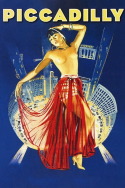
Review of Piccadilly (1929) by Irvin C — 16 Jun 2013
An Even Larger Career Impediment Than Just Being a Woman.
It's strangely disheartening to me to discover that people think Anna May Wong was buried in an unmarked grave. It's true that she isn't buried under the name "Anna May Wong." She was buried under the name Wong Liu Tsong, her birth name. She wasn't considered for the lead role in [i]The Good Earth[/i], a role she wanted a great deal. Instead, the actress cast was German-born (and still alive, at 103!) Luise Rainer. I have often lamented the careers of women who got their start in the pre-Code days and were then hampered by the fact that the roles at which they excelled were no longer available to them. However, it was much worse for actresses like Wong. Take the problems with being a woman at a time when women's roles weren't great and combine them with the problems of being any ethnicity other than white at a time when even Chinese and Japanese characters were usually played by white actors.
Large amounts of the plot are unnecessarily complicated. In short, however, Shosho (Wong) is a dishwasher at a London nightclub. She dances for the rest of the staff; it gets her fired, because she is distracting them from their work. Nightclub dancer Vic (Cyril Ritchard) quits, because he's planning to go off to Hollywood, and it turns out that he was the main draw for the audience, not conceited Mabel (Gilda Gray). Mabel, it's worth noting, who rejected Vic for nightclub owner Wilmot (Jameson Thomas). Wilmot rehires Shosho, this time as a dancer, and she's a huge hit. Mabel is furiously jealous. Also jealous is Shosho's boyfriend, Jim (King Hou Chang). Which is fair enough, because Shosho and Wilmot fall for one another, and Mabel and Jim are both pretty upset about it. There are all sorts of unhappy confrontations back and forth among the various characters, but it doesn't take a genius to work out that things aren't going to end well for Shosho.
Because, you know, Asian woman. While pre-Code only technically refers to talkies, it is true that Hollywood movies were basically unregulated at the time--and this was British and therefore not actually subject to the Code anyway. However, one of the problems in Wong's career was that audiences weren't in general comfortable with watching Wong in romantic relationships with white actors. Even if there had been much in the way of Asian actors (because it still counted as "miscegenation" if they were playing Asians!), they apparently showed her basically no respect. She didn't want to put up with it, and she shouldn't have had to. Then again, who did that leave for her to act opposite? She was hampered in her role opportunities because of the limits on whom she'd be allowed to share the screen with. This may be why I'm not sure I've ever actually seen a movie with her in it before. She had limited opportunities, and she knew it. How could she not?
It's also a bit of a stereotypical Chinese thing going. When Shosho sends Wilmot to buy her a costume, she tells him that the only place to go is a place with the helpful name of "Chinese Restaurant." In what I'm reasonably sure is the London Chinatown, though I admit I'm not all that familiar with London's ethnic divisions. And you know, I'm fine with her sending a little business to the people she cares about; I think the owner of Chinese Restaurant is Jim's uncle, and she still is in a relationship with Jim at that point in the story. However, there's some weird corruption going there. Not on Shosho's side, but on the uncle's, I guess. He just gives off a weird vibe that I can't put my finger on. Maybe it's because he's a silent movie Chinese character. While the roles for female characters were limited, at least they weren't all supposed to be sleazy, and pretty much all the male ones were. Even the so-called heroes had something a little unpleasant to them.
Probably the most ironic moment in the movie is when a couple of people are dancing in a club that is, shall we say, not quite so exclusive as Wilmot's. And they get yelled at, because the woman is white and the man is black. And they don't allow that kind of thing at his club. I have no doubt that Anna May Wong herself spotted the irony, because how could she not? It's okay that Shosho dances for the white people, and it's even okay if Wilmot shows interest in her, though we all know it won't end well. But it's different when it's a Chinese woman and a white man, after all. That isn't threatening (except to Mabel, of course). The social order remains as it was, the more so given the ending of the movie. But if a Chinese man had been the one to make a sensation with a white woman, that would have been considerably more shocking. Unfortunately, that's still true even today; how often do you see Jet Li have a white woman as his romantic lead? Then again, at least Jet Li still has a career, even if it's just making [i]Expendables[/i] movies.
This review of Piccadilly (1929) was written by Irvin C on 16 Jun 2013.
Piccadilly has generally received positive reviews.
Was this review helpful?