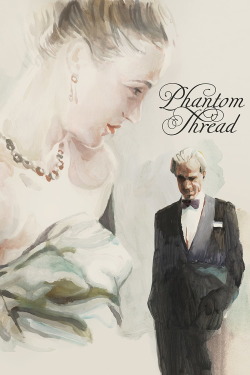
Review of Phantom Thread (2017) by Pipec — 05 May 2018
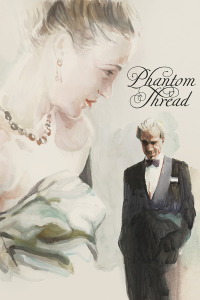
Shockingly exquisite and overwhelming piece of art crafted by high-fashion maestros. His newest piece of art, which aspired to six Oscars without any surprises, wickedly slips through the 1950's day-to-day characters of Daniel Day-Lewis, Vicky Krieps, and Lesley Manville: a close-minded designer, his faithful and inseparable sister-assistant and his new wife and muse. What the director and screenwriter — two in one — communicates through the aesthetics of his storytelling comprises more than a mind can get caught in one fell swoop, as it displays a dazzling commentary about loving relationships and how they can destroy each other or construct each other. As expected, the only thing our characters will swim against the tide, creating an inhabitable environment where subjugation, confrontations, and madness build a fatality barrier. The story never gets caught in muddy matters as giving a vengeful and righteous attitude to the unsubmissive lady, giving her a voice to express what goes through her mind, to express how the relationship is getting her to fly off the handle and in the end, inexplicably, how it manages to transform her. It's time to say goodbye, Daniel Day-Lewis has bestowed one of the most forceful, intoxicating and electrifying interpretations of his career for his fervent followers, the definitive show of one of the real egregious artists of the last century. Well-spoken Woodcock is who concludes his filmography, the designer by which the British actor had to undergo a hard preparation process in order to portray with honesty and truthfulness the unspoken pain and personal demand of a man who can only fall in love with his threads. It was a huge surprise to hear about the nomination the Academy gave Lesley Manville thanks to her role as the nosy and demurely envious Cyril, a character that, although is important for the development of the central conflict and shows the unspeakable talent of the actress, never gets to stay the necessary time on screen to justify tremendous recognition. Perhaps, the truly inexplicable thing is that, even if she performs a restrained and applaudable work, the real laurels and props should go to Vicky Krieps, because it's such the scope of her interpretation that the scenes in which both ladies share screen are pure fire. Turning to the matter in hand, Krieps is the absolute femme-fatale of the film. Her powerhouse performance is rebellious and caustic, emotional and fun when she should, never melodramatic; each line of the screenplay comes out delicately from her mouth, using as means a character who doesn't want to lose freedom at the expense of an unsolicited recognition and toxic love.
And of course, the visual section leaves anyone speechless. A close-up, the camera slowly moves away from Alma's face, who, tranquil, narrates how unconditional and true was her love for the designer. Having as a background an incandescent bonfire coloring her skin of a crackling orange lost in blackness, it's how opens one of the most aesthetic and brilliantly crafted movies I have seen on the big screen. Obviously, it's primarily Mark Tildesley's production design that jumps out at you, which facilitates the staging of a discredited cinematographer who, without expecting, turns out to be the one who directs and writes, a man who truly put, soul, mind and heart to a memorable work. The colors of the landscapes, the textures of the dresses, the coincidence of the elements and the setting allow the construction of scenes that now are in my mind, without intention of leaving. Among the endless delicacy of vintage beauties, There are specifically two with which I'll remember the film: the first défilé de mode in which Alma models a gorgeous dress, a phenomenal and impossible to improve moment; and Woodcock looking for his wife at the New Year's Party, the fall of the multicolored balloons is a feat and an artistic gift full of love for cinema.
Shockingly beautiful, interestingly touching and caustically moralizing, "Phantom Thread" by Paul Thomas Anderson is an intense trip through the damaging relationship of two human beings consumed by hate and love, a story which you will only be willing to enjoy if you know the characteristics and constraints of the works from this warhorse. Laying on the table again the importance of women at any time, age and context, the film acts as a treatment to current global issues such as love martyrdoms, marital conflicts, abuse and human reaches. With an invaluable interpretation of Vicky Krieps and an emotional and sublime farewell to acting of a giant, the film benefits from the onerous and elegant high-class visuals and a passive-aggressive narrative to deliver an absorbing story, with dimensions of perfectionism as exquisite as those of the protagonist, with whom, from a personal point of view, the director/writer raises a representation of his own story; his films are the refined, detailed and tantalizing dresses.
This review of Phantom Thread (2017) was written by Pipec on 05 May 2018.
Phantom Thread has generally received very positive reviews.
Was this review helpful?