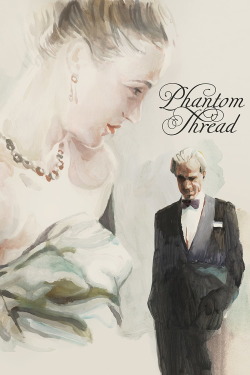
Review of Phantom Thread (2017) by Teddy F — 28 Jan 2018
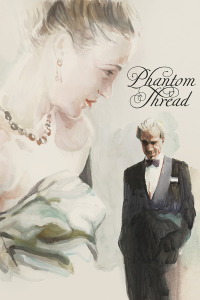
A subtle piece of art, Paul Thomas Anderson's Phantom Thread delivers as a proper send off to Daniel Day-Lewis' sensational career.
Daniel Day-Lewis is excellent as Reynolds Woodcock, a renowned dressmaker and "confirmed bachelor". DDL convincingly depicts a master at his craft, the way his character goes about creating dresses and measuring models are authentic; you truly do believe this man is the genius behind the dresses displayed throughout the film. Beyond just the simple acts of putting pins in your mouth and properly using a measuring tape, Daniel Day-Lewis also effectively captures the obsessive and meticulous nature of his work; he takes lots of pride in his dresses and will let it be known if he feels disrespected by how it is being worn or treated. While not the most pleasant of people, he is at least sincere. Not a man of many words, Day-Lewis counteracts his overall soft-spoken temperament with extreme irritability. Without ever getting overly loud, Daniel Day-Lewis finds a way to be intimidating and establish his dominance in a subtle manner. What really elevated his performance, however, had nothing to do with dialogue at all. His small movements, gentle smiles, and cold stares help establish Mr. Woodcock as a character of his own, and as a genuine person. Superbly played by Vicky Krieps, Alma, a younger waitress who falls in love with Reynolds, serves as a perfect foil to Day-Lewis; she brings the best and worst out of him. Similar to Daniel Day-Lewis, the impressive nature of Krieps' performance stems more so from her physical acting than anything else. While her delivery of dialogue is very good, and her ability to match Day-Lewis' level of intensity is fantastic, it is the way that she looks at people and at the environment she has put herself in that catches your eye the most. You can never quite tell what she is thinking or how she is feeling, and this leads to her character's wonderfully done unpredictability. In Phantom Thread, Day-Lewis and Krieps clash in one of the most intriguing on-screen relationships of the past year. Lesley Manville also deserves credit for her work as Cyril, Woodcock's sister who looks out for him and serves as the key administrator behind both his work and life. You can see her caring attitude towards her brother intermingle with her frustration with him, as they display an authentic sibling-relationship.
While one may go in expecting a film largely about dressmaking and fashion, Phantom Thread actually comes out to be more of a film about toxic relationships and the struggle partners have in establishing their dominance. The film's darker themes end up lending to its more somber tone, but also make it be more suspenseful. Between Johnny Greenwood's score, which feels overpowering early on but blends much smoother later on and enhances some scenes greatly, and the overall drawn-out pacing, Phantom Thread is able to effectively construe these themes to the audience. With the primary focus of the film being centered around the relationship that develops between Reynolds and Alma, the relationship not only must be feasible but must be interesting. Without interest in the two characters and their interaction with one another, the film would fall apart. Fortunately, Paul Thomas Anderson is able to expertly manipulate the emotions of the audience and invest them into the two characters. Throughout the film, I experienced a constant swaying of my sympathy from one side to the other. One second you feel bad for Reynolds and then before you know it, he says something demeaning and you feel bad for whoever is on the opposite end of that comment, most often Alma. But, without spoiling anything, Alma is not entirely innocent either and sometimes you'll find yourself rooting against her albeit rare. The film captivates your interest because you can never settle on a feeling towards it or something within it, and in every scene, whether subtle or dramatic, your opinion shifts at least a little. It does not take long before you become invested in Reynolds and Alma and their relationship. The writing is also brilliant, with more than a few memorable lines.
Now, let's talk about the dresses. Phantom Thread is set in 1950s high-society London, and this setting is beautifully brought to life. The interior set designs throughout the film are exquisite, especially at a massive New Year's party scene in the latter half of the movie. There is so much attention paid to detail, whether on a table for Breakfast or at a fancy restaurant. The costume design done by Mark Bridges, however, is what tops off the cake. The dresses are all so unique and lively, the simple tuxedos are dapper, and even Reynolds' casual wear is stylish; the costume design in the film should serve as a dream come true for those highly interested in the elegant fashion of post-war London.
Where Phantom Thread gets off, is in its presentation of its message. It is possible that the film is so subtle that what it is trying to say becomes blurred. I commend Phantom Thread for its reliance on the audience to put pieces together, but when the pieces are put together, I'm not so sure of what I'm looking at as a whole. The ending also felt prolonged, as nearly half-an-hour give or take before the actual ending, I sensed credits. Where you think the film might end, Phantom Thread decides to keep going, which ended up changing a would have been satisfying and not entirely predictable ending, to something much more unconventional. The ending does not bother me, it may you, and it certainly was surprising, but I can't say I loved it. It makes you question the characters, and not in a good way, as you wonder if their actions stayed true to their characters. I think introducing more backstory to Alma could have helped this. The reason for making this film is unclear. The reasons for seeing Phantom Thread are there, it being supposedly Daniel Day-Lewis's final performance, the wonderful production design, and to hear Paul Thomas Anderson's writing, but what constituted Phantom Thread's creation is beyond me. In the end, the film is quite a journey and would be taxing to sit through? again anytime soon, but is still produced at such an excellent level, and is so well written and acted, that you would be doing yourself a favor by giving Phantom Thread a chance. Of course, this is far from a film for everyone. There are few loud and super dramatic scenes and not much action to go with it, so I wouldn't recommend this film to people who don't like movies that require patience.
This review of Phantom Thread (2017) was written by Teddy F on 28 Jan 2018.
Phantom Thread has generally received very positive reviews.
Was this review helpful?