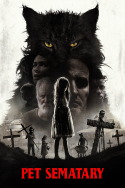
Review of Pet Sematary (2019) by Bertaut1 — 10 Apr 2019
Not bad, but not a patch on the book, and the new ending is awful.
In Stephen King's celebrated oeuvre, his 1983 novel Pet Sematary (the misspelling is intentional) is something of a curio. Although reasonably well received at the time, critics have never considered it worthy of the kind of attention lavished on work such as The Shining, The Stand, The Dark Tower series, It, Misery, or The Green Mile. Fans of King, however, have long championed it as one of his most emotionally devastating and philosophically complex works, whilst King himself considers it the scariest novel he's ever written. And although on the surface, the plot is as schlocky as they come, buried underneath is an examination of grief and how it can compromise one's ability to act rationally.
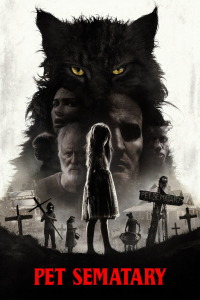
Written by Jeff Buhler, from an initial script by Matt Greenberg, and directed by Kevin Kölsch and Dennis Widmyer, for me, much like It (2017), Pet Sematary doesn't really work. It's certainly better that Mary Lambert's 1989 filmic adaptation, but it pales in comparison to the novel. Granted, most films suffer when compared to a source text, but Pet Sematary, which relies far too heavily on jump scares, is especially disappointing in this sense insofar as it starts off very strongly, taking care to respectfully modernise the novel's themes and examine the characters' underlying emotions, before descending into absolute stupidity in the last act.
Dr. Louis Creed (Jason Clarke) and his wife Rachel (Amy Seimetz), their eight-year-old daughter Ellie (Jete Laurence), three-year-old son Gage (Hugo and Lucas Lavoie), and Ellie's beloved cat, Church relocate from Boston to Ludlow, Maine. When Church is found dead, the Creeds' neighbour, Jud Crandall (John Lithgow), shows Louis an ancient Mi'kmaq burial ground in the forest, with the power to resurrect the dead. After burying Church, Louis is stunned when the cat returns, albeit far more aggressive than he used to be. However, when a horrific tragedy befalls the family, Jud warns Louis not to return to the site. Louis, however, has no intention of heeding that warning.
The big change in the film is that it's Ellie and not Gage who is killed, and whom Louis decides to bring back. However, King himself approved the change, and personally, I think it improves the story - as in the novel, it's Ellie with whom Louis and Rachel have portentous conversations about what happens after we die, and having her be the one killed establishes a more coherent thematic through-line.
Much like the novel, the film is primarily focused on grief, and how it drives him to do something unspeakable. He's a man of science, who clashes with Rachel about what to tell Ellie regarding death - she wants to talk about an afterlife, he wants to focus on the finality of death as something natural. This is a smart choice by King, as Louis becomes the one who refuses to let death have the final word, with his conscious mind unable to accept the random tragedy that has befallen him.
And for about two-thirds of the runtime, the film deals reasonably convincingly with these issues. At least up to the point when it seems to forget about them entirely, as the third act descends into a ridiculously campy series of murders, attempted murders, and all round violence.
The last half-hour or so is as superficial and immature as anything in any King adaptation, and the new "twist" ending completely undercuts both King's original themes, and how well the film itself had handled those themes earlier on. I've no problem with filmmakers altering the end of a literary adaptation; the finale of Frank Darabont's The Mist (2007), for example, is completely different from King's novel, but it replicates the spirit of the original. The whole point of the end of Pet Sematary, however, is that Louis learns nothing from his experience with Gage. The tragedy is that, lost in madness and despair, he repeats his mistakes. The end of the film has none of this, with the final shot more of a silly "dun-dun-duuuun" moment.
The film also leaves out almost all of the backstory and mythology of the burial ground and the role of the Wendigo (an evil necromantic spirit from Algonquin folklore); Louis sees a picture of it in a book, but it's unnamed, and later, he thinks he sees something in the distance of the fog-shrouded forest, but that's as close as we ever get to it.
As a novel, Pet Sematary is a study of grief and childhood trauma first, a horror narrative second. Investigating our psychological reaction to death, the book probes how far we might go to ensure a loved one never leaves us. As a film, Pet Sematary seems to be charting a similar course, until it abandons this tack in favour of a shock-for-shock's sake ending. With an over-reliance on predictable jump scares, ultimately, what could have been a mature and emotionally affecting story gives in to the worst excesses of the genre.
This review of Pet Sematary (2019) was written by Bertaut1 on 10 Apr 2019.
Pet Sematary has generally received positive reviews.
Was this review helpful?