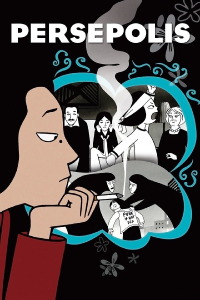
Review of Persepolis (2007) by Tim M — 26 Apr 2010
Based on director Marjane Satrapi's own graphic novel, Persepolis bulges out of the screen with style and wit that scream with originality and heart, making it an epochal work, in addition to being an immensely enjoyable, creatively unparalleled one. And the DVD accentuates its element of grandeur by meticulously documenting how difficult it was to perpetuate cinematically.
An autobiographical account of Satrapi's life leading up to her early-twenties, this film depicts the dawdling growth of its protagonist, her family, and their Central Eurasian country of Iran during the time of the Islamic Revolution, whereupon women were forced to wear veils to cover their heads and countless citizens were taken captive for no lesser reason than to force upon their country oppression.
Marjane is a rowdy 9-year-old Iranian girl, whose parents' desire for political change is shared by Marjane's uncle, Anouche, a Communist leader against the dictatorship of Iran's monarch, the Shah, whose rule would cease in 1979 and later be replaced by a republic. After being freed from prison in the early '70s, Anouche visits Marjane's parents and later obliges Marjane's eager wish to hear all about his political activism -- he tells her of the proletariat for which he fought and a period in which he fled Iran for Moscow, where he studied for self-betterment. Yet, sooner than later, Islamic fundamentalists arrest him and sentence him to death. Devastated by the news, Marjane's only source of solace comes when Anouche chooses her to appear as the single prison visitor he is granted before his execution.
Over the years, that minimal feeling of comfort outlines everything in her life, leading her into a rebellious rage that amounts to her public insubordination of the Islamic regime's laws -- she frequently takes off her veil or replaces it with a headscarf; she wears Adidas rather than that which is allowed; and she sports a leather jacket with "Punk Is Not Ded" embroidered on the back. In addition to her outlandish individual behavior, Marjane develops an ear for "insurgent" music from bands such as The Bee Gees and, eventually, Iron Maiden (which wonderfully caps a truly memorable set of scenes).
When the danger of the Iran/Iraq war reaches alarming heights, Marjane is sent to Vienna from Tehran, where she had been schooling. As a teenage Iranian girl in Austria, she becomes the target for much racial intolerance, which slowly chips away at the slight comfort she felt when she last saw her uncle, Anouche. Feeling rejected by her peers, her government, and even her parents, Marjane builds friendships with a rough crowd that spends its nights at underground metal concerts and advocates anomalous, if not completely absent, social values.
She quickly realizes that her place is not with the crowd that she'd been a part of, and returns to Iran to start over with the support of her family right next to her. She builds and strengthens her relationship with her parents and, more noticeably, her grandmother, a sweet, chipper, free spirit whom Marjane looks to for direction and tranquility. Despite having suffered a few disastrous love relationships, Marjane, now out of her teenage years, falls in love with a man whom she marries quickly. As that marriage snowballs into staleness (as would only be appropriate for the film's continuity), it is again her grandmother who is there above all else, advising her to make a mature decision regarding the outcome of her and her husband's marriage as an independent woman with integrity. She does; and, as long as it took, Marjane finds herself and finds happiness, ironically through a string of tragic events that culminate with the death of her grandmother and a plane trip to France.
With the help of co-director Vincent Paronnaud, also a graphic novelist, Satrapi manages to make this painstaking story of hope lost and hope found one that gleams with symmetry and visual sublimity -- and she does so using mostly shades of black and white. (Taking lessons from the school of Steven Spielberg, Satrapi and Paronnaud also use the color red, though do so limitedly and, like Spielberg, to astounding effect.) Moreover, the film's narrative is both educational and enthusiastically delivered (Chiara Mastroianni brilliantly voices Marjane as a teenager and young adult), often concealing the gravity of the film's sequential grimness, which, as a result, never feels as severe as it should.
As a moviegoer, "Persepolis" created within me a crushing feeling of ecstasy; it couldn't have possibly been more perfect of a watch. In fact, "Persepolis" is not just a film fit to stand the test of time, rather it's one best suited to stand against time with the same thunderous defiance as its bright, spirited main character. This debut from both Paronnaud and Satrapi is anything but something to be taken lightly; it sings to the impossible pitch of true life transformed into the very truest art form, laced with inspiration beyond that of most films (or works of art). "Persepolis" is really one-of-a-kind; and as a recognized motion picture, that's a crowning accomplishment.
This review of Persepolis (2007) was written by Tim M on 26 Apr 2010.
Persepolis has generally received very positive reviews.
Was this review helpful?