Review of Patton (1970) by Van R — 15 May 2010
Few Hollywood biographies capture the ambiguities of the person it portrays, but "Planet of the Apes" director Franklin J. Schaffner's biography of General George S. Patton proved the exception to the rule. "Patton" received seven Oscars, including Best Picture, Best Actor, Best Director, Best Writing, Best Editing, Best Sound and Best Art & Set Direction, and garnered nominations for Best Cinematography, Best Special Effects, and Best Original Music. Repeated screenings of this extraordinary World War II epic combat film, especially George C. Scott's bravura performance, make it difficult to believe that producer Frank McCarthy toiled for 19 years to persuade the Pentagon as well as General Patton's family, both adamantly opposed to it, to help him produce this multi-faceted film.
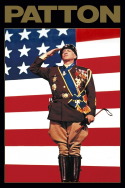
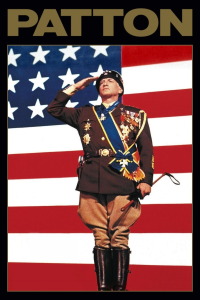
Scenarist Francis Ford Coppola, long before he made his own masterpiece "Apocalypse Now," penned one of the earliest versions of the "Patton" script and realized the deadly pitfalls that lay in the subject matter for any filmmaker. "Wait a minute, this guy was obviously nuts. If they want to make a film glorifying him as a great American hero, it will be laughed at. And if I write a film that condemns him, it won't be made at all." Coppola encapsulated the contradictions that confronted McCarthy for nearly twenty years. According to Coppola, only George C. Scott's intervention brought Coppola's long since rejected elements back into the film, particularly the stunning opening with Scott poised in from a gigantic American flag delivering his stirring speech to the troops.
Initially, the Patton family opposed "Patton," and McCarthy recalled the rage of Colonel George S. Patton III who threatened shoot anybody who made a movie about his father. Indeed, Twentieth Century Fox shelved "Patton" in 1951 and Warner Brothers following in their footsteps in 1953 not only because the family did not trust the filmmakers, but also because the Pentagon felt any film about Patton would portray the Army in an offensive manner, particularly because the general emerged as such a controversial figure. The family interpreted any movie as an invasion of privacy, lobbied the Pentagon to deny cooperation to filmmakers, and even launched a law suit.
Eventually, the Defense Department cooperated, but it provided none of the equipment that appeared in the film. The Spanish Army furnished the tanks, equipment, and troops for the battle sequences. Patton's daughter Ruth Ellen Totten dropped the law suit after she saw Schaffner's film. Reportedly, Totten told her attorneys, "Call off the dogs." She gushed about it. "I think that it is the best movie I have ever seen since Gone with the Wind." Totten added brother George was thrilled by Scott's portrayal.
The positive reception of "Patton" seems almost inevitable in light of the authenticity of Schaffner's film. McCarthy scored a coup when he convinced General of the Army Omar N. Bradley to serve as 'senior military adviser. Bradley scrutinized the script and later took McCarthy and Schaffner on a tour of the battlefields in Belgium, France, and Tunisia, so Schaffner was confident that "we didn't do anything which was outrageous or silly." However, McCarthy had to purchase Bradley's memoirs to obtain his services. Inevitably, "Patton" compared its insane, quixotic hero with Bradley's more down-to-earth, humanitarian general. Four-star General Paul Harkins, who had been Patton's chief of staff, joined Bradley as another military adviser. These two figures placated the earliest anxieties that the Patton family had about the production.
Clocking in at walloping 169 minutes, "Patton" depicted the celebrated general as an amalgamation of contradictions. He was religious but profane. He was violent but sentimental. George C. Scott perused Patton books and watched news reel films. Indeed, Scott transformed his appearance to resemble the general. Totten called Scott's portrayal "tour de force." Winning the acceptance of the Patton family and the military proved one part. Twentieth Century Fox had to win over moviegoers during the era of the Vietnam War with most people agreed that the nation has lost the war. Co-scenarist Edmund North summarized what attracted audiences divided over Vietnam to "Patton": "I believe it was because each person brought to it his own underlying feelings about the Vietnam war.".
Those who were appalled by Vietnam interpreted "Patton" a fascinating anti-hero. Thoseâ??like Richard Nixonâ??who regarded Vietnam as a noble enterprise could find comfort and support in Patton's self-righteous and dedicated savagery." President Nixon watched "Patton" twice and admired the general's arch-authoritarian attitude. Later, Nixon denied in an interview with David Frost in 1977 that the film "Patton" had inspired him to launch his Cambodian invasion Cambodia five days after watching Patton the second time. The film has many memorable moments, especially Patton's orders to a chaplain to intervene with God with a prayer for good weather and the scene in the desert when Patton leaps out of a window to fire on a German aircraft. Karl Mauldin is fabulous as General Bradley and there are tanks galore. Every World War II fan should put "Patton" on their required viewing list of movies.
This review of Patton (1970) was written by Van R on 15 May 2010.
Patton has generally received very positive reviews.
Was this review helpful?