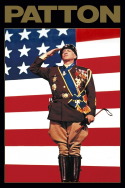
Review of Patton (1970) by Sue B — 29 Aug 2010
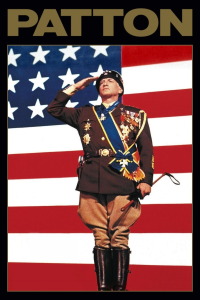
Patton as a film is not so much a great film as it is a great performance, one truly great performance that renders the general simultaneously a villainous hero and a heroic villain. George C. Scott is charismatic and affecting; at Patton's worst, he's one mean son-of-a-bitch. At his best, he is an intelligent, soft-spoken, sentimentalist with a penchant for poetry and history, and Scott plays these extremes to perfection. He commands every scene he is in and literally makes the film. He allows the viewer to cheer for Patton, even though the general is the very epitome of flawed human being, hampered by his own hubris and quest for a legacy of immortality through military honor and success. Without Scott's truly excellent portrayal of Patton, the film would have been something much less than it is.
Still, Patton contains many individual ingredients that form a solid marinade for the electrifying performance of Scott. The screenplay, in part penned by Francis Ford Coppola, is quite something, relying as it does on monologues in which Patton can wax poetic about great war-related exploits on erstwhile battlefields of yore. Even the tenuous relationship between blow-hard Patton and Bradley, a calculating general less prone to recklessness and headlong risk, is marked by intelligent dialog exploring the greater purposes of war, duty, and the value of life in the face of both soldier and civilian casualties. The actors in this film, particularly Scott, were awarded many meaningful lines with which to chew scenery (albeit sometimes subtly) thanks to the richly creative adaptation of Patton biographies by the screenwriters.
Also, the score by composer Jerry Goldsmith was something truly unique. It captured the essence and emptiness of war while, at the same time, gave the film a flair equal to the larger-than-life persona at its center. The lilting, echoing fanfare of trumpets invoked a brilliant musical metaphor for the distant echoes of history that mattered so much to Patton.
Further, director Franklin J. Schaffner, for the most part, constructed a lean, tightly focused film that never strayed from Patton's perspective. The film became a biopic and character study of a deeply imperfect general, fueled as much by passion as by ego, and this real-life character's ego was exemplified by the fact that almost no scene distracted from this figure. Scott appeared in most of the film, but even the scenes that did not feature Patton but, instead, centered on Rommel's machinations or on other officers in the American forces revolved exclusively around the musings of "what would Patton do" or "what has Patton done?" In addition, Schaffner and his cinematographers used creative camera angles, including many shots of Scott from below his torso, to inflate the audience's visual image of the man in an effort to (almost) equalize it with his self-image and, perhaps, his reflective image in the historical consciousness.
Still, while there are some that might find Patton, the film, a masterpiece, especially if they really love war films or good character studies, this film was not absolutely perfect. The narrative flow was very choppy, as the story jumped in a staccato way from one notable event in the general's exploits in war to the next. Even with this bullet point method of storytelling, however, the film dragged in places; ironically, the most exciting parts of the film were the quiet scenes in which Patton verbally mused upon his present station and his possible role in lifetimes past or his sentiments toward his legacy. Some of the few "battle" scenes moved more slowly, seemingly, than these poetic speeches, perhaps to meditate upon the alleged grandeur of the war in which Patton invested so much of himself and his considerations. In addition, some of the scenes in which Patton was chastised for his brash and bullheaded ways grew to be tedious, perhaps partially due to the sheer number of them. While it is understandable that many of these checks by his superiors and other offended parties were true to life and were direct consequences - and sometimes, the corresponding motivations - of Patton's actions, they also added to the already lengthy running time.
Nevertheless, the film was still very good, and the quiet, understated ending proved to be the perfect contrast to the loud and opinionated perspicacity of the good general. Many will adore this film for its uncompromising portrayal of a human being in all of his fire and folly, however, and, in that vein, Patton is certainly enjoyable and, without question, a cut above many other films.
This review of Patton (1970) was written by Sue B on 29 Aug 2010.
Patton has generally received very positive reviews.
Was this review helpful?