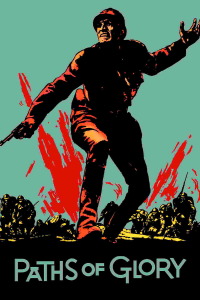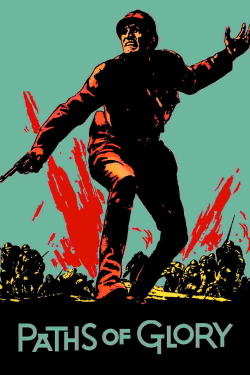
Review of Paths of Glory (1957) by Dalia D — 23 May 2008
As early films in his career, this might defy your Kubrick expectations; and yet, I would argue that its odd, stilted, heavy-handed (dare I say ham-fisted) qualities come not from its being anbearly movie, or an old movie, but in fact, a Kubrick movie: for all his fame (well-deserved, of course), there is something very odd, stilted, and heavy-handed (and dare I say ham-fisted) about later Kubrick movies (I'm thinking 2001, Eyes Wide Shut, and Clockwork Orange, respectively, though all qualities apply to all of his films).
Paths of Glory is a war movie turned courtroom drama (think All Quiet on the Western Front (the book) meets 12 Angry Men (with Kirk Douglas as Henry Fonda's voice of reason, this time silenced by military corruption). Douglas plays Colonel Dax, charged to send his men on a suicide mission by General Mireau (George Macready), who is hoping for a promotion. When the men run back into their trenches under unrelenting fire from the Germans, Mireau insists that his artillery man fires on his own soldiers, cursing them as cowards, but the artillery man refuses. Incensed, the General demands that all of Colonel Dax's men be charged with cowardice and sentenced to death; his superior, General Broulard (Adolphe Menjou), agrees to charge three men as examples to the rest of the company.
Dax (who was a famous attorney prior to entering the military) volunteers to defend the three soldiers in the next day's court martial; he does what he can, but that isn't much, as the entire court is against him and his soldiers from the get-go. The three are unfairly sentenced to death and, after a grueling night in prison, during which one man breaks down into tears and prayer when he meets the priest, one man asks the priest to deliver a letter to his wife, but refuses to pray, and the third soldier lashes out and attacks the priest, leading to a near-fatal injury that leaves him in a coma all night long, all are blindfolded and shot to death in the early morning (the comatose man leaned up against the pole on a stretcher). Kubrick inserts a painfully long pause prior to the shots, cutting to show the faces of Dax and the two Generals who might, at any time during a different movie, pardon the men and spare their lives; they don't. Three gunshots are fired, and the three soldiers collapse dead. Afterward, we do see Mireau get his comeuppance; since Dax had privately explained to Broulard Mireau's orders to fire on his own troops, Broulard brings Mireau into his office while he and Dax are lunching to break the news that there will be an inquest. After Mireau's sputtering, splenetic exit, though, Broulard offers Mireau's job to Dax, having assumed that Dax was motivated all the while by his ambition rather than his ethics. Then it's Dax's turn to exit, shouting and splenetic, rather than just sputtering.
My number one complaint about this film is that it's all in English. Oh, did I not mention that these soldiers in question are French? Well, I didn't figure that out until halfway through the movie, either, because, well, French soldiers, particularly during WWI, speak French! Not American English. I realize that in 1957, there was probably less of a market for foreign-language films, but then why not make the film about English soldiers (based on a true story or not, Hollywood always allows finagling)? Everyone else I've asked about this has just shrugged, but I still insist that it's important.
This review of Paths of Glory (1957) was written by Dalia D on 23 May 2008.
Paths of Glory has generally received very positive reviews.
Was this review helpful?