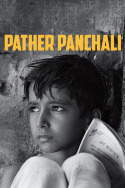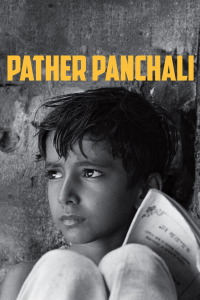
Review of Pather Panchali (1955) by Karmic J — 26 Nov 2007
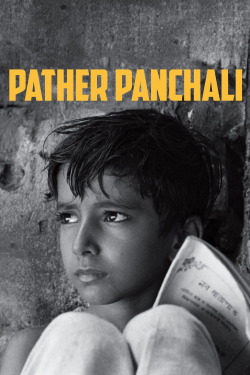
It has been a while since I watched an Indian movie that belongs to the golden era of Indian indie cinema. Satyajit Ray unarguably is one of its best auteurs. Pather Panchali is the first of the Apu trilogy that traces story of Apu beginning from his childhood. This is Satyajit Ray's first film and the music is by a then unknown Ravi Shankar.
Set in the India of 1920's it follows the lives of a poor family. Hari (Kanu Bannerjee) is the head of this household, an aspiring writer and playwright, his wife Sarbojaya (Karuna Bannerjee) and their daughter Durga (Uma Das Gupta) and young son Apu (Subir Bannerjee). Hari can barely hold down a job to keep the home fires burning, and is frequently taking off on things that look like decent job possibilities that lead to long absences leaving Sarbojaya to take care of their crumbling house, life and children.
The movie begins slowly and the initial parts of it are spent examining the rhythms of life in the village including the power structure and the class divisions. We get to meet the characters that form the heart of this movie. A frail old woman (Chunibala Devi) who appears to have no one, but Hari's family to live with (she steals from their kitchen and gets chided by Sarbojaya). Chunibala plays this role to perfection. The camera work by Subrata Mitra is excellent especially the interplay of light and shadow, one such scene is when Chunibala is narrating a bedtime story to the kids and she cackles like the character in her story, her shadow on the walls reminded me of some of my own childhood fears. (I used to have a downstairs neighbor whose grandmother was ancient and a good lady but she would scare the heck out of me).
Her daughter Durga is extremely fond of the old woman and steals fruit from their relative's orchard (the orchard originally belonged in the Bannerjee family). Apu's arrival is celebrated with much joy but the condition of the house and family continue to deteriorate. But Apu' relationship with his sister is a delight to behold for we can feel their love and bond develop. There is a great scene when Apu & Durga are out in a field and hear the sound of a steam train which Apu has never seen. The moment they come upon the train is beautiful to watch, the train on its way someplace as opposed to our protagonist and their family.
All the actors in this movie I thought were brilliant, especially the ones playing Apu and Durga. Often not much needs to be said by them, their faces and eyes convey magnitudes and a range of emotions that say it all.
- When Durga gets accused of stealing a necklace, by her playmates mother, Sarbojaya loses it and drags Durga by her hair out of the home, Apu eyes and face say it all.
- The reaction of the children to death which they may not quite comprehend when they find the old crone dead on the road back home.
The camera work is truly brilliant a number of scenes stood out for me, the bamboo forest, the paths that wound their way thru it and the fields, the gathering storm clouds of the monsoon, the water bugs on the surface of a pond, the tall swaying grass in the fields are some that come to mind.
The scariest scene of the movie is when Durga falls sick with a raging fire and Sarbojaya is watching over her trying to bring her fever down with cold compresses as the wind and rain hammer the house, and the pieces of cloth that pass for protection against the wind and rain start getting torn off the frames. Sarbojaya tries to patch one only to see the door broken down by nature in its fury. We do feel her fear and dread and her urgency as she tries the best a mother can do to save her daughter and their belongings. Through all of this we see shots of Lord Ganesha perched on a shelf in the house buffeted as it is, and we see a the candle go out and I thought this was visual metaphor for the fact that sometimes the pull of fate is often much to strong in the face of faith. This moment like many others made a very effective use of light and sound.
The director Ray uses visual metaphors very well and has a gift for story telling and has the power to make his films strike emotional chord with his viewers. The other thing I noticed about this film is how poverty does not necessarily mean a lack of love and even under adverse conditions people seem to find some pleasure under the most trying conditions.
There is not a lot of action or happenings in this movie, and although it might take a bit of patience to appreciate this movie, it truly is a gem to behold.
This review of Pather Panchali (1955) was written by Karmic J on 26 Nov 2007.
Pather Panchali has generally received very positive reviews.
Was this review helpful?