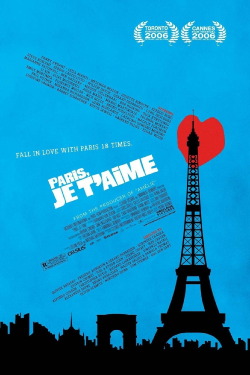
Review of Paris Je T'aime (2006) by Diego C — 19 Feb 2011
I am a fan of the Coen Brothers. That being said, I was not particularly fond of the rest of this movie. Therefore to focus on the good I wanted to analyze in detail an aspect of the Coen short that you guys might find interesting or want to look for sometime.
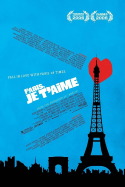
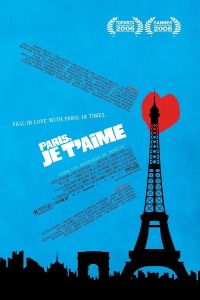
In the 2006 film Paris, je t'aime, multiple virtuosic directors present their own take on love in the famous city. Joel and Ethan Coen portray the Tuileries arrondissement by taking a more comedic approach. Through their creative use of camera movements the directors place the audience in the position of the tourist, and control story information. Their conscious camera decisions allow the audience to feel the emotions of the characters better than a script with language barriers could.
As the tourist idly reads from his guidebook, the camera moves slowly over the words matching his thoughts. The camera movement speed picks up, going from the words "eye contact" to "avoided." The tourist's face lifts up from the book to a girl kissing her boyfriend on the other side of the subway. In this sequence, when the reaction shot shows the tourist looking up, the shot changes to a POV shot, which matches the tourist's head-moving action. The shot goes vertically upward just as the tourist's head tilts upward to look at the girl across the subway tracks. This small match on action includes us in his thoughts. The audience learns he did not stare to be rude, but he did so without thinking. This is important for the short story to be comedic by producing situational irony. The audience understands the naïve tourist's thoughts while the boyfriend thinks he is trying to steal his woman.
Also, from the movement of the camera over the guidebook as the tourist reads, the audience gets a sense of the tourist's panic from being yelled at in public. Before his encounter with the couple, the camera meanders along the words of the guidebook. As the boyfriend yells at him across the metro station, the POV camera moves rapidly through the guidebook as the tourist looks for a translation. The speed of the camera view moving through the words of the guidebook serves as an indicator of the tourist's sense of panic. The audience is made more aware of the increasing tension of the situational irony developing between the couple and the tourist from the tourist's sense of panic.
The directors use camera movement to take us into the head of the tourist, as well as reveal information to the audience. The tourist loses sight of the bickering couple as a train stops. When the train leaves we have a medium shot of the boyfriend standing alone, which leads us to believe that his girlfriend has left him on the train. However, in the next shot of the tourist, the camera suddenly swivels to the left, showing the unsuspecting audience the girlfriend sitting to the tourist's left. This surprise camera movement mimics the tourist's reaction to the Frenchwoman sitting next to him. At first he thought, just like the audience, that she was on the train, only to be proven wrong by the directors' camera movement. This is another example of a subjective camera motion to build suspense while illuminating the protagonist's thoughts.
All the tension between the three characters builds up until the boyfriend beats up the tourist. As the tourist is on the ground, we get a final POV shot of the couple walking out the subway station. The directors, rather than presenting a stable POV shot, tilt the camera to the side, place it low to the ground, and make it wobble a bit. It is as if the boyfriend beat up the tourist and the audience, connecting the camera movements and the tourist's view from the ground. This is a final confirmation of our alliance with the tourist's point of view.
From the camera movement the audience can get a glimpse into the head of the tourist even though he does not say one word. Because the tourist's thoughts are made clear, the situational irony crescendos, resulting in a comedic effect. The scene is about the miscommunications of different languages, but the Coen brothers overcome these obstacles with their use of subjective camera motion.
In my opinion this movie is worth it for a few of the sketches, but not all of them. The Metro Station sketch with Steve Buscemi is definitely one of those.
This review of Paris Je T'aime (2006) was written by Diego C on 19 Feb 2011.
Paris Je T'aime has generally received positive reviews.
Was this review helpful?