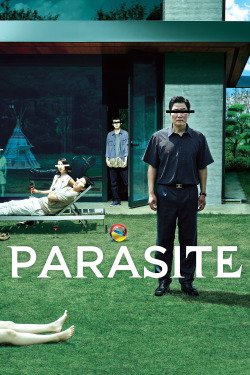
Review of Parasite (2019) by Bertaut1 — 20 Feb 2020
An uncategorisable masterpiece.
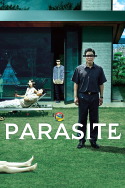
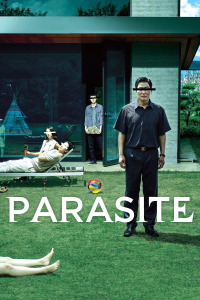
What is one to make of the utterly uncategorisable and impossible-to-define Parasite? Part comedy of manners, part social satire, part heist film, part thriller, part horror, part family drama, part farce, part economic treatise, part social realism, part tragedy, part allegory. What is certain is that it's exceptional in just about every way – screenplay (co-written by director Bong Joon-ho and Han Jin-won), directing, cinematography, mise en scène, editing, production design, sound design, score, acting. There's not a weak link here, in a film that achieves that rarest of things – it lives up to the hype.
The Kim family are down on their luck. Father Ki-taek (Song Kang-ho), mother Chung-sook (Chang Hyae-jin), daughter Ki-jeong (Park So-dam), and son Ki-woo (Choi Woo-shik) reside in a tiny basement apartment eking out a meagre living folding pizza boxes. However, their fortunes change when Ki-Woo bluffs his way into working as an English tutor for the daughter of the wealthy Park family. Father Dong-ik, (Lee Sun-kyun), mother Yeon-gyo (Cho Yeo-jeong), daughter Da-hye (Jung Ji-so), and son Da-song (Jung Hyeon-jun) welcome Ki-woo into their home, and upon discovering just how wealthy the Parks are, the Kims hatch an elaborate scheme to oust the Park's current domestic staff and take their places. However, it doesn't take long before things start to go very, very awry for both families.
As thoroughly entertaining (and funny) as Parasite is, it remains an economic treatise, albeit with a savagely satirical quality. This is far from the first time Bong has dealt with issues of class, but never before has he been this caustic and acerbic, but so too compassionate and witty. One of the most deftly-handled elements of the film is his avoidance of the clichés one so often finds in films dealing with economics – the Kims are by no means a victimised family immediately worthy of sympathy, whilst the Parks are by no means a callous family immediately worthy of scorn. Rather, the Parks are depicted as perfectly friendly and pleasant whilst the Kims are shown to be liars and scoundrels.
Bong is uninterested in trucking in heroes and villains because such rigid diametrics aren't the norm in the real world. For all their scheming and lying, the Kims merely con their way into menial jobs, whilst the Parks' greatest crime is allowing their wealth to insulate them from the world of families such as the Kims. At the same time, the Kims are depicted as a far more loving family than the Parks. Although all four Kims often occupy the same frame, we never see the four Parks together in the same shot. Important here is the title. A simple reading is that the Kims are the parasites and the Parks are the hosts, with the Kims feeding off the Parks' wealth and status. However, Bong depicts the Parks as parasitic as well, feeding off of the labour of their servants. Just as the Kims feed off the Parks, the Parks feed off the Kims, in what is a symbiotic relationship.
Aesthetically, Hong Kyung-pyo's cinematography is magnificent. Hong also shot the superb Beoning (2018), and the camerawork here has a similar smoothness and restlessness, gliding through the Parks' house like it's a fifth member of the Kim family. Lee Ha-jun's production design is also praise-worthy, with the Kims' cluttered and dilapidated apartment contrasted with the Parks' pristine post-modernist semi-open plan house.
It's also in relation to production design wherein one of the film's best metaphors is to be found. As a story at least partly in the tradition of the "upstairs/downstairs" subgenre, Bong literalises the separation between those above and those below by using stairways as a recurring motif. The Kims' apartment has no stairs, indicating their inability to rise socio-economically. On the other hand, the Parks' home has two stairways – one going up to the bedrooms where the four children spend an increasing amount of time, cut off from their parents, and one going down into the cellar. Bong shoots this stairway like he's suddenly directing a horror film, bestowing upon it an ominousness that, at first, makes little sense, but ultimately reveals itself to be a spectacular bit of foreshadowing.
Parasite is a masterpiece, with Bong never putting a foot wrong. It could have been a self-serving and didactic message-movie – a homily to the honour of the poor or a deconstruction of the unhappiness of the rich – but Bong is far too talented for that, avoiding rhetorical cant. Quite unlike anything I've ever seen, it works as allegory just as well as it works as social realism just as well as it works as comedy just as well as it works as tragedy and so on. This is cinema as art, a film which has proven itself very much a game-changer and completely deserving of every bit of praise it's received.
This review of Parasite (2019) was written by Bertaut1 on 20 Feb 2020.
Parasite has generally received very positive reviews.
Was this review helpful?