Review of Paprika (2006) by Marcelo C — 08 May 2012
While it is up for debate for many others, there is no debate for me - "Paprika" is kon's masterpiece and arguably the greatest animated film my country has produced since "Spirited Away" (Full review below.).
This may sound awkward coming from the mouth of someone born, raised, and still living in Japan - but I often dislike our animation type. Not saying I don't like our animations themselves, I just feel that the actual type of animation is often stiff and.. well, unexpressive. We often make up by using complex backgrounds, but sometimes that is not enough to save the fact that most animators here - just aren't good at expressions. Arguably two of the masters of expression in Japanese animation though, are Miyazaki Hayao and the unfortunately late Kon Satoshi.
Kon was arguably the greatest animator in our entire history; his motions were fluid, expressions were all done in full, and even lips actually synched - no "puppet mouth" syndrome like many other of our animations. It helped too, that his movies were genuinely excellent. While it is up for debate for many others, there is no debate for me - "Paprika" is Kon's masterpiece, and arguably the greatest animated film my country has produced since "Sen to Chihiro no Kamikakushi." Known to the Western world as "Spirited Away.".
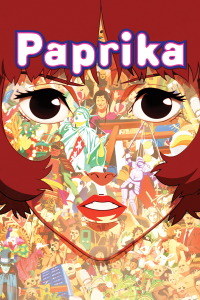
Paprika, based on the novel of the same name by psychologist and satirist Tsutsui Yasutaka, tells of a brilliant inventor & psychologist, Chiba Atsuki, who is the co-creator of a device known as the DC-Mini; a devise that will allow therapists to treat their patients by literally entering their dreams. However, Atsuki never truly enters the DC-Mini as herself... rather, she always enters as the eponymous and rather sprightly Paprika; a literal manifestation of her ID, the part of the brain that gives into self-indulgent fantasy and pure, uncontrolled chaos at the behest of pleasure.
However things get complicated, when Atsuki's boss is quite literally "hijacked" by a mysterious figure hacking the DC-Mini, causing his dreams to literally take over his mind - even when he was awake, causing him to go mad and insane with irrationality and dream-logic. Atsuki & Paprika work together to attempt to find this man, but things are getting worse - soon even people who have not even come in contact with the DC-Mini are following in the corrupt minds of the men and women who have - leading to a situation where dreams and psychological taboos begin consuming and merging with the real world.
It's a fascinating concept, and writer Yasutaka at heart is just as much a satirist as he is a psychologist - there's a satirical and comical edge to Paprika's representation of the human mind, and during the films insane climax you will often see dreams that also work as caricatures of the human condition. Not all foreigners may notice them all as many of them are targeted at the social life of my people, but the references and spoofs are still there - and they are a brilliant "extra" on the film.
There is another plot of sorts, and while it definitely feels like it takes time out of the main story - it isn't bad by any stretch, in fact it is just as engaging and memorable as the rest of the film and to be fair, it actually has the most scenes involving Paprika; telling of a detective named Konakawa Toshimi. Konakawa is plagued by a recurring dream in which he is unable to prevent a murder and as he chases the culprit - the hallway stretches, falls beneath him, and as he sinks into the very floor beneath him - he realizes the corpse of the murdered man is his own. It would delve into spoilers to say much else, but he often delves into the DC-Mini to speak to Paprika and Paprika - as well as Atsuko - form something of a bond to Konakawa and his story does have a very interesting payoff; providing one of the more down to earth and "serious" aspects of Yasutaka's psychological theories and ideas.
Have I mentioned the Animation? I probably have, but I'm going to mention it again. Kon's fluid style was absolutely perfect for a story of this design, and due to Kon's imagination - dreams come to life here, and this is arguably the most brilliant and beautiful representation of human dreams since Kurosawa Akira's film titled... well, "Dreams." Before the eye popping orgy of bizarre images that culminates in the final act, there takes place a scene where Paprika is chased through artistic works by one of the films antagonists - and while the pay-off to the scene is a little disturbing and well, genuinely nightmarish, this is arguably one of the most visually impressive sequences and the choices of artwork chosen accurately represents the roles, emotions, and ulterior motives of the antagonist chasing her.
It is also worth mentioning that Paprika is one of the most memorable female characters on screen in recent memory; let alone animated. Choosing her to be Atsuko's ID was a brilliant move, and this allows Atsuko to remain level headed and realistic in the real world, while Paprika swims from one dream to the next - satisfying Atsuko's inner desires without letting them intrude during her work and Paprika is excellently written, designed, and you are almost always having fun watching her. She's sprightly and bubbly without ever becoming annoying, and you root for her - and at the same time, you know you are also rooting for Atsuko - afterall, Paprika is also a method of building Atsuko's character. Despite the fact Atsuko created Paprika to help separate her inner desires from her serious work, you always feel the connection between the two and each others actions help you grow to love her character on either reality.
"Paprika" is simply a wonderful film, and while it may not be for everyone due to its mania, especially during the final act, there is no denying that it is one of the most beautiful, smart, clever and thought provoking animations our country has produced and it deserves more recognition than it gets. If anything I've said about the film intrigues you - see it without haste. It does have a dubbed English release from what I can gather, so if you aren't a subtitle fan and don't speak Nihongo then you still have reason to give it a chance.
This review of Paprika (2006) was written by Marcelo C on 08 May 2012.
Paprika has generally received very positive reviews.
Was this review helpful?