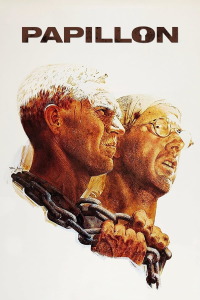
Review of Papillon (1973) by Paul Z — 19 Oct 2010
How can so many critics gripe about a lack of "sufficient empathy" for a character consigned to a dehumanizing, barbaric, inescapable prison colony for the rest of his life? I don't care whether the title character's guilty or innocent of killing the pimp, I wouldn't care who he killed. There are very very very few people in the history of the world who truly, in an absolute sense, deserve this sort of lifelong treatment. Such is the charm of prison films, survival films: It's not about who they are; it's about us. We want out of there, he's going to struggle to do so, so we watch engrossed.
The film begins with co-adaptor Dalton Trumbo lecturing the newest consignment of prisoners sent to the South American jungle terrors, en route on a cargo ship steaming into a Caribbean port, in one outstanding long shot that incorporates the ship, quay, river, jungles on the other side and the sea far off. He tells them they are hereafter objects, property, luggage. It sets up the expanse and atmosphere for a stimulating spectacle of fortitude, pioneering and besieged camaraderie. It's a very classically made adventure movie. We're always caught up in the physical expanse of the story. Director Franklin J. Schaffner doubled between personal dramas and grand-scale epics, and Papillon was one of the gargantuan Oscar-effort productions that confirmed him on the A-list, along with Patton and Nicholas and Alexandra.
Though many spectacular shots in Papillon aren't practically vital and though they give you the sense that the film was shot predominantly from a zeppelin, they bring to mind an all but outmoded storytelling technique to which we're all a little biased, the sort that looks to substantiate character and event by telling us a large amount more about topography, environment, climate conditions, plant life and architecture than we categorically need know. Likewise, its puffy running time emphasizes the captive feeling of the characters languishing in time. The metric nature of the cutting is protracted, using the usually massive visual composition of the shots to extend the physical nature of time rather than eliciting the most basal and emotional reactions in the audience with a fast pace. It elicits those reactions from us with the desperation of the prison environment itself.
The movie analogy to the novel's descriptive paragraph is the long shot. It fills the screen with elements and data intended to persuade us that since the setting is authentic, so must be the people in it. Papillon frantically needs this kind of scaffolding since the Dalton Trumbo and Lorenzo Semple Jr. screenplay, apparently like the book, identifies its characters less by what they feel or think than overstated events and Herculean feats. I can understand the view that Papillon is dry in the sense that a Victorian costume drama is. We understand the dilemmas of the characters right off, because they're in a strait-jacket environment where they always have to watch their step, much less express how they truly feel in ways other than what's not considered downright subversive. But Pride and Prejudice, Sense and Sensibility, Howards End and Gosford Park tell their stories in the same manner as this prison struggle. And it's effective on just the same level.
Steve McQueen was not just another action hero. He was like Clint Eastwood, a master of masculine understatement. And Dustin Hoffman, who plays a refined counterfeiter, a white-collar criminal whose guilt is without doubt, does outstanding work portraying his character's adjustment to the demoralization of prison life. There are various and sundry peripheral characters in the story, all essentially requisite for a Devil's Island adventure: the sadistic guard, the condemned prisoner, the idealistic doctor. The atrocities of prison life are explicitly exposed, including a decapitation that concludes in blood gushing onto the lens of the camera, cockroaches eaten to improve the prison intake, storms at sea and a hand-to-hand confrontation with a crocodile.
This review of Papillon (1973) was written by Paul Z on 19 Oct 2010.
Papillon has generally received very positive reviews.
Was this review helpful?